 Follow Us on Google News
 Follow Us on Google Discover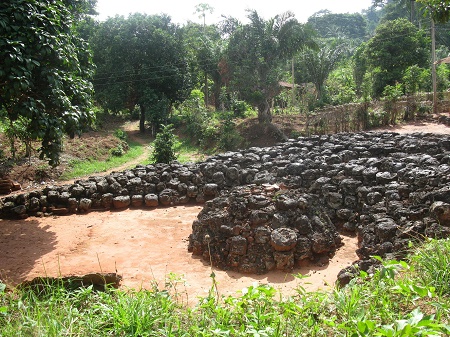
 Oyaogwoo means “anti-poison,” in English. The shrine’s appellation, points to the power and prestige of smelters—who were both envied and feared, for their magical ability to transform red rock (hematite ore) into iron. This, Opata said, made them prime targets of poison attacks.
Despite evidence of a large smelting industry, archaeologists are perturbed at the dearth of recovered tools, utensils and weapons. Professor Chami infers from this, that iron (and possibly steel) production at Lejja, may have been mainly for export—with the Roman Empire as one prospective buyer.
Iron smelting and black smiting are intrinsic to Igbo culture and cosmology. A traditional axiom, which N.C.E. Nwafor cites, in Leopards Of The Magical Dawn, is that “Iron never escapes the eye”. In Igbo myth, the first metal was forged in Orion constellation; and the universe became “an endlessly active furnace”.
At Otobo-Ugwu, the potency of the smelting furnace finds ritual expression at the Odegwoo shrine. It localizes the cosmic ethos—in which smiting is the first act of creation—through rituals that associate iron smelting with human reproduction.
Located at the entrance to the complex, Odegwoo is a conical mound of reddish clay and haematite iron ore, with large slag-masses strewn around its base.
“These materials,” Opata explained in 2009, “are symbolically important. The smelting furnaces are made from clay, while hematite is the charge that is heated to produce iron”.

The smelting of iron is thought of as a replication of childbirth. Lejja people conceptualize the furnace as a “womb” and the heating of the ore as “labour”.
All Dunoka parents, Anthony Ochike Chinyelugu, Igwe of Lejja, told me, must register their babies at the Odegwoo shrine, within seven native (four-day) weeks after birth. Otherwise, one’s offspring is not fully alive—and is thus excluded from rituals, ceremonies or deliberations.
The fact that Dunoka villagers know so little about Otobo-Ugwu, raises questions as to who built it. Lejja people have either lost knowledge of themselves and their culture: Or they have simply appropriated the shrine complex for their own ritual purposes—perhaps after driving out the builders.
Among the present inhabitants, for instance, the circular mound situated between the horns of the crescent is a “war shrine,” which they call “Oshuru”. But the configuration is a powerfully redolent pointer to the periodic visual proximity of the planet Venus and the crescent Moon.
This, in fact, is a widely employed symbol in human culture. The Yorubas refer to it as “aja osupa” (“the Moon’s dog”); and it is emblazoned on the flag of several Islamic states. The Siddis, a Bantu people of Murud-Janjira, in India, also use it.
According to Nwafor, the planet Venus is linked to the “miraculous” resurrection of the female deity, Eke-Nnechukwu, who is the mythical progenitor of cocoyam. “Cocoyam represents Venus…in Igbo …astronomy…,” he writes. “Venus… is said to have been ‘killed’ to bring cocoyam in Igbo agrarian myths”.
The size, symmetry and setting of Otobo-Ugwu are also significant. It is clearly not a temporal creation—not a fleeting or whimsical contrivance.
It is equally apparent—and this is centrally important—that Otobo-Ugwu was conceived as a metaphor: An enduring symbol, designed to impress and inform future generations.
At the conscious level, it may have been erected to placate a deity. But in doing so, the builders made an indelible statement about themselves: About their engineering prowess, their knowledge of astronomy and their highly cultivated aesthetic.
J.K. Obatala

