 Follow Us on Google News
 Follow Us on Google Discover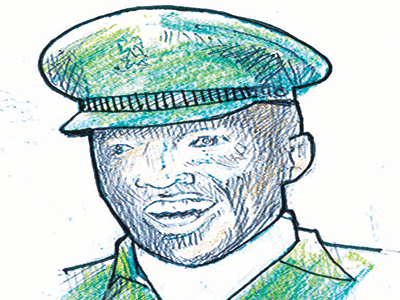
 Several books have been published on the coup of January 15, 1966, and its aftermath. Yet Nigerians have not been able to agree on the real significance of that day’s events on the nation’s history. In spite of this, the day remains significant and has been marked every year as the Armed Forces Remembrance Day, a day set aside for honouring Nigerians who lost their lives in the process of defending Nigeria’s territorial integrity.
Before that date the country had been in the throes of violence especially in the Western Region as a result of the rigged elections of 1965 in that part of the country. The rest of the country appeared calm, but it was obvious we all were sitting on a keg of gunpowder. The violence in the Western Region which took many lives was nicknamed “operation wetie”. In the rest of the country the discussion centred on such issues as tribalism, nepotism, favouritism and double standards. Unknown to a lot of people these cankerworms had also eaten deep into the Armed Forces and that institution remained polarised too.
Among the civilians, there was an obvious revulsion against the graft, greed, ostentation and tribalism that seemed to drag the country into the cesspit of vulgar history. There emerged the feeling of alienation and such slogans as North for the Northerners, East for the Easterners and West for the Westerners became a regular subject for serious discussion.
Meanwhile, the Nigerian Army which was known at the time as the Queen’s own Nigerian Regiment was boiling within. One of the five majors who plotted the coup, Adewale Ademoyega, says in his book, Why we struck, The story of the First Nigerian Coup, that the Nigerian Army at the time was very conservative and reactionary. In spite of that fact Patrick Chukwuma Kaduna Nzeogwu, an Ibo man who was born in Kaduna in 1937, thought he could find young people of like minds to embark on the coup which was codenamed Exercise Damisa (Damisa means Leopard in Hausa). Ademoyega says that Nzeogwu talked openly and freely about the country’s failure to rise to the position of greatness and held the leaders responsible for the situation.
Apart from Ademoyega, Nzeogwu was able to convince Major Emmanuel Ifeajuna, the man who jumped six feet eight inches to give Nigeria a gold medal in the Commonwealth Games held in Vancouver, Canada. He was a science graduate from the University of Ibadan, one of the few graduates who considered a career in the Army as noble. Two other Ibo officers joined the group. The coup planners met several times informally. However, they had one formal meeting mid November 1965 in Lagos to finalise plans for the coup.
At the November meeting, the group had a list of those to be arrested. They were the Prime Minister, heads of governments in the regions and their råight hand men. According to Ademoyega, no one was to be killed but if there was any resistance force would be used. Ademoyega stoutly defended the one-sided loss of lives from the Northern and Western Regions without anyone being touched in the Eastern Region. This accusation was heightened by the fact that of the five coup plotters, four of them were Ibo, while the fifth person was Yoruba. Ademoyega explains: “There was no decision at our meeting to single out any particular ethnic group for elimination or destruction. Our intentions were honourable, our views were national and our goals were idealistic.”
On coup day, Nzeogwu made his first and last statement on the takeover. “Our enemies are political profiteers, the swindlers, the men in high and low places that seek bribes and demand 10 per cent, those that seek to keep the country down, divided permanently so that they can remain in office as ministers or VIPs at least. The tribalists, the nepotists, those that make the country look big for nothing before international circles, those that corrupted our society and put the Nigerian political calendar back by their words and deeds.”
Since the first blast of martial music on January 15, 1966, we have had eight more coups. That is clear evidence that since the Army ate the first forbidden fruit of power seizure by means other than the ballot, the country has known no peace for any long stretch of time. Also since Johnson T. U. Aguiyi Ironsi took power, we have had 13 other Heads of State or Presidents in Nigeria. This works out at one ruler every three years.
This high turnover looks to me as a diary for disaster. However, it is important to note that since 1999 when we changed from the Westminster model of government to the presidential system there has been no known attempt by soldiers to throw a spanner in the works. That testimonial can be somewhat misleading if we do not put it in context. There have been several moments of nostalgia, moments of turmoil, moments of tension, moments when some Nigerians out of frustration, have openly wished that the colonialists should come back. This tells us that we have not reached where we should be, considering our vast human and material resources. So Nigeria is still work in progress.
In his coup broadcast, Nzeogwu talked about political profiteers, swindlers, ten percenters, tribalists, nepotists and other corrupt elements. In one word, Nzeogwu was talking about leadership, or the lack of quality leadership. This has been the bane of Nigeria since independence. This has been largely the reason for these many coups that we have had since 1966.
We haven’t been lucky to have leadership that is selfless, committed, incorruptible and devoted to the cause of a new Nigeria. And that is basically so because we haven’t had leaders who have had the opportunity to go through leadership’s finishing school. In other words, our leaders just emerge from almost nowhere. It is when they succeed in clinching power that they begin to scratch their heads as they search for what they can do for Nigeria. That is why Nigeria remains a sleeping giant that we love to describe as a “potentially great nation.” We have remained “potentially great” for 55 years. When will we be truly great?
Nigeria is like a false pregnancy, every symptom is there but there is no baby. We have enormous resources that could have catapulted us into the small club of great nations but here we are still scratching our head and wringing our hands waiting for solution to our woes.
Japan received a devastating blow during the Second World War. Two of its cities, Hiroshima and Nagasaki, were leveled with atomic bombs. Ten thousand people were buried under the rubble. However, by the instrument of the Marshall plan the country was able to rise again. Today, Japan has the third biggest economy after China and the United States. Japan has risen to its full height and Western experts are going there to drink from the fountain of its management model.
Nigeria has not been able to rise to its full height because of corrupt, uncommitted and selfish leadership, the very attributes that Nzeogwu condemned 50 years ago. Fifty years ago we were swimming in wealth thanks in the main to our agricultural products. We paid very little attention to agriculture after that because we had suddenly found a new mistress: oil. Now the price of crude oil has been going south. This is a country that was paying the salaries of some workers in the Caribbeans some years ago. Today, it is unable to pay the salaries of its own workers.
Only a few years ago we paid off our debts and drank champagne to celebrate the achievement. Today, we are back at the lenders’ door asking for clemency as the debts and interest pile. Our fortune is swinging from riches to rags.
The corruption that Nzeogwu talked about in those days was a miserable ten percent. Today, it is 100 per cent. Let me explain. If you collect money to buy arms and ammunition and you don’t buy them that is 100 per cent. If you are to buy fertiliser and supply to states and you only supply it on paper. That is 100 per cent. If as a politician you promise to put a chicken in every pot and you give us neither chicken nor pot that is 200 per cent.
It has been a long journey from January 15, 1966, to today. The journey has been marred by accidents and bad weather but above all the drivers have been reckless, the same recklessness that Nzeogwu took up arms against. And it is debatable whether even now we are on the path of a smooth and flawless journey.

