 Follow Us on Google News
 Follow Us on Google Discover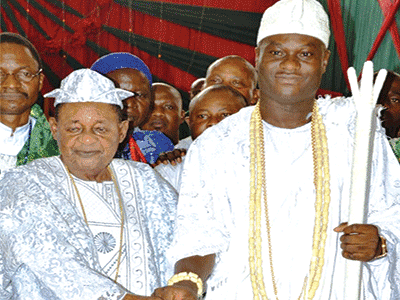
 The visit of Ooni of Ife, Oba Adeyeye Enitan Ogunwusi to Oyo recently, has reawakened hope for unity and peace among the Yoruba people. Iyabo Lawal writes from Ibadan
THE visit last Sunday to the ancient Oyo town by the newly crowned Oba Adeyeye Enitan Ogunwusi may have marked the end of the age-long rivalry and supremacy struggle between the Ooni of Ife and Alaafin of Oyo.
THE visit last Sunday to the ancient Oyo town by the newly crowned Oba Adeyeye Enitan Ogunwusi may have marked the end of the age-long rivalry and supremacy struggle between the Ooni of Ife and Alaafin of Oyo.
Oba Ogunwusi had moved to rewrite history and imprint his name on the sands of time by joining Oba Lamidi Olayiwola Adeyemi at the thanksgiving service commemorating his 45th anniversary on the throne at the Methodist Church Apaara in the ancient Oyo town.
Over 40 traditional rulers accompanied Ooni in the royal visit which chroniclers of Yoruba history described as “unique’. The mood at the church was that of disbelief, and then celebration as the people were agog at seeing the two royalties seated together.
Ogunwusi arrived at the church to the warm embrace of the Alaafin, who shook hands with him as the congregation watched in awe and expressed admiration for the historic union.
This special visit was done last in March 1937. That was the first time the kings in Yorubaland met in Oyo town. Today, history was made with the visit of Arole Oodua Enitan Ogunwusi, Ojaja II and I feel delighted to host you and to reassure you that I will be ready to work with you.
Speaking on the visit, Alaafin said it was the first by any Ife monarch since 1937. He said despite the fact that he did not enjoy cordial relationship with the immediate past Ife monarch, he related well with the other Yoruba obas, and commended the new Ooni’s move to reconcile all Yoruba monarchs.
With smile spread across his face, Alaafin said, “May your reign be long, Ooni. I am happy with Ooni Ogunwusi’s moves to unite all Yoruba Obas. This special visit was done last in March 1937. That was the first time the kings in Yorubaland met in Oyo town. Today, history was made with the visit of Arole Oodua Enitan Ogunwusi, Ojaja II and I feel delighted to host you and to reassure you that I will be ready to work with you.
“I had a close relationship with Ooni Adesoji Aderemi and I did not want to withdraw from any Ooni of Ife that assumed the post, but everybody has his own little differences.”
On his part, Oba Ogunwusi said he recognised the place of Oyo monarch in Yoruba history, adding that a new dawn had fallen on Yoruba monarchs and the people.

“It is a new dawn for all Yoruba sons and daughters around the globe. Ore l’a o mase…Awa o ba ti ja wa ooo, Ore l’a o ma se (We are friends and not enemies). I am here today though not invited but as the Arole Oduduwa, the onus is on me to felicitate with all sons and daughters wherever they are and to show my solidarity with any of them. I am ready to damn any consequences or insinuations from anywhere; my mission here is to preach peace among the Yoruba, both home and abroad and I am ready to work with the Alaafin of Oyo, Oba Olayiwola Adeyemi, to project the unity and love which we believe is existing in the days of our forefathers,” Ooni said.
With the enthronement of the late Oba Okunade Sijuwade Olubuse 11 as the Ooni of Ife in 1980, after the demise of his predecessor, Oba Adesoji Tadeniawo Aderemi, who bestrode the entire Yoruba traditional council of Obas and Chiefs landscape like a colossus, there was no love lost between him and the Alaafin of Oyo, Oba Lamidi Olayiwola Adeyemi 111. Oba Aderemi, who reigned for 50 years between 1930 and 1980 was more or less the undisputed father figure for other Obas in the entire Yorubaland or what was then known as the Western Region, which then included the present Edo and Delta States in addition to the present six states of Oyo, Ogun, Ondo, Ekiti, Osun and Lagos.

A lot of things worked in favour of the highly revered monarch then. Firstly, he was enlightened and had no relationship problem with the colonial overlords that were in the saddle before Nigeria got her Independence in 1960 and he was favourably disposed to the most popular political party in the region, Action Group (AG), by that time. By the time the late sage, Obafemi Awolowo, was the Premier, Oba Adesoji was the Governor-General under the parliamentary constitution in operation then. In addition to this was the generally held historical belief that Ife “is the source of the Yoruba race” – a belief that is still held firmly till date.
With this political influence, coupled with his age on the throne as well as his humble disposition, he was able to hold sway as undisputed foremost Yoruba monarch of his time. His successor, Oba Sijuwade, naturally would want to step into his shoes, but Alaafin Adeyemi would not allow that.
For this reason, the supremacy battle started with neither of them ready to bow to the other. As soon as Oba Sijuwade ascended the throne as Ooni of Ife in 1980, the battle began with Alaafin demanding for the rotation of the position of Chairmanship of Oyo State Council of Obas and Chiefs, which the late Ooni Aderemi held in perpetuity. Alaafin wanted the position rotated between himself, Ooni, Olubadan of Ibadanland and Soun of Ogbomosoland to indicate that it was not going to be business as usual in the dominance of the other Obas by the late Sijuwade.
It is a new dawn for all Yoruba sons and daughters around the globe…I am here today though not invited, as the Arole Oduduwa, the onus is on me to felicitate with all sons and daughters wherever they are and to show my solidarity with any of them.
Fortunately, the military was in the saddle and the idea of anyone using political party influence did not occur and the issue of rotational chairmanship which was taken to court for adjudication by Alaafin and two others continued to drag until the old Oyo State was split into two – Oyo and Osun States on August 27 1991, by the administration of Gen. Ibrahim Badamasi Babangida (rtd).
This notwithstanding, the rivalry between the two royal fathers continued. The situation became so embarrassing that former President Olusegun Obasanjo had to, during his tenure, summoned a meeting of the late Alake of Egbaland, Oba Oyebade Lipede, Awujale of Ijebu-Ode, Oba Sikiru Kayode Adetona, Oga Adeyemi and the late Ooni Sijuwade where he expressed worries over the ceaseless media battle between the two.
Oba Adeyemi reportedly explained that the bone of contention between him and his Ile-Ife counterpart was his belief that Ooni was distorting history.
The acrimony was so intense that they rarely attended the same function, and where they did, there would be disapproving reference to each other, directly or indirectly. One of such occasions was the centenary anniversary of Late Chief Obafemi Awolowo held at the MUSON Centre in Lagos in 2009 where the late Sijuwade allegedly accused the Alaafin of reigning over a dead empire. Alaafin on his part described the late Sijuwade as an Oba fond of distorting history and one “who was ignorant of the details of his ancestral roots”.
Another bone of contention was who had the right to celebrate Oranyan Festival. The late Sijuwade had allegedly attacked Oba Adeyemi over his decision to celebrate Oranyan festival in memory of the late Ife Prince, but who at a time ruled over Oyo Empire.
Making reference to series of documentary evidence, Oba Adeyemi re-called that “Oyo is superior to Ife in many ramifications, asking where did this Yoruba language that we are speaking evolve from? Which language was used in writing the Bible? It is Oyo language, he reiterated. Why not Ife language? Where else are they speaking Ife language apart from Lagere Quarters? Why are the Modakeke people, who are living behind Ife, not speaking Ife language”? Alaafin said that he had confronted Sijuwade with the various questions in the past, even before Chief Obasanjo at the meeting, but he could not answer them, “instead, he came with books that could fill three baskets”.
He continued: “When we wanted to celebrate Sango, they said Sango is not Yoruba. Sango studied Quran. He was the one that was first conferred with the title of ‘Akeugberu’. He was the first in the art of adjudicating justly. When he was born, the umbilical chord that joined him with his mother could not be severed. Because they pulled it and it would not cut, it became the name ‘Afonja’. The glory, success and tradition of Yoruba started from Oyo.”
A professor of history who spoke on the duo explained that the position of the Alaafin of Oyo and Ooni of Ife are clearly defined.
“Ife is regarded as the spiritual home and Ooni, the Arole Oduduwa, as the spiritual head. But you have to remember also, as the spiritual home of the Yoruba, Ife was respected, and so had no standing army of its own, because all other Yoruba towns were expected to protect it. From that standpoint, you cannot address Ooni as ‘Imperial Majesty’ because he has no empire; it is an anomaly.
“But, in the case of Alaafin, who is the direct offspring of Oduduwa, (the Ooni was not, he was a priest) not only does he have the blood claim to the supremacy title, because Oyo created an empire that increased the stature of Alaafin beyond the shores of Yorubaland. So, do you then say that because the Alaafin did not rule from Ife, being a direct descendant of Oduduwa, he is no longer the son of the father? In the case of Ooni, he is called ‘Arole’ and even from the title, there is a question mark. When you are an Arole, the meaning is not lost to an average Yoruba person.
“For me, because modernity has caught them in two different positions and two different roles, it is just safe for the Ooni to continue to act as the Spiritual Head of Yorubaland while the Alaafin remains both the political and military head,
it is as simple as that. Ife has no stature beyond the spiritual significance.”

The Afenifere Renewal Group (ARG) as well as the Presidential candidate of the National Action Council (NAC) have lauded the union of the foremost traditional rulers.The ARG said the visit by the Ooni gladdened the heart of all Yoruba people at home and in the Diaspora. The group through its chairman, Wale Oshun also proposed an annual convening of Yoruba traditional rulers conference, noting that Yoruba nation is blessed with several powerful kingship dynasties, pointing out that it would count for strength, pride and versatility of Yoruba people.
The NAC chief, Dr. Olapade Agoro said with the historic visit to Oyo, Ooni Ogunwusi has set the ball rolling for the peaceful coming together of all the lost sons and daughters of Oduduwa.
“Irrespective of how anybody will like to see it, Ooni Adeyeye Ogunwusi, has set the ball rolling for the peaceful coming together of all the lost sons and daughters of Oduduwa. Incidentally the commanding slogan of the ruling party in Nigeria now is ‘Change’.
Agoro maintained that there is no doubt that “Alaafin of Oyo is a prime factor in the historical placement of the Yoruba race, and that Ooni as the Arole Oduduwa can never be subjected to disputes unless by good for nothing rabble rousers”.
He then urged other traditional rulers, religious leaders as well as prominent Yorubas to ensure the sustenance of the peace move initiated by Ooni Ogunwusi with the visit to the Alaafin of Oyo, Oba Lamidi Adeyemi, saying, “since the Yoruba race and people will normally and of customary necessity give meaningful name to a newly born child, this visit of the Ooni to the Alaafin of Oyo is customary to his name ‘Enitan’- literarily meaning ‘a person of history-making.
“Let it be noted that unless the spirit of forgiveness, give and take, is allowed now and thereafter, there will be no peace in the Yorubaland.”

