 Follow Us on Google News


 Follow Us on Google Discover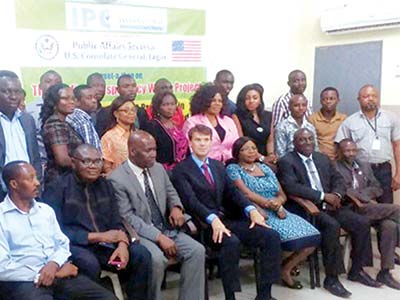

THE media in playing its watchdog role has the responsibility of being the intermediary between the government and the governed, which is a critical link between the function of the media and good governance.
Understanding this function of the media as a critical ingredient to the growth and development of the society, the International Press Centre (IPC) with collaboration from some development partners launched a one year Media and Transparency watch campaign aimed at ensuring transparency in governance.
The transparency campaign which is going to be driven essentially by a quarterly tweet-a-thon event had its maiden edition last week in Lagos with the theme: “International best practices in transparency in governance and the role of the media.”
The lead speaker, the Deputy Public Affairs Officer, United States Consulate General Lagos, Mr Frank Sellin noted that without transparency and accountability, trust would be lacking between government and the governed, which would result in social instability and an environment not conducive for economic growth.
He reiterated the fact that transparency serves to achieve accountability, through leaders being held responsible for their actions. He pointed that the US supports open government, with emphasis on principles of participation and collaboration which allows the public to participate in governance.
Sellin asserted “Transparency is a crucial way to break the chain of corruption and government succeeds when it promotes transparency in its dealings and ensures independent media, independent judiciary and critical civil society.”

According to him, corruption thrives when government fails to reveal information about what is being done, advising that government should endeavour to publish the information concerning its activities on line for all to access and have strategies to meet quality standard. Adding, he said, “Governments become unstable when they muzzle the media; they become blind to the problems of the people and the solutions.”
He however advised the government to promote media independence through constitutional provision and functional legal framework.
He noted that issue of ethics is a key tool to successful operation of the media to engender best practices in the profession. He urged the media to set and uphold ethical and professional standard.
According to Sellin, “transparency is an evolutionary process and it is possible when governments partner with the media.”
Sellin further urged the media to be vigilant about the workings of the government and the need for the media to ensure that facts and accuracy remained watch-words as it would help fostering credibility, which in turn, enhances increased readership and patronage in terms of advertisement.
He said the public should speak up when they see evidence of corrupt practices and government and the media should make conscious effort to investigate.
On his part, the former editor of The Guardian, Mr. Martins Oloja, one of the lead discussants, said the media must be vigilant as reporting was a remarkable aspect of journalism.
According to Oloja, “governments have the tendency to hide things, news is what somebody wants to hide, and we need to be vigilant.” He urged journalists to investigate and expose activities about the economy. “We have to follow the money trail in Nigeria to make democracy work,” he noted.
He said reporters need to be document minded as this would help in engaging in interpretative reporting.
He noted that many journalists are lazy as they only report the surface of the story without digging deep. “Reporters that cover the National Assembly only cover the floors of the house, they need to ask questions and have knowledge of the system, read widely, because the public needs financial literacy which can only come from the media,” he added.
He further noted that the quality of report can draw attention to a medium even in a digitized world.
Responding to a question on freedom of expression, Oloja noted, “we cannot have editorial independence without financial independence.” He reiterated that the reporters need to be credible to have credible information.” The market reacts to untrue stories, and this affects the credibility of the outfit, while unethical practices prevent investigation,” he added.
“Reporters must look inward and kill the spirit of mediocrity, and bring good projects and stories that would enhance national development,” Oloja said.
He advised journalists to read as only knowledgeable people would enjoy this century.
The Director of IPC, Mr Lanre Arogundade said time had come for the Nigerian media to go beyond the mere reporting of the EFCC’s dramatic arrests and the government’s almost daily pronouncement that it would not relent in the war against corruption to look at the inadequacies in our institutional and legislative frameworks that make it so easy for politicians to have unrestrained access to the public treasury and bleed it dry.
He said IPC advocates for the media to lend support to the government that fights corruption, “it would be in the greater public interest if the media helps to build a governance system that prevents corruption”.
The Secretary of Nigeria Union of Journalists (NUJ), Lagos State chapter, Mrs. Bimbo Oyetunde said NUJ encourages members to do thorough investigation before publishing stories. She also disclosed steps being taken by the national leadership of the NUJ to uplift journalism profession as well as preserving the dignity of practitioners. Some of the steps, she mentioned, included “All Nigeria Journalists Conference” coming up later this year and the recertification of members to drive away quacks.

