 Follow Us on Google News
 Follow Us on Google Discover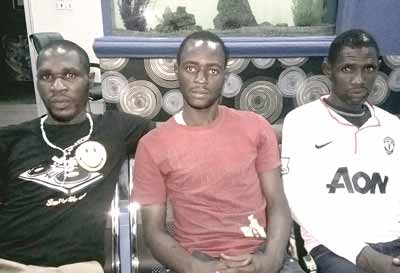

KINGSLEY Akhabue, 36, was until his eight-year sojourn in the Maximum Security Prison in Lagos as death row inmate, an auto mechanic, who resided in the Igando area of Lagos State.
He breathed the air of freedom December 2015, courtesy of the pronouncements of the Lagos Division of the Court of Appeal following the intervention of the Legal Defence Assistance Project (LEDAP) and its promoter, Mr. Chino Obiagwu.
Narrating his ordeal to The Guardian, Akhabue said it was a case of street fighting that ‘magically’ turned into an armed robbery case. He said: “In March 2008, one of my brothers from Edo State visited me. He had a disagreement with some people in our area. We had a fight and were arrested and detained at Igando Police Station. A male Okada rider refused to get ‘change’ for his fare and would not allow us to pay what we had.
“They (Police) took us to the state CID, Panti. At Panti, my other friends and I involved in the fracas were labeled armed robbers and criminals. They tortured me so much; I thought I would die. When I realised that the only thing that would make them release me from where I was hung was admit to the crime, I confessed that I was a robber. The torture chamber is called ‘Dinner,’ while the cell where criminals are kept is known as ‘Oven’.”
Akhabue explained that after the fight, he reported the incident to the Igando Police station the following morning, showing them some of the injuries he sustained. He said the Police asked him to go and get a medical report from a government hospital. “I left for the hospital to get the report. When I returned to the station to hand in the report, to my amazement, the Police took it from me and tore it, saying I was under arrest. I thought it was a joke until I was pushed into a cell, where I saw some of my neighbours and friends already in detention. Later, they freed those who paid money and transferred our case to Panti,” he said, adding that he was shocked to learn that that he was being detained for armed robbery.
He said but for the magnanimity of a suspect of Hausa extraction, who was brought in to identify his gang members and who insisted he never knew him, the Police would have ‘wasted’ him in detention. He recalled that a lot of suspects were usually taken away one after another and never returned to the cell again.
According to him, the Police once drove him to Igando streets at midnight to identify non-existing members of his gang, promising to free him if he implicated anyone. “I could not do that since I knew somebody had previously refused to implicate me. I didn’t want to implicate innocent folks. They reprimanded me after the exercise and returned me to the cell,” he said.
Akhabue said he was taken to the court in the company of others, and on May 2011, Justice Mojisola Dada of the Lagos High Court condemned him to death. He became hysterical in court after the judgment and wondered what kind of world it is, where the innocent is sentenced to death for an offence he never committed.
Resigning to fate, he picked courage and faced imminent death with prayers. But LEDAP took up his case and filed an appeal on his behalf. On December 11, the Court of Appeal, Lagos discharged and acquitted him.
The freed man, who is now seeking reintegration into the society, said he was married with a kid before the incident, but regretted that his wife had already remarried as a result of his travails.
Co-inmate, Fabian Matthew, 29, who was also freed, said his world came crashing down when the judgment was read. Matthew said: “I live in Ikotun. I thought the world had ended. I lost all hope. All I dreamt of was death.”
He said his ordeal began with a fight between his group and the Odua People’s Congress (OPC) in the area. According to him, though no life was lost, the Police arrested him and others and branded them criminals.
Ismaila Fatoki, a 38-year-old carpenter corroborated the story. He, however, said the cause of the fight was because Akhabue and his brother refused to pay an Okada man, who had brought them home on the fateful night, contrary to the narration of the first two, who claimed the Okada rider had refused to provide them with ‘change’ or allow them go into the house and get the exact fare.
Fatoki said when he intervened, urging them to ‘settle’ the Okada rider, Akhabue’s brother slapped him, prompting retaliation. Other people in the street later joined in the commotion.
He said: “We fought. After that, the Police came and arrested us and said it was a case of armed robbery. They tortured me; I almost died before I was released. As a result, my wife abandoned my two children and fled. My landlord broke into my room, evacuated my belongings and gave them out.”
Fatoki appealed for an accommodation and expressed desire to return to his former craft.
According to LEDAP, some death row inmates are unjustly sentenced and consist of the poor and downtrodden, who have no one to take up their cases.
Obiagwu said the confession statements used by lower courts to convict suspects are often obtained through torture and under duress, even as he called for abolition of the death sentence. According to him, the penalty has, over the years, failed to achieve its desired goal.

