 Follow Us on Google News
 Follow Us on Google Discover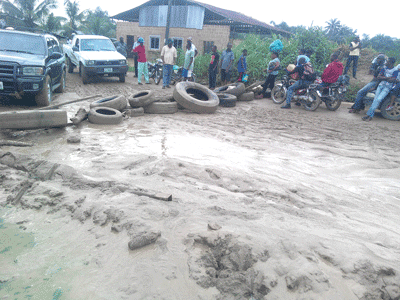

•‘Buhari Must Ensure Agency Is Not A Drainpipe’
I AM guessing that up till this moment not everyone knows that the songs that refer to White Christmas are talking about the snow that covers the ground at the season. For many years, I sang the songs without knowing that White Christmas means Christmas time that has a good amount of snow on the ground. And I never saw snow until I began to travel to Europe.
Nigeria is blessed with two main seasons, the rainy season and the dry season. And in between, there is the harmattan, which comes with cold winds and dust particles from the Sahara desert. In Europe, America and other parts of the world, this is the winter season. Apart from the cold, which is the hallmark, an added feature is the snow. Yet it doesn’t snow everywhere. Some cities go for years without snow, and sometimes when it falls, it does so lightly. But occasionally, it snows quite heavily. Some cities and states in Europe and America, as a standard, have more than their own share of snow.
Last week, I received the sad news of friends in Massachusetts who attempted to pay condolence visits out of state but could not travel beyond their gate because of the heavy snow. They waited for two days, hoping the snow would subside and actually drove out of city but had an accident not long afterwards, as their vehicle skidded off the road and they tumbled over. One broke her leg. Luckily, they were rescued before something more devastating happened. People in snow prone areas therefore learn to stockpile supplies and stay indoors, when it snows heavily. As a matter of fact, it is said that geography has a role to play with a culture’s ability to think and plan ahead, as people in such climes over the years learn to be innovative and ensure life indoors remained comfortable rather than being subject to the vagaries of nature even within the home.
Surprisingly, in Nigeria, there are communities that suffer effects akin to heavy snowing; they are locked out from civilization and locked in within their impoverished communities, not really because of snow but because of bad roads made worse when the rains come. These communities are beyond Oban-Town in Akamkpa LGA in Cross River State, towards the Nigerian border with Cameroun, on a stretch of road that may be less than 60km. I decided to traverse the road after the Vatican Ambassador to Nigeria, Archbishop Ignatius Kasujja, made a trip on that road to the Nigeria border with Cameroun. As he remarked later, “A road would be the greatest gift to these people.”
The road is a Trunk A road, an international road. Constructing it must have been quite a feat for Costain West Africa Limited, way back in 1972 because of the winding nature of the road, cutting through hills and ravines. During the Abacha era, General Buhari’s PTF rehabilitated the road; but then Abacha died, and the project stopped in Oban. When I met Chief Tony Ani years later, Abacha’s finance minister, he was surprised that the rehabilitation stopped at Oban, whereas it was meant to reach the border. You can imagine a road that was constructed in 1972, how it would look like, without maintenance.
Once in a while, FERMA goes to repair few portions before and beyond Oban but the work does not get to the core bad spots close to the border. Many portions of the road have narrowed to single valleys of earthen paths, the caked red mud mounds on either sides portending the fatality that comes with the rains when the mud gains life. As we drove through the lonely, less travelled road, I wondered if these parts still belong to Nigeria.
The irony of it all was that, as we got to the border with Cameroun and the Cameroun immigrations allowed us to cross over, I had the surprise of my life; right across the river, Cameroun had graded the road. I was surprised because Cameroun was famous for bad roads, especially in English speaking territories towards the border. The Cameroun Police Commissioner told us that the road was being prepared against the championships Cameroun was about to host, that soon the road would be tarred to the border, and that if we drove now, in 30 minutes, we would burst onto the newly tarred roads, which would take us to Limbe and other cities of Cameroun, that the President wants anyone who wants to watch the championship live, not to be encumbered.
Well…for whatever reason, the fact was that Cameroun, notorious for poor roads infrastructure, had repented. We reflected along with my companions that rather than go to Europe or America on holidays, we would explore this route during our 2016 vacation.
And yet there is a reason these communities on the Nigerian side should not be neglected. The forests in these communities sustain the world. The world over, there aren’t that many rain forests remaining. With the whole concern about climate change and how these forests contribute oxygen to the eco-system, these communities need to be ‘spoilt silly’; they are prevented by law from exploiting the forests resources, and yet government has not been able to provide any alternative, not even a good passable road! These communities cultivate banana, plantain, cocoa etc., and sometimes these produce are underpriced or get rotten because of poor roads. Successive civilian administrations in Cross River State have paid little attention to people of these communities.
We stopped by in a community called Ojok when we saw a tank stand with solar panels and were quite excited and wanted to find out if the water project was still functioning. Alas! We realized that it was a project of the border commission; they came and installed the tank with solar panels and laid pipes to reticulate the water to various points in the community but without digging any borehole for water! And so, the tank stands as an embodiment of the deception, which is characteristic of our governments and its agencies. I have not investigated, but I hear the Cross River State government has received carbon credits based on these forests. Akamkpa remains the most exploited local government area without commensurate efforts to develop its communities.
Recently, there was hope that the entire stretch of road from Calabar to Ekang and to Ikom would be reconstructed. In a terrible twist of fate, the contract was awarded to a Chinese company CENC. This company, to begin its work, went to the best part of the road that stretched from Akai Effa to the Idundu bridge and excavated it and sold off the scraps and then abandoned the road, perhaps for the usual reason of lack of further payments. Someone told me that we should thank our stars that the company didn’t go farther, because normally, as the first part of the contract, they should have excavated the road to the end. This would have meant that the fate of communities between Calabar and Oban would have been joined with those beyond Oban to the border.
I kept wondering why the Chinese company did not go and start the reconstruction beyond Oban where the roads are quite terrible. I understand it was UNICEM that intervened and alleviated the suffering caused by the Chinese company by pouring granite when the road became impassable during the rains. Even then, because it is close to a swamp, it gets flooded with the rains and vehicles lose their bearing wading across the pools.
We could drive through to the border with Cameroun because we are still in the dry season. My heart beats for these communities as the rains come. Buhari should take a look at FERMA and ensure it no longer remains a child’s play and a drainpipe. FERMA should be directed to immediately complement the efforts of the local government on this road. I saw that there were graders contracted by the Akamkpa LGA on the road, still far from the notorious portions.
I took coordinates of more than 27 very terrible spots but the worst are: 473 336 E, 610 720 N and 196M (mean sea level); 473 553,611 230 N and 252M (msl); 473 633E, 611 349N and 241M (msl); 477 600 E, 613 291 N and 179M (msl); 477 967E, 613 970 N and 168M (msl); 478 135E, 614 495 N and 157M (msl); 478 284 E, 614 914 N and 174M (msl).
FERMA should step in before the rains. If we gain so much from a people, why not just help them a little?
Bassey is the Executive Secretary of Caritas Nigeria, Abuja.

