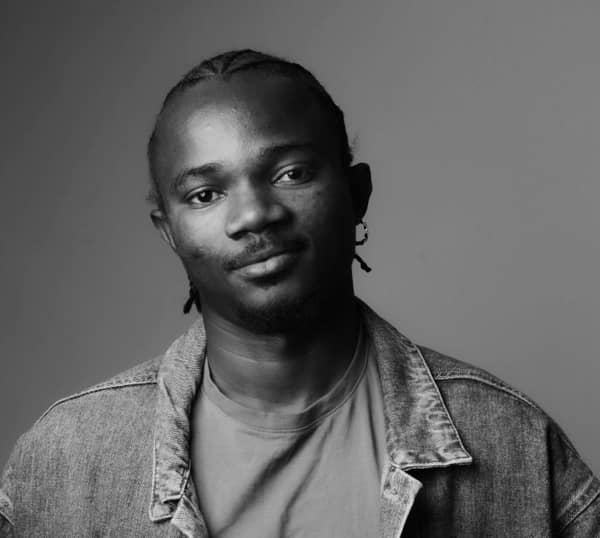
In Osogbo, where cultural tradition is woven into the everyday and style often leans toward the ceremonial, Bashir Adejumo has managed to carve out a visual identity that feels both rooted and quietly radical. His early appearances on social media, uncaptioned images posted to Facebook, didn’t announce a new designer. They suggested a different kind of eye. Someone not interested in shouting, but in rearranging the codes.
One image showed him in a kaftan split high at the sides, thrown over slouchy jeans. Another in an open agbada layered like outerwear, worn with grey trousers and a white tank. A third: a sheer shirt under a retro blazer, no shoes. Nothing about these looks was conventionally “finished”, and that was the point. They weren’t polished for effect. They were styled to provoke a mood.
People noticed. Not just online, but on the ground. Customers walked into his brother’s boutique with screenshots. Some asked for specific outfits. Others simply said they wanted to look like “the guy online” What they were chasing wasn’t a trend. It was the emotion in the image. The tension between softness and strength. The balance of structure and ease.
That tension became Adejumo’s signature. He layered lace over denim, wrapped ceremonial fabrics around everyday silhouettes. Sometimes gendered, sometimes ambiguous. He played with contrast: thick and sheer, sharp and undone. Colour was always measured, creams, soft blacks, quiet browns, then interrupted by a mustard yellow, a flicker of red, a metallic accent.
Nothing ever felt arbitrary. Every detail had intention. He began styling others too: friends, neighbours, regulars from the boutique. Photos were taken in alleys, on rooftops, beside cracked paint and metal gates. No studio. No lighting kit. Just the garment, the body, and the street. These images became something of a lookbook in motion, forming the early blueprint for what would become Ventunna, the label he officially launched in 2024.
But for anyone watching in 2023, the handwriting was already on the wall. The voice was clear.
The work didn’t feel like sketches or rehearsals. It had presence. There was a story in every look, a quiet rebellion, a deliberate reimagining of what West African menswear could hold.
Ventunna today is sharper in construction, bolder in silhouette, but its energy is unchanged. It still carries the Osogbo spirit: grounded, textural, unbothered by convention. The label doesn’t lean into spectacle, but it doesn’t play safe either. It resists categorisation. It lets mood lead the
way.
What makes Adejumo’s style powerful is that it’s not chasing perfection. It’s chasing clarity. The confidence to style lace with the ease of denim. To wear denim to a ceremony. To take what’s familiar and let it move differently. His work doesn’t ask for attention; it earns it. And people have responded, not because the clothes are loud, but because they say something without needing to explain.
For a designer who never sought the spotlight, Adejumo has created a body of work that speaks volumes. He didn’t launch with fanfare. He didn’t wait for validation. He wore his ideas and let the world come to them. From those first images on the streets of Osogbo to Ventunna’s growing global reach, the thread has stayed the same: authenticity, intention, and a quiet kind of courage.


![SPIE_PHRC_SOLAR_PV[1]](https://cdn.guardian.ng/wp-content/uploads/2025/05/SPIE_PHRC_SOLAR_PV1.jpg)