 Follow Us on Google News


 Follow Us on Google Discover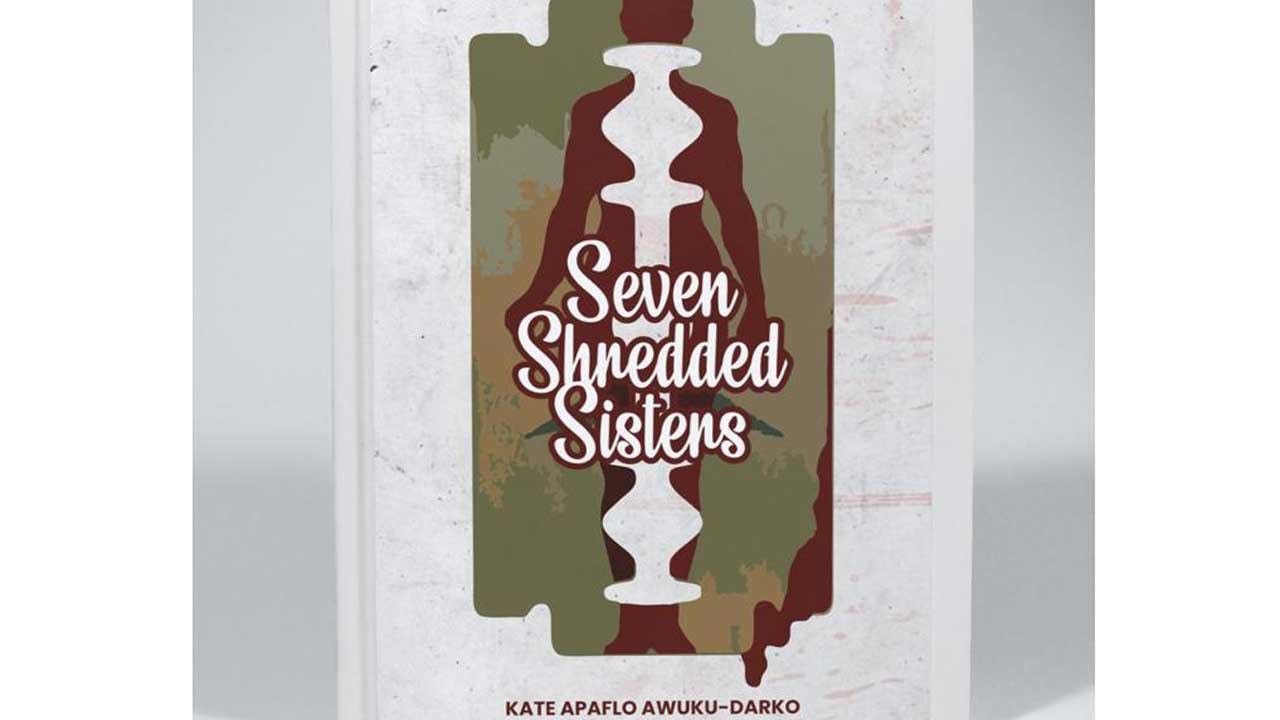
 Author: Kate Apaflo Awuku-Darko
Publisher: Redletter Crib signature
Reviewer: Ifeoma Ezinne Odinye
Year Of Publication: 2021
Genre: Poetry
Title: Seven-Shredded-Sisters
[ad]
Kate Apaflo Awuku-Darko’s collection of poems, Seven-Shredded-Sisters displays strong and discernable poeticality that dazzles with the purity of concern—one that has evidently bedeviled female happiness, preservation and survival. The title is unquestionably predictable, a subtle revelation of the poet’s resolve to draw attention to the indices of female pain. The syntax of her title is not shrouded in allusion and mystery; rather it exposes an unrestrained excruciation borne out of ruthlessness.
Unarguably, feminists’ praises for Awuku-Darko’s poems are unavoidable for seriously and honestly presenting demeaning circumstances—the tragedy of female predicament with vitriolic exactness. The language of the title eloquently speaks of direct assault with dizzying ponderings that trample on female sensitivity. Seven-Shredded-Sisters appears to us a title too suitable for the daily abuse—a title that seems to allude to bizarre conditions of female existence in a period of cyclic seven successive days.
Awuku-Darko’s lyrical utterances bite with meditation that is painfully engaging. Her first poem “Pain” is replete with bitterly-expressed lines dedicated to a female persona, Aisha. The poem is unambiguously significant with images that cut through the flesh like sharp blades. Whatever the poet’s reservation is, there’s no doubt that she has brilliantly crafted shapes with vivid descriptions and sensation into lines to disapprove hurtful apprehension with accuracy of statement. In a toned perception, she feels that:
pain is a sort of paralysis
grating,
round as a void,
a gurgling slit of heaviness,
un-hushed
blooms with gloom,
it itches deep into the marrow….
[ad]
Obviously, the vulnerable confessions devoid of full-scale attack on the perpetrators of this parasitic pain is why the poet has titled her poem “Pain”. Awuku-Darko’s lines are unarguably declarative thus fulminating the senses with slippery hope of female survival. She has fully described the larger conglomerates of pain as “bodies drowning in a greasy pool of/ inconveniences, /like a mouse in a lake of fire”.
Readers of Kate Apaflo Awuku-Darko will have no difficulty in her poetic proceeds because there is a conventional familiarity that deepens conversational mode in her poems. She carefully maintains narration with clear images that are truly disturbing. In the poem “At Moonrise”, she laments that “most days/ sleep comes with despair / the faces of young girls scattered / on the cold ground like dead sunflowers / a man comes breathing like a locomotive / he takes a ride till he trembles /each girl, each night”. This remarkable poem has a disturbing undertone that is difficult to overlook—it has an original thought conveying abuse through apt description. Rhetorically speaking, the poet’s earnest use of sensible objects is to awaken social consciousness.
The titles of Awuku-Darko’s poems birth imagination as a world, which gives importance to actions. The titles: “Lean”, “Mist”, “Dead Butterflies”, “Sisters”, “Caves”, “When You Dare to Call My Name”, “Open” and others —are not mere objectiveness of facts, but symbolic representations that speak to action and situation.
The impersonal nature of the poems is a technique which attempts to separate experiences from the poet who is obviously a female. In most lines, the poet avoids falling prey to her lines by employing the pronoun “her/she” as a determiner to escape the tentativeness of human interpretation. This is evident in her poem, “Open” where the agonizing image of rape is painted. The poet speaks astutely about the manner of rape in strained feeling: “her dignity rustled in the wild of desecration/her sanctuary writhing in flames/ her gait plundered by plank protuberance/ hymen rupture/ She no longer sings/ her voice squeaks like a tired rickshaw/ as her smiles ebbed into numbness”.
[ad]
Awuku-Darko’s poems communicate an assertion that ruthless attitude towards the female gender is illogical — a shift in the sense of behaviour that leaves any girl shattered to the extent that “she snaps under the weight of stares” (“Open”).

Surely any reader of Awuku-Darko’s poems will have a special effect in the ruefully confessed lines devoid of any sense of humor. My concern is that these poems contain moving images that haunt the mind with unending fear of what the future holds in defence of the vulnerable.
Primarily, the poet seems to have stressed that we have lived through the contemporary age of continuous criticism with less adequate action. The above declaration does not count with mere proclamation— action must be matched with potent passion to end an overwhelming burden.
• Dr Odinye is a senior lecturer on dual appointment in the departments of Chinese Studies and English Language and Literature, Nnamdi Azikiwe University, Awka.
[ad]

