 Follow Us on Google News
 Follow Us on Google Discover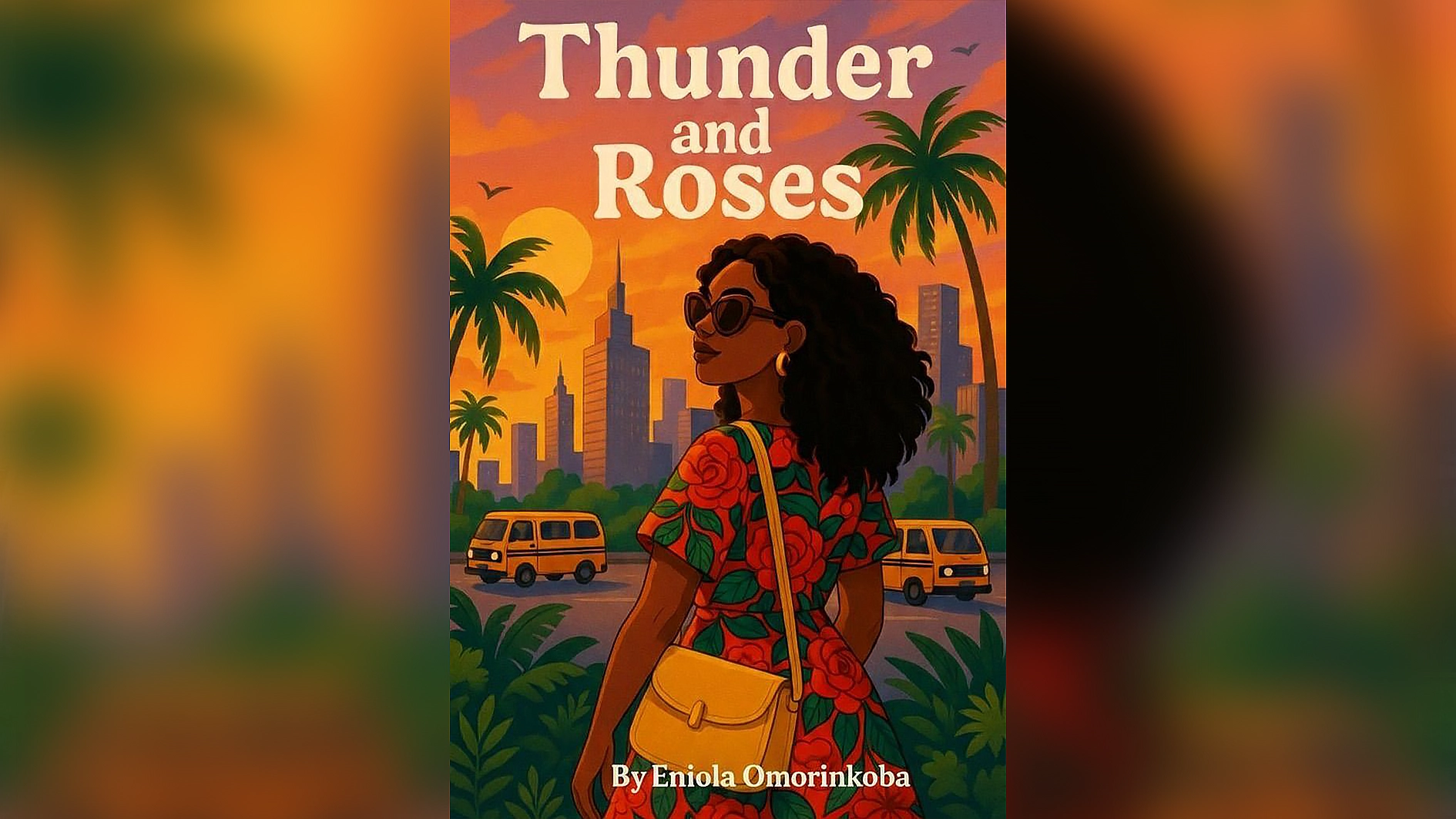
HOW can human beings find their direction and purpose when life appears too complex? Is it possible to free themselves from the concerns that weigh them down? In ‘Thunder and Roses’, a contemporary romance novel by Eniola Omorinkoba, the book asks a simple question as who was her thunder, and who was her rose? Can a woman claim both without losing herself? She does not postulate an actual hypothetical construct for answer, she, however, finds the foundation of morality in principles that reasonable people will mutually agree with.
Richly illustrated and lovingly written, the novel is a narrative that offers fresh insights into love.
Omorinkoba examines the fragile mechanics of modern intimacy—how quickly love is formed, how easily it becomes distorted, and how deeply it is shaped by emotional need, faith, and self-perception.
Through love, sisterhood and awakening, Omorinkoba cranks a cinematic reel that is an intimate portrait of contemporary Nigerian womanhood. More than a love story; it is a culture mirror. It interrogates the woman’s narrative using romance as the eye of the camera through which we see Nora and her garden of roses. Flowers are leitmotif for understanding the novel.
A debut work of fiction set in Lagos, the novel provides one of the most potentially life-altering encounters. It is a user’s guide to the everyday challenges of living, which looks to philosophy to reframe the way human beings understand themselves and relationships: The fiction is not just about love stories; it is about women, their choices, their sacrifices, and their resilience. It is about the kind of love that heals and the kind that almost destroys you.
The story explores how unpredictable, messy, and deeply beautiful love can be. It highlights the strength and agency of African women navigating personal and societal expectations. Faith and Growth: Balancing modern relationships with deeply rooted beliefs and personal routines.
Romance fiction is not just about love stories; it is about women, their choices, their sacrifices, and their resilience. ‘Thunder and Roses’ is about the kind of love that heals and the kind that almost destroys you.
Beyond romance, ‘Thunder and Roses’ poses questions about identity, duty and selfhood in a society where cultural expectations often outweigh personal choice. She argues that romance fiction, often dismissed as frivolous, can be transformative in Africa. It challenges stereotypes, it gives women space to imagine better relationships, and it insists that their desires matter.
Omorinkoba reframes how African women are seen and how they see themselves. How unpredictable love is and where couples find love or of devastating heartbreaks that capture public attention.
The novel is a narrative that offers fresh insights into love. The overarching message of ‘Thunder and Roses’ is clear: love is layered, unpredictable, and often messy. Yet, in one form or another, love prevails.
The 230-page romance follows Nora, a 29-year-old florist, who finds her life suddenly disrupted by an unexpected romance. Nora, a woman who has built a careful, faith-filled life around her late mother’s flower shop, Roses of Eden.
She points to how African women are often boxed into tropes: submissive wife, suffering mother, silent lover. She disrupts that narrative pushing forward a superior argument that women are passionate, conflicted, strong, vulnerable, and above all, human.
Caught between the two, Nora must navigate not only desire but also tradition, loyalty and power. Just as she believes that love requires the patience and timing of a growing flower, she meets Ugo.
His entry into her life is described as “thunder after a calm sky,”forcing Nora to confront her insecurities and navigate the delicate balance between faith, expectations, and genuine desire. The novel follows Nora, a woman whose strength is tested by love, family and cultural expectations.
When she discovers she is pregnant, Nora’s life spirals into an emotional journey shaped by two men: Ugo, a passionate but possessive doctor with royal lineage, and Yinka, the thoughtful son of a state governor who offers steadiness and respect.
Returning from London years later after a failed engagement in Nigeria, Yinka visits Roses of Eden to purchase a bouquet for his arranged date. His encounter with Nora sparks an instant attraction, thus completing the love triangle between Nora, Ugo, and Yinka. It is this triangular tension that propels the novel.
Rather, it finds Nora in her messiest state, where she is physically drained, emotionally neglected, and spiritually adrift. Ugo’s neglect plunges her into an existential crisis.
Yinka, too, has endured his own share of heartbreak, his fiancée, Saint Tracy, having seemingly pursued him only for the clout attached to his family’s social standing.

Yinka functions less as a romantic alternative and more as a contrast in emotional behaviour. Where Ugo embodies withdrawal and unpredictability, Yinka represents attentiveness and clarity. Yet Omorinkoba avoids reducing the narrative to a straightforward choice between two men.
Instead, the novella suggests that emotional clarity is not automatically produced by the presence of stability, but by the slow recognition of one’s own emotional entanglements. Thematically, ‘Thunder and Roses’ is concerned with expectation versus experience in modern relationships. Nora’s belief in love as structured, patient, and reciprocal is gradually challenged by encounters that are inconsistent and emotionally asymmetrical. The novella suggests that intimacy today is often shaped less by certainty than by projection, longing, and the hope that emotional imbalance can eventually resolve itself.
Stylistically, Omorinkoba writes in a clear, accessible prose that prioritises emotional immediacy. While this supports the intimacy of Nora’s perspective, it occasionally limits the depth of psychological subtlety, as emotional states are sometimes stated rather than fully dramatised. Structurally, however, the novella is coherent and effectively paced, with its central narrative arc remaining focused and easy to follow.
Where the work is most successful is in its refusal to romanticise emotional suffering. Nora’s experience is not presented as transformative heartbreak, but as sustained emotional negotiation. Love, in this context, is neither purely redemptive nor entirely destructive—it is unstable, contingent, and often difficult to distinguish from fear of loss.
Ultimately, ‘Thunder and Roses’ is less a traditional romance than a study of emotional misrecognition: how love is formed, misread, and sustained under conditions of vulnerability. While the novella would benefit from deeper character development and more stylistic restraint, it succeeds in capturing the emotional uncertainty of contemporary relationships with clarity and sincerity.
It is a work that leaves its central question open: whether modern love is something to be trusted, or something to be carefully navigated.

