Bukola Oyebode is a Nigerian arts professional working internationally. She recently moved to China, having lived and worked in The Netherlands for some years. In this virtual interview with GREGORY AUSTIN NWAKUNOR, Deputy Editor, Weekend Guardian, she shares her recent work experience and a peek into her future plans.
The influential 18th International Triennial of Textile in Łódź, Poland, opened on October 11 this year, and runs till April 2026. You are the co-curator of the main show titled: Deconstruction /Reconstruction. How did you get involved? How has the experience been?
My invitation to the 18th edition of the triennial came from Marta Kowalewska, the Chief Curator of the Central Museum of Textiles in Łódź, Poland, organisers of the triennial since 1975. Kowalewska, who curated the 16th and 17th editions, proposed to the Programme Council of the triennial to have a co-curator for the 18th edition which would be in line with their goal to expand the role and significance of the triennial and set new directions for the future. Their focus was expanding its curatorial process, reflecting the dynamics of the art world, textile art practices and our increasingly complex global society.
My work began in 2024 and will end when the triennial closes in 2026. I was well received from the onset, and my experience has been positive. Kowalewska and I had a beautiful opportunity to expand our previous work relation which began in 2023 when I was a guest curator of the Textile Culture Net, an international network of four institutions from Poland, Italy, Hong Kong, and The Netherlands, bridging textile art and design, heritage, fashion, urban regeneration and sustainability. Our relationship there made it possible for her to be familiar with my work ethic and interest in global social-political issues. This gave her the confidence to invite me to co-curate the triennial without the rigorous process of an interview. I didn’t realise I was being observed prior to the invitation in the summer of 2024.
Kowalewska and I, (with the support of the museum and triennial team) put together the 18th main exhibition Deconstruction/Reconstruction which began with an open call for artists. The open call received over 1600 portfolios. From these submissions, we selected a total of 70 artists from about 40 countries, including Victor Ehikhamenor from Nigeria, Liz Kobusinge from Uganda, Fatim Soumaré from Senegal, as well as other artists of African origin in the diaspora. Deconstruction/Reconstruction features a broad selection of international artists and birthed a new community. The diverse artistic imaginations made it possible to address topics such as notions of identity and belonging, religion and tradition, colonialism and historical erasure, migration, class and economic issues, invisibility of women’s labour, war, conflict and trauma, as well as questions about modern Western values. It became a space to rethink the current state of the world.
Concurrently, you are the curator of one of the side shows – Rhizomatic Portals: Ways of Knowing – which equally opened in October and will be on view until April 2026. Tell me more about this exhibition?
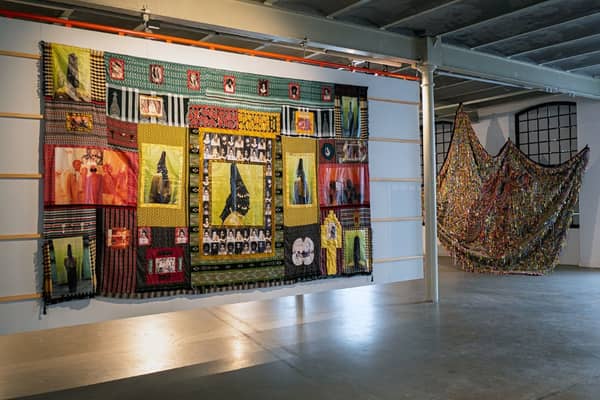
Yes, in a twist of events, I was also asked to curate one of the accompanying shows for this edition, which reflects another aspect of the changes made to the triennial. In previous editions, the supplementary shows focused on local artists and national developments. But for this edition, they decided to expand to other regions and integrate more voices outside of European countries and discourse. Thus, for this part of the programme I curated Rhizomatic Portals: Ways of Knowing featuring an inter-generational selection of women artists from Africa. The exhibition is a web of non-linear narratives and varied artistic forms combining textile elements, textile production processes and new media. I placed emphasis on weaving together self-stories and emotions, lost practices of land regeneration, spiritual and cosmic philosophies, women’s labour, heritage, contemporary imagination of traditional practices and textile techniques, an examination of textile motifs, local histories and the essence of textile to personhood and cultural belongingness. The artists featured are Aissa Dione from Senegal, Amina Agueznay from Morocco, Marie-Claire Messouma Manlanbien with origins from the Ivory Coast and Guadeloupe but based in France, Ngozi Ajah Schommers from Nigeria, living in Germany, Adeola Olagunju and Peju Layiwola from Nigeria, living in the USA, Sondos Shuaib, an artist of Sudan origin based in the UAE, and Weavers from the Upper West region in Ghana represented by Nubuke Foundation.
I am immensely grateful for the experience of working with these amazing artists, especially the older generation (Peju Layiwola, Aissa Dione and Amina Agueznay) whose work significantly paved way for a young generation of women artists in Africa. Through this show, I emphasised the importance of returning to the archive and acknowledging history. For instance, I didn’t want any visitor to assume African art and artists are new to this museum or to Poland. So, I turned to the museum’s archive to see those who were there before the artists in the main show and Rhizomatic Portals. In the 17th edition, for example, Nigerian artist Karo Akpokiere was one of the selected artists in the main exhibition. However, I was interested in earlier times and was excited when I found the late Madame Zo (Zoarinivo Razakatrimo from Madagascar, 1956–2020), was there in the 2007 edition. To honour her and further bring her work and legacy to an international audience, I included her in Rhizomatic Portals through an homage presentation. We are living in a time when it is trendy to pronounce every encounter and exchange with Africa as the first without giving much thought to past events. In my work and especially how it is framed, I try my best not to erase precious history.
I am just wondering how you were able to handle both shows. Can you share your experience?
To be honest, it was quite demanding and I was doing other projects simultaneously. While working on the exhibitions in Poland, I was also organising a programme in Lagos for The Listening Biennial involving an exhibition with six artists. I was involved in publishing a small book and was part of a guest-curated online project for this year’s British Textile Biennial. Thankfully, the online project demanded less time. It was a collaboration with the Textile Culture Net, and because I enjoy working with the people in this network, I accepted to contribute to the project in spite of my tight schedule. This year was exceptionally busy but also fulfilling. I created and realised works that coalesced and deepened most of my interests and the activities I have been committed to in the last ten years.
Let’s talk more about your programme in Nigeria. You curated and co-organised the Satellite Project of The Listening Biennial and the exhibition – Wind Chimes, Gongs and Bells. For whom is this call? at the Centre for Contemporary Art in Lagos known as CCA Lagos. Can you give an insight into this programme and what your home coming meant to you?
Wind Chimes, Gongs and Bells. For whom is this call? was a satellite project of The Listening Biennial 2025 presented at CCA Lagos. The exhibition opened in August and was on view until October. Artists in the exhibition were Ana Bravo-Pérez from Netherlands/Colombia, Ayọ̀ Akínwándé from Nigeria, Dunja Herzog from Switzerland, Eythar Gubara from Sudan, Simone Goslinga from The Netherlands and Soñ Gweha from France/Cameroon. Their work, presented together, call attention to the overwhelming feelings of the present time and how we relate as humans, particularly how we treat the realities of others. It also addressed the origins of the disenchantment unfolding in some parts of the world right now and how it impacts the people there.
Anchored in the show was a collection of sound works from artists featured in the main programme which were presented across the other 25 locations and online spaces dedicated to this year’s edition.
During the exhibition run, there was also a sonic gathering with the Lagos Sound Artists’ Collective (LSAC).
The Listening Biennial is unlike the other biennial models we are familiar with. Although it is directed by a group of curators, researchers, scholars and artists in Berlin (led by Brandon LaBelle), it is conceived as a global project and is organised through a decentered structure. The presentations at the different locations are organised through a close collaboration, for instance, how my platform – TSA Ideas Lab – and I hosted this edition in Lagos.
Returning to Lagos was a major highlight of my year. The last time I was home was in 2022 for the presentation of the TSA Art Magazine Collector’s Series: Artists & Cities. Assembling people and presenting my work at the CCA Lagos, which just re-opened after it was closed for renovation was the real homecoming for me. The late founder, Ms Bisi Silva supported my journey in the Lagos art world from the onset. So, returning to CCA was special to me and I am grateful to the new director, Oyindamola Fakeye, for hosting us, as well as the Goethe Institut Nigeria and Pro Helvetia for supporting the exhibition.
You are an art professional who has been a key player in the Nigerian media space – specifically, you were the publisher of TSA Art Magazine even though you refer to yourself as the lead editor. Briefly describe the experience and the next phase since you rested the magazine which had ceased publication.
I consider the work we did with the TSA Art Magazine extraordinary. It was run by a small group of passionate people, and I will return soon to reflect on that time, the significance of some of the things we enabled, our limitations and the Lagos art world from which all these emerged. Indeed, calling me a publisher is correct, I just preferred using the title ‘lead editor’ during the magazine era to keep things simple and because sometimes I was afraid to carry the weight of that title. But the work was indeed publishing, and I enjoyed the creative aspect as much as the technical bits, especially when I ventured into making prints. In general, I consider my work in publishing a conscious archiving practice, as well as a response to the gap created by the absence of infrastructure in the African art ecosystem, which includes structures that should enable significant documentation of artistic practices by African artists. Therefore, my work has been shaped by an inventiveness to fill that gap by bridging my individual art practitioner’s work with institutional vision. For example, when the magazine closed, the dreams behind it morphed into TSA Ideas Lab, which is my playground for collaboration and making art projects that matter. Although, I prioritise publishing and organising, this floating lab allows me to rethink the notion of platform and protocol, and to make what I consider significant to expanding local and intercultural arts dialogues.
Briefly take me through some of your recent publishing and documentation projects, which you are equally passionate about?
My recent editorial and publishing projects include Collector’s Series: Artists & Cities (2022), the monograph on the Nigerian-German artist, Ngozi Ajah Schommers: Tracings of time and place (2023), Okhiogbe Omonblanks Omonhinmin’s Kids from the River (2025) and, as part of BB Collective, I co-edited Together as to gather, the publication for MOMENTUM 12, Norway’s Biennial of Contemporary Art.
So, what’s next?
Without getting into the details, I am in the early phase of a publication bringing together some amazing women artists from Nigeria and The Netherlands. But as the funds are not rolling in fast, it is taking some time to come together. But God willing, we will present it to the world soon. I am also pushing for work interests and collaborative exchange with Asia and will share when things become more tangible.