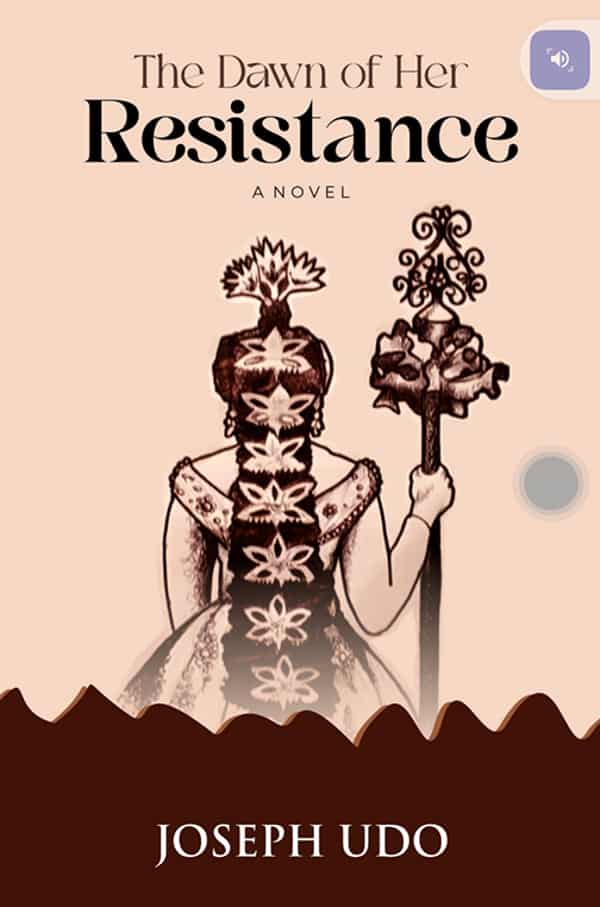
Titled, The Dawn of Her Resistance, Joseph Udo’s book is one of those novels that stick with you long after you finish it. The characters feel incredibly real, and their stories hit hard. It’s one of those novels that resonate with you for a while. The 255-page book, with a distinctive mass of history, is written in simple, well illustrated narrative.
Loaded with the history of people who occupy the Southeastern coast of Nigeria in the 17th century, it interrogates their socioeconomic and commercial space. The novel’s exploration of complex societal dynamics, including the influence of the British Empire and the internal conflicts within the kingdoms, adds depth and nuance to the narrative.
The five-part novel builds up the characters’ stories and back-stories, moving back and forth to give the reader a deeper understanding of who the characters are, and of their pasts that have shaped them.
Through its fast-paced narrative, it immerses readers in the vibrant culture, traditions, and complex societal dynamics of the era. As the novel unfolds, their lives intersect and intertwine in various ways, and the reader sees each of the characters evolving in very different ways: Familial and romantic relationships are tested, as are loyalties; desire burns; facades crumble; and the striving for survival is explored in all its many guises.
The author delves into the life of Adiaha Obong, a woman from the Ibom Kingdom who becomes a symbol of resistance against colonial oppression and an advocate for women’s rights. Her journey is that of a ‘powerless slave-wife’, a marginalised voice, who moves to become a revolutionary force. She is the eyes of the camera through which actions are seen.
The author skillfully portrays her transformation and the ripple effects of her actions, painting her as a beacon of hope for women’s empowerment in an era of rigid societal constraints.
Adiaha Obong’s transformation is the heart of the novel. The reader watches her grow from an innocent kid to a high flying adult and warrior during the war of attrition. The author sees Adiaha Obong, as a fearless and determined protagonist who challenges the deeply ingrained patriarchy of her time. From her forced marriage to Ezeife, the prince of Arochukwu, to her escape and new life as a trader in Ikot Ekpene, Adiaha Obong’s journey is fraught with challenges and hardship: She is a femme fatale.
Her resilience and determination to fight against colonial taxation and mobilise market women across regions highlight her strength and leadership. The novel also explores her personal life, including her marriage to Nkeruwem, a reformed tax collector who supports her cause and her reunion with her adoptive parents.
And like Charles Ukpong’s Mma Udoma, a historical play written on the 1929 women’s revolt in Aba, Adiaha, the heroine stages an anti-colonial revolt to address tyrannical, insensitive and oppressive imposition of taxes on women, as well as other socio-political and economic grievances against the British colonial government. The novel’s depiction of the women’s riot against colonial taxation is particularly powerful.
Just like Adiaha Edem Udoma, Adiaha Obong’s ability to mobilise market women and force the British government to reconsider their policies underscores the impact of collective action and the importance of women’s voices in the fight for justice. Her continued advocacy for women’s rights and her efforts to help people settle in new lands further emphasise her commitment to social change and empowerment.
The author weaves a tale that is as educational as it is entertaining, offering insight into the historical intersections of local traditions and external influences, such as the looming presence of the British Empire.
In addition to its engaging narrative, the author’s meticulous research and attention to detail bring the 17th century Ibom and Akpa Kingdoms to life, providing a vivid backdrop for who the Ibibios, Annangs, Oron, Mbo, Itumbonuso, Ejakam and others that share similar culture are.
What stands the novel out is the author’s descriptive power. He paints the literary canvas in such a manner that is concrete. “Her flawless skin glowed like polished ebony, shimmering under the sun’s rays as if kissed by the gods themselves. She was the living embodiment of a legend, hailed as the most beautiful girl in the world. Her father, the great Oku Abasi, had cherished her so deeply that he had kept her hidden within the palace walls, shielding her from the outside world. But now, as she rushed from the central hut, her heart pounded with fear. Her father, the charismatic leader of Ibom, lay wounded, an arrow piercing his side.”
He also says, “the sun hung low in the sky, casting a golden hue over the ravaged lands of the Ibom Kingdom. The air was thick with the acrid scent of smoke and the metallic tang of blood. The once
-thriving kingdom, also known as Mbot Abasi (In the likeness of God), now lay in ruins, its people scattered, its spirit broken.
“The war with the Igbo invaders had raged for years, leaving behind a trail of destruction and despair. He describes the new peace in a rather beautiful manner. “The battlefield, once a cacophony of clashing swords and war cries, fell silent.”
All eyes turned to the princess, her presence commanding the attention of friend and foe alike.”
The narrative is rich and brimming with emotional depth, celebrating the courage and resilience of women in the face of oppression. Udo’s masterful storytelling and rich cultural detail make this a must-read for anyone interested in historical fiction, women’s empowerment, and the enduring fight for equality.
Udo unflinchingly captures the displacement, violence, starvation, degradation and horrifying losses endured by people, as well as the voids left without hope for closure as people simply disappeared. The novel’s themes of freedom, justice, and courage resonate strongly, making it a poignant and thought-provoking read that will leave a lasting impact on readers.
The story through the eye of the characters makes it easy to follow, plus it is mixed with emotions throughout the book. Storytelling and character-building is superb and completely engrossing. The only thing that throws you off is the timeline: 17th century is too far a locale.
The story jumps around, and there are moments like when the character ‘Edidiong’ shows up in the house of Oku Abasi after years of abandonment, and you’re confused for a bit. Eventually, everything clicked, but it did take me out of the story for a while.