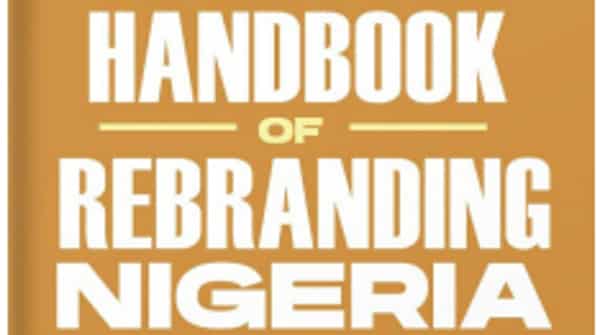
The Handbook of Rebranding Nigeria: An Anthology of Context, Critical Analyses, and Counsel (Vol. 1), which was recently unveiled in Lagos, is a store house of narratives that offer immense views about Brand Nigeria, loads of hindsight, and the foresight that can lead the country to El Dorado.
Edited by Ofuma Agali and Dr Temi Abimbola, the anthology brings together 54 voices offering context, critique, and counsel for the Nigeria brand. Among the contributors are marketing communication practitioners, journalists, academics, public affairs analysts, and elder statesmen.
Lead Consultant at Candella and the anthology’s lead editor, Agali, described the book as a record, and an intentional act of preservation.
He noted that the country has been blessed with useful insights, brilliant argument, bold recommendations, and clear warnings, all of which appear in everyday speeches, conversations, essays, and in the media; yet, they appear to vanish after a while, getting lost in the grind of national existence, time, and forgetfulness.
“The conscious and responsible preservation of our thoughts, stories, and projections, therefore, offer us a foundation, as a people, to harness the depths of hindsight so we can be equipped with the foresight that will lead us in the right direction.
Speaking on the book’s objectives, Abimbola, an Associate Professor of Marketing and the book’s Co-Editor, said it sets out to contextualise the nation’s perceptual value and image trajectory as a means of equitably addressing questions such as “Where are we?”, “Where should we be?”, and “How should we aim to arrive at where we are aiming to be?”. “In capturing this set of broad questions, the contributors addressed some of the brand’s historical narratives, current states, and potential prognosis for the future of Brand Nigeria,” she said.
Agali informed that the book project was inspired by the debates of the 2009 “Good people, Great Nation” campaign. He said the project is an assembly of narratives and thoughts around the Nigeria image question – from inception, amalgamation, and independence, to all the current national issues, including corruption, mediocrity, morality, and identity.
“This is why you will find that more than 90 per cent of the essays in the book were previously published in newspapers, magazines, and blogs, or presented as papers; these contributions were curated, processed, organised, and formed into an anthology,” he said, adding that the book now exists so these important contributions to the Brand Nigeria conversation do not become invisible. “The book has gathered what could have become forgotten and placed it within reach – to serve as a reference for debate.”historical perspective for planning, and a reminder for affirmative action and follow-through,” Agali said.
Despite being assembled from hindsight, Abimbola noted that the body of work is timely, relevant, and urgent. Buttressing this, she identified three areas in which this timeliness is explored. The first is the historical perspective: “If one does not know where one is coming from, one’s journey becomes confused and hazardous.”
The second is the role of anchoring: “The essence of a brand acts as the pivot for all its future growth and our judgment of what is “desirable” and “worthy” as the brand equity of such a brand. The third is that the time to merge the historical perspectives and the brand anchoring for a constellation of ‘new Nigeria’ – an inclusive nation state – is now. “Such a coherent nation brand is to act as a platform from which Nigeria can propel itself out of the quagmire of strife and stunted development and into its rightful place among the pearl of nations,” she said.
In his keynote address, Akin Adeoya, the CEO of MarketingMix, said one of the book’s principal strengths is the clarity it provides on ‘Brand Nigeria’. “By tracing the events preceding and following the 1924 amalgamation, it effectively documents the nation’s brand development from a period when the very concept of nation branding was unfamiliar,” he said. While noting that it is this historical grounding that facilitates clearer understanding, he brought three critical issues to fore. One is that where there is no identity, there is no brand, which argues that a successful nation-branding endeavour is impossible without first resolving the fundamental question of national identity where citizens must share a genuine sense of oneness. Two is the imperative of history, which argues that before we can build a great national brand, there is a need to first cultivate robust, confident citizens who understand their rightful place as Nigerians and Africans within the global order.
There is the question of comparative advantage and economic restructuring, which argues that nation branding succeeds when the comparative advantage of a nation is obvious and credible, pointing to economic viability as a fundamental prerequisite. His address ended with an appeal: “Let us continue to engage earnestly with the project of building a greater nation, a stronger Brand Nigeria, and a better country for all” he said, while urging citizens not to succumb to bitterness or become disoriented by present challenges.
In his review, Chido Nwakanma, Editor-at-Large, BusinessDay Media, described the Handbook of Rebranding Nigeria as a monumental and ambitious project. “The handbook ‘s most immediate feature is its extensive scope; covering nearly 400 pages, it analyses the Nigerian experience through the perspective of history, sociology, politics, culture, management, diplomacy, and communication,” he said, adding that it documents important branding campaigns from the fundamental “Heart of Africa” to the widely-recognised “Good People, Great Nation” initiative, offering a valuable record of the nation’s dialogue with its own image.
Some of the contributions in the book were drawn from Prof. Kayode Soremekun, Prof. Emevwo Biakolo, Dr. Josef Bel-Molokwu, Dr. Lugard E. A. Aimiuwu, Dr. Jossy Nkwocha, Dr. Kayode Fayemi, Dr. Biodun Shobanjo, Dr. Uche Nworah, and Bishop Matthew Hassan Kukah. Others include Bola Akingbade, Al Ries, Akin Adeoya, Akonte Ekine, Funmi Iyanda, Salisu Ahmed Koki, and Lauratu Umar Abdullahi, among many others.