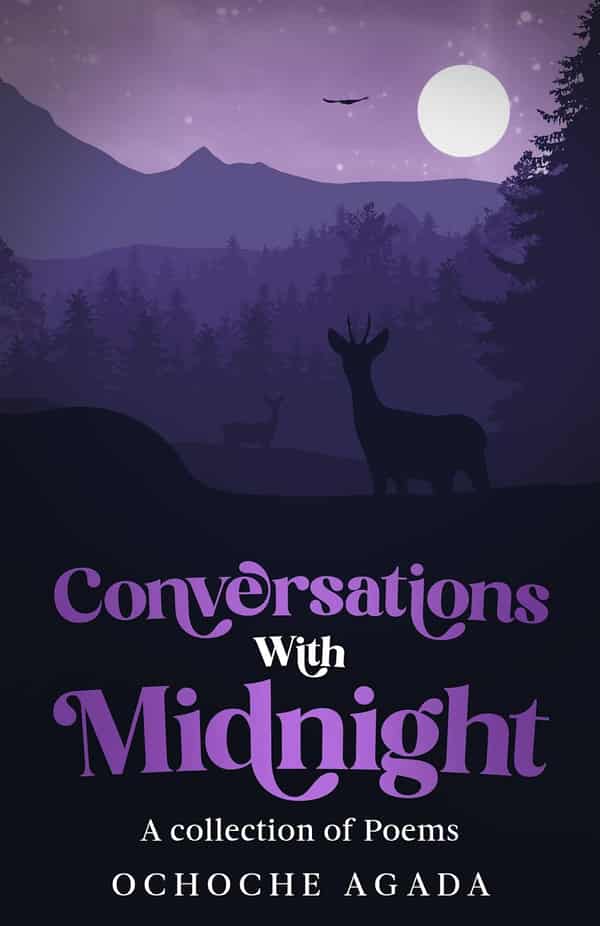
Title: Conversations with Midnight
Author: Ochoche Agada
Publisher: Paperworth Books, Lagos
Genre: Poetry
Year of Publication: 2025
Number of Pages: 165
Driven by a deep connection to his African heritage, Ochoche Aklo Agada, in his latest collection of poetry, Conversations with Midnight explores the rich tapestry of Africa, delving into human’s civilisation’s evolution, structure and essence. Much like a philosophical journey, the poet invites his readers to think and appreciate nature.
Published by Paperworth Books, the collection takes readers on a journey of discovery, introspection, reflection and projection.
With 80 poems, the 165-page collection exposes readers to African experience—life, community, and growth—highlighting the challenges and triumphs, which shape his being and resilient spirit. Each verse resonates with the raw truth of hope, fear, and struggle, painting vivid portrayals of the storms human beings navigate: The reader is thus left immersed in deep conversations.
A multifaceted and respected storyteller with a profound love for African history and folklore, Agada, through a series of interrogations and contemplations such as At The Floor Of The Mountain, Colours Of Fear, Dancing On A Strand Of Hair, Journey Of Harmony, Sometimes I Wonder, Teach Me To Be Free, Distant Echoes, My Acres of Diamond, Paradoxes, Fragments Of Hope and the eponymous poem, Conversations With Midnight, as well as A Chequered Story, A Forest of Willows and Silver Lining, The Panacea, and others, catalyses the human experience, offering what could be described as a thought-provoking message inspired by the diverse landscapes of Africa.
As the poet insists in the Introduction,” a tide of serenity often captures the mind when the sun sets and the moon appears in the sky, ushering in the midnight.”
He says: “Conversation with Midnight explores the relentless nature of our worries and the choices presented to us every night until the morning when we awaken to mull over the dream and the scream they can elicit when they torture us – thoughts that keep us awake and sit up through the night surging through our being and telling us the things that we must do. The ones we must remediate are the stories we should seek to tell.”
Agada, the author of The Hand of the Iroko, a poetry collection that intertwines the roots of tradition with the branches of contemporary consciousness, reflects a profound curiosity about the physical, natural, and metaphysical realms, offering readers a distinctive perspective rooted in cultural and African traditions.
In The Panacea, the poet notes: “The sky gives shelter to the man and his companions, / trees give housing to birds and their ilk, / bees, too, in their hives braving thunder. / Oceans in mesmeric motion; the seas, and their wonder. / When you sit and learn under the shades of nature, you cannot go under. / Beyond the colours of fear, there is so much more to ponder.”
From bustling villages to serene highland settlements, the poet confronts humanity’s deepest fears, while celebrating greatest triumphs. The poet deplores various figures of speech, including metaphor, simile, personification, hyperbole, irony (opposite of literal meaning), onomatopoeia, alliteration, and others, to convey his message.
He confronts human beings’ innermost thoughts with his poetry such that Conversations with Midnight becomes something like a companion to defeat threats of the night.
In At The Floor Of The Mountain, the poet writes: “It is a feat of an uncanny kind to have made it to the floor of the mountain / On my journey, I drank deep bitterness from a flurry of lurid fountain / I was drenched in sordid stench.”
While in Empty Into The Sea, the poet says: ‘I will jettison fruitless passions and these tedious possessions… / give me a new beginning as a newborn with gifts that never go away.’
The poet describes ‘midnight’ as a cosmic creature that seeks “to speak with us on our terms. / This is the reason it comes with such serene fanfare, like mice in a haystack.”
No doubt, Conversations with Midnight is a beautiful collection, and I will not hesitate to recommend it to those interested in reading good natured poetry.