 Follow Us on Google News
 Follow Us on Google Discover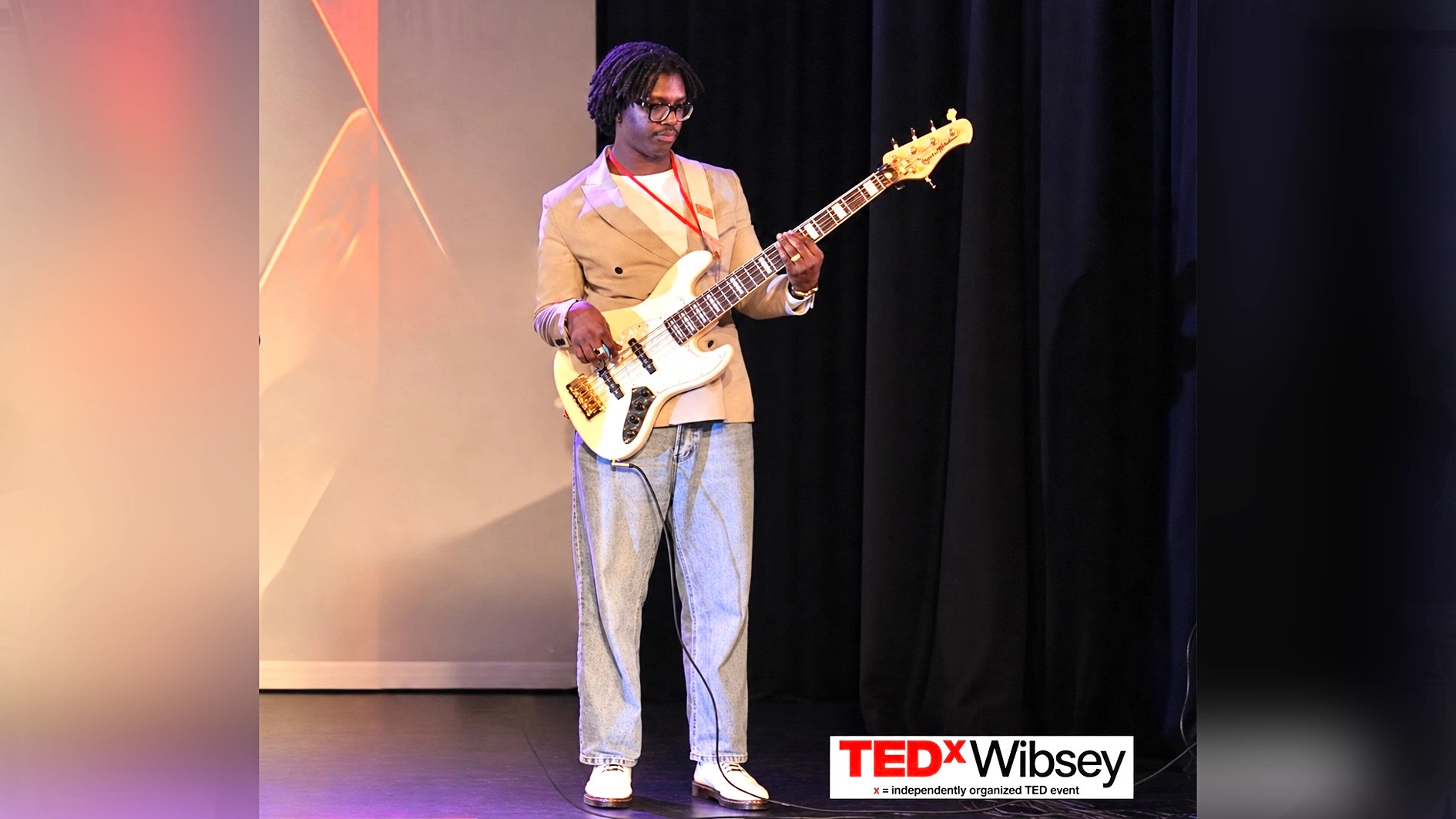
By Wale Oloworekende
Although the bassist is one of the least singularly visible members of a live band, much of the rhythm the audience perceives travels directly through the bass guitar’s low-frequency range. In contemporary live performances, especially in genres such as Amapiano, Afrobeats, and high-energy African gospel, the instrument links raw percussion and harmonic structure. It responds to the drummer and helps drive the sound’s physical movement.
This structural authority took centre stage on September 19, 2026, at TEDxWibsey, hosted at the Bradford Arts Centre under the theme “How Ideas Shape Our Future”. TEDx events traditionally rely on spoken lectures and mostly panel discussions to convey ideas, but the programme integrated a live performance segment to demonstrate how non-verbal mediums carry intellectual and cultural weight.
The critical success of that segment relied on the dynamic interplay between bass guitarist Iteoluwa David Akinsete and saxophonist Samuel Oladayo Ogundapo (Dayo Sax). A common arrangement would have been to make Iteoluwa Akinsete a background accompaniment, but instead he functioned as an indispensable co-architect of the set as they went through inventive performances of Kenny G’s “The Moment” and Asa’s “Jailer.”
The performance opened with smooth phrasing inspired by Kenny G, deliberately utilising familiar jazz aesthetics to draw a diverse auditorium into a shared emotional moment. This transition recontextualised the music, grounding a mainstream smooth-jazz framework inside a distinct African sonic heritage. Akinsete’s position in the group acted as a stabilising anchor, holding onto the low-frequency base necessary to keep the key players aligned.
The way Iteoluwa David Akinsete executed his performance during this transition provided the critical artistic weight of the set. Ogundapo’s saxophone carried the melodic narrative, but it was Akinsete’s low-end placement that dictated the shift in cultural energy, carrying the emotional undertone of the performance. His ability to move from steady, ambient room-filling resonance to sharp, syncopated African pocket-playing provided its physical drive. Without that structural anchor, the performance risked remaining a pleasant interlude; with Akinsete establishing the rhythm, the set became a compelling demonstration of cross-cultural adaptation and artistic dialogue.

To execute this role successfully across such diverse platforms, an instrumentalist must understand a wide range of musical styles, adapt quickly in real time, and have the discipline to put ensemble cohesion before personal showmanship. Few rising African instrumentalists show this ability to provide a solid structural foundation while adapting to different styles as clearly as Iteoluwa David Akinsete. A look at Akinsete’s performance record offers a clear example of how this instrumental responsibility is carried out across diverse settings.
A major challenge in large-scale African music performances is organising complex live arrangements without overburdening lead vocalists or crowding the percussion section. Live performance in Nigeria, especially within major gospel traditions, demands high physical endurance and rapid adaptability. Akinsete gained early professional experience in such demanding environments. When he performed at the RCCG (Redeemed Christian Church of God) Marathon Praise Concert, a high-intensity worship event, he had to keep a steady low-end sound going throughout multi-hour sets where worship leaders rotated continuously.
In this kind of performance, where songs change spontaneously in response to the audience, the bassist must maintain strict tempo control while handling the harmonic weight of a large live band. This need for structural stability also emerged in his collaborations with Nigerian gospel minister Bukola Bekes, where live performances emphasise repetitive, groove-based foundations meant to sustain energy over long periods.
Moving his practice to the United Kingdom presented a new operational challenge: adapting West African bass techniques to suit various regional genres and urban music production styles. In 2025, Iteoluwa Akinsete performed with British-Nigerian artist Faithchild at TAE. For this performance, he converted traditional African gospel pocket playing into modern urban arrangements influenced by hip-hop and grime rhythms. Akinsete modified his flow, providing the sharp low-end needed for modern urban music rather than changing his fundamental method, which maintained the warm resonance of live instrumentation.
While serving as the musical director at Blankets & Wine Bradford in 2025, he further explored this stylistic versatility. The festival program featured a wide range of acts, including East African musicians Bensoul, Njerae, Boutross, and Coster Ojwang. Akinsete incorporated distinct regional rhythmic characteristics into one unbroken event across acoustic soul, alternative pop, and syncopated urban rhythms. Handling consecutive performances for several headlining artists required immediate familiarity with a variety of arrangement styles, accurate dynamic control, and an intuitive grasp of how different acts interact with the rhythm section.
By 2026, Akinsete had expanded his festival appearances to include the UK’s outdoor African music circuit, as shown by his performance at the Bradford Afrobeats and Amapiano Outdoor Festival alongside DJ Neptune. Since genres like Amapiano and Afrobeats make heavy use of sub-bass frequencies and repetitive syncopation, performing them live requires balancing the synthetic character of studio recordings with the natural attack of an electric instrument. Akinsete’s execution kept the hypnotic pulse needed for dancefloor-focused music while adding dynamic flexibility to the stage.
At TEDxWibsey, this accumulation of technical experience was deployed in a stripped-back, high-focus setting. Without the massive production layers of stadium festivals or large gospel choirs, the interaction between Ogundapo’s saxophone and Iteoluwa Akinsete’s bassline was fully exposed. The performance demonstrated how a lead bassist can hold the dynamic centre of an intellectual assembly, driving rhythmic movement while maintaining the clarity required for a seated, attentive audience.
Alongside these major public appearances, Akinsete has formed performance partnerships with saxophonist Adedoyin Oseni and vocalists O’Phils, RukeGure, and Yemi Pelda. His engagement in collaborative work reflects an artistic approach that prioritises ensemble cohesion over individual showmanship, viewing the instrument as a foundational component whose role is to enhance the primary performer and preserve the integrity of the composition. Now based in Yorkshire, Iteoluwa Akinsete has incorporated local teaching into his activities by mentoring teenagers in Bradford. The course covers basic technical mechanics, fretboard navigation, tone production, and the informal rules of rhythm section interaction, passing on established methods of performance to young instrumentalists.
Looking at Akinsete’s documented performance record, moments like the TEDxWibsey showcase demonstrate how an essential band member operates as a cultural and technical bridge. By bringing the rhythmic complexity of African live arrangement onto a TEDx stage, his work shows that consistent technical discipline and stylistic adaptability enable an instrumentalist to articulate complex ideas and establish a clear artistic identity across global cultural networks.

