 Follow Us on Google News
 Follow Us on Google Discover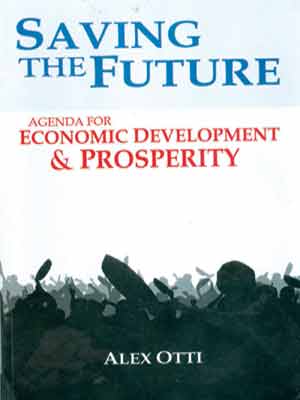
 Nigeria is at a critical crossroads in her political and economic fortunes and all well-meaning citizens across sectors are lending their voices on how to make Africa’s largest economy truly great in real terms. This is not unexpected especially from among business managers who feel the pinch the most and whose business fortunes depend on a functioning state to survive. So far, it would seem the politicians constitute the biggest obstacle to moving the country forward with their penchant for profligacy.
This is not surprising. Nigeria’s political class has continued to fritter away the resources wtat would ordinarily have been deployed to make Nigeria great. It is in order to avoid continuing monumental wastage of the country’s scarce resources that men like Dr. Alex Otti are weighing in intellectually. As economist and former Managing Director of Diamond Bank Plc, Otti should know where the shoe pinches. In this book, he brings in his banking expertise and patriotic zeal to bear on Nigeria’s economic woes and chart a path to the country’s redemption. What is more, he recently threw his hat in the political ring and entered the governorship race of his state, Abia.
But long before he entered that race, he had been pondering the economic problems plaguing Nigeria and had sought ways to intervene both as an economic player and robust intellectual. These twin efforts by Otti are what gave birth to the book, Saving the Future: Agenda for Economic Development and Diversity (Patrioni Books Limited, Lagos; 2014). It’s a critical resource book that highlights the many problems Nigeria faces. But beyond highlighting the problems, Otti is also forcing Nigerians to critically look inwards for the solutions that they have glossed over for too long.
Indeed, the ideas Otti advances and the solutions he proffers may not be new. In fact, they are not new. But he approaches them with the necessary vigour and forthrightness that engender soberness. For Otti and many who think like him, it’s like knocking on the door of the deaf, and until he opens the door, it makes sense to keep knocking.
It is perhaps for this reason that he starts the book with Nigeria’s single economic resource, oil, and how N800 billion was badly mismanaged in 50 years and not plowed into making Nigeria better. Otti asserts that doark clouds hover over Nigeria, as she refuses to innovate like others, with other sources of fuel and renewable energy are being invented to take the shine away from oil. Otti argues that the dwindling oil fortunes in the international markets were long foretold, but Nigeria failed to heed the warning. And even now the facts stare Nigeria in the face, managers of the economy prefer to play the ostrich.
Otti paints an alarmingly believable socio-economic and political scenario for Nigeria, “With Nigeria’s wholesale dependence on oil as the main source of her revenue, drop in revenue as a result of the inevitable transition from oil to alternative energies portends a fearsome socio-economic and political danger of a cataclysmic nature for the nation… Unemployment will double, investment in social infrastructure will drop, social discontent and violent protest will increase, and political instability will fester. Anarchy and Hobbesian state of nature will be our condition.

“And the reason is simple. Nigeria, in the past 50 years of oil exploration, has not strategically invested the proceeds and diversified the economy. The gas sector… largely undeveloped, leading to the current challenges with electricity generation”.
The first chapter provides the canvas on which the banker-turned-politician anchors the other chapters: largely a need for his countrymen and women to wake up from their 55-year old slumber and stagnation to give leadership to the future. While other countries are taking to heart the biblical injunction to leave a legacy for their children, Nigeria is doing the reverse, says Otti: that of devouring the future of their children, like a wicked hen that drinks the life-source from its own eggs!
He admonishes, “Enlightened self-interest demands that we do something to change our situation and guarantee the future prosperity of our children… What legacy will this generation bequeath to those coming after? It is only wise to do so, because the world will not get better economically”.
Other chapters simply reinforce the first and provide a roadmap for the future. Other issues Otti gives attention in the book are education and agriculture. But his emphasis is on the type of education Nigeria should provide her young from the current educational rot. Like many before, Otti comes to the emphatic conclusion that a lot is left undone and calls for renewed impetus in providing education that is skill-oriented to meet the demands of labour rather than paper certificate as it is the current norm.
Among the problems of education in the country, the author recognizes funding as the main area of failure by government. And he advises a policy that has worked in other parts of the world. He states, “It is obvious from the trends in the private education sector that many parents could afford moderate tuitions (sic) fees for their children. However, governments should be encouraged to develop bursaries and educational loans schemes with banks for those in need… The loans scheme should be structured in a way that beneficiaries would pay back over a period of time on securing employment…”
He stresses qualitative education as against the quantitative one Nigeria currently runs with graduates being poorly trained and unfit for the labour market. In fact, education is so crucial that Otti devotes two chapters to it by way of emphasis. And he puts it succinctly, “…the nation has to muster all of her will to fix this problem. Education is too fundamental to be trifled with… the alternative to a robust educational system is a continued perpetuation of widespread ignorance, lack of properly skilled manpower, non-productivity and under-development”.
In concluding the book, Otti lists the many development goals Nigeria has missed on the road to greatness. In setting a national agenda, he says, “Nigeria wants to be a great country. Her political and business leaders have said as much and many Nigerians share this aspiration”.
And so the difference between the shared aspirations and achievement is what makes for a great country. Nigeria is far from realising her aspirations, and greatness consequently eludes her. From setting agenda for Year 2000 to Millennium Development Goals by 2015 and now to Vision 20:2020 and Sustainable Development Goals (SDG), what next? This is where scholars and business experts like Otti get worried, this perennial failure to set national agenda and repeatedly failure to meet them. It’s at the heart of Saving the Future: Agenda for Economic Development and Diversity, a book those saddled with leadership must read for the greater good of Nigeria.

