 Follow Us on Google News


 Follow Us on Google Discover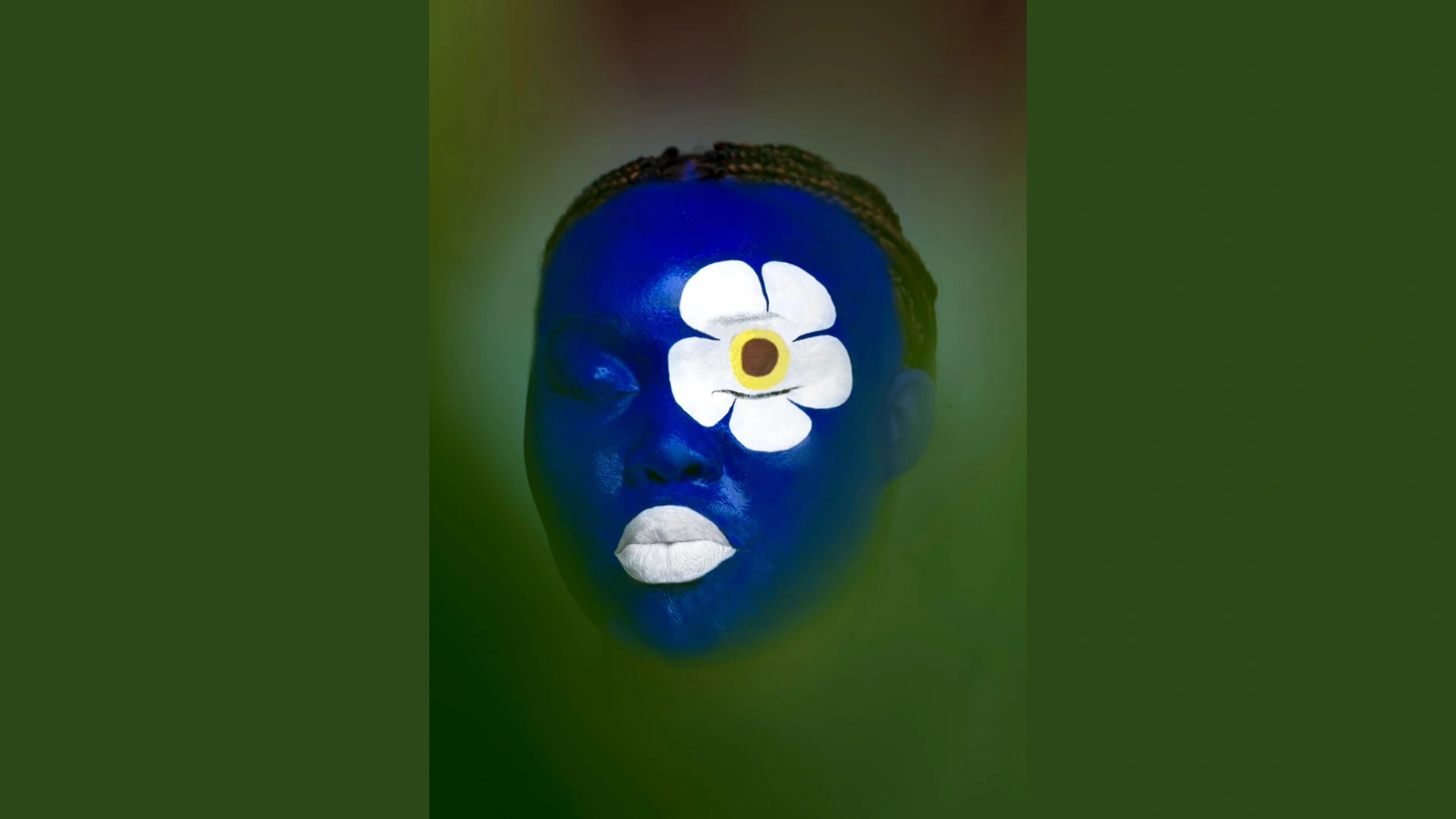
There is something quietly powerful about Blue Heritage. It doesn’t announce itself. It invites you in. At first glance, the image appears direct: a face completely washed in blue, a white rose resting over one eye, the lips painted white. The colours are bold, yet the composition feels controlled. The face holds still, inviting you to look longer.
Jumoke Muritala understands restraint. The blue sits evenly across the contours of the face, following cheekbones, brow, and jaw with careful precision. It does not flatten the features. Rather, it allows the structure beneath to remain present. The surface feels almost textile-like, recalling dyed cloth stretched over form. It is a subtle reference, but a powerful one.
Bradford’s history is deeply tied to textile production and dyeing. Long before synthetic pigments arrived, woad was used to colour wool that fueled the city’s industrial rise. Muritala draws from this past through colour rather than illustration. The blue becomes a carrier of memory. Skin becomes fabric. The human face becomes an archive.
The white rose, taken from Yorkshire’s civic crest, shifts the balance of the composition. Placed over one eye, it introduces tension. It interrupts symmetry. The lips, also painted white, deepen this disruption. Vision is partly covered. Speech is muted. What emerges is a face that feels both present and restrained.
What strengthens the work further is Muritala’s technical control. The human face is not a flat surface, and painting on it requires precision. Cheekbones, jawline, and eyelids all affect how colour sits and moves. Before she ever paints on skin, she studies facial architecture on canvas, testing placement and proportion with acrylics and watercolours. She works through balance and tension until each element feels resolved. By the time she reaches the living surface, nothing is accidental. The pigment holds consistently across every part of the face. The paint responds to movement without losing its integrity. This level of control speaks to preparation and experience.
Blue Heritage succeeds because it avoids excess. There is no need for heavy decoration or dramatic effects. Every element feels considered. The symbolism is clear without being forced. In using the human face as her canvas, Muritala brings the past into the present. The work becomes a meeting point for heritage, identity, and community memory. It does not tell the viewer what to think. It simply invites reflection.

Overall, Blue Heritage stands as a thoughtful and well-executed work that reflects Muritala’s growing confidence in using the human face as a space for cultural storytelling. Jumoke Muritala is a Nigerian-born, UK-based visual artist and art educator whose practice continues to explore heritage, identity, and community through face art and visual expression. With works like this, she steadily expands her artistic voice across the world, honouring local histories through carefully considered visual storytelling.

