 Follow Us on Google News


 Follow Us on Google Discover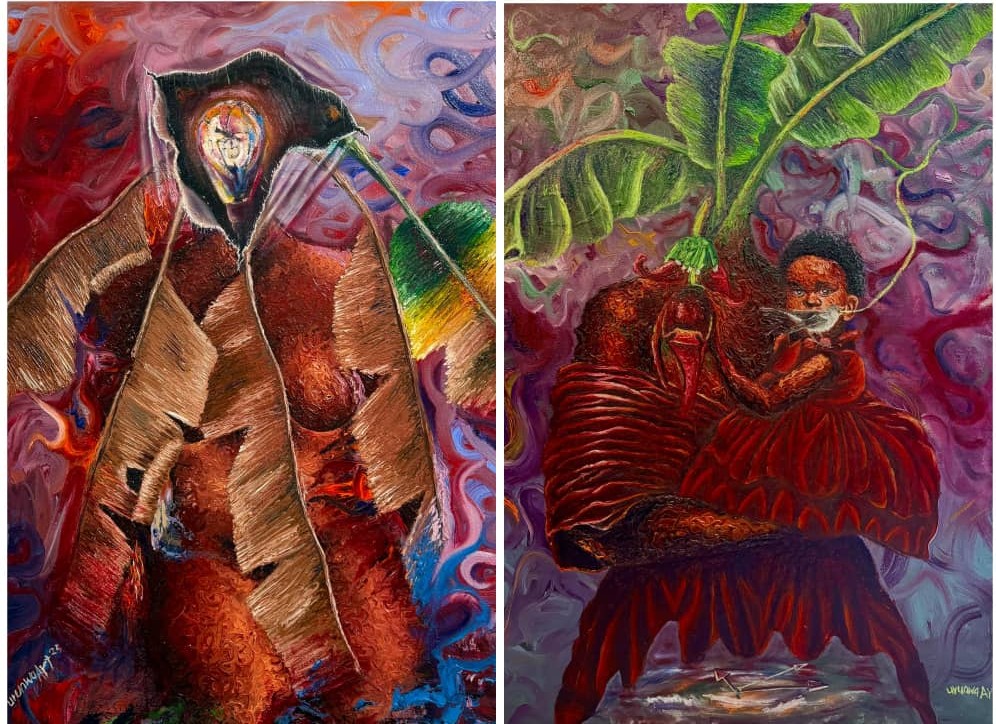
Chidimma Ikegwuonu’s work offers a compelling visual dialogue that navigates the relationships between memory and tradition, while echoing the contemporary. Her art has evolved over time from simple portraiture of women to surreal images of human and animal forms and of flora and fauna.
Her thematic perspectives include identity, memory, and the shifting phases of the existential realities of women.
Through blends of formal innovation and deep cultural symbolisms, Ikegwuonu enacts cohesive and emotionally resonant narrative, which positions her as a unique voice in contemporary African art.
At the centre of Ikegwuonu’s practice is her marked use of formal elements, particularly texture and colour. This is seen in her compound layering of colours, whereby she combines conventional media like oil colour and acrylic with found objects and materials such as wax-print fabrics and more.
Her approach is more than a stylistic choice; it also serves a crucial symbolic purpose. The use of these materials creates a physical and conceptual bridge, linking the identities of the materials to her history.
Her compositions are often done with imagery depicting the mythical and the natural. In the work titled Uncertainty, the artist paints a detailed, expressive portrait of a beautiful young woman. Blindfolded, mouth agape, with her right hand placed in a chest-beating gesture as if frozen in an eternal act of self-acclamation and proclamation. The subject’s hair is modelled after a fertile tree with multiple branches, with leaves and flowers in an apparent reference to the theme of fertility and growth. This piece resonates within the context of contemporary womanhood.
Another of her paintings, titled Life, from the body of work Ode to Becoming, is among many of Ikegwuonu’s thematic expressions of womanhood. A mother carries her teary-eyed child as both of them are dressed in scarlet robes.

The mother’s head is replaced by a plantain tree, which the artist uses to symbolise the life force and the resilience of mothers even in the most challenging situations, like grief and death.
Life was inspired by the death of Ikegwuonu’s aunt during childbirth. The Plantain was part of the burial rite in her culture. This time, she introduces the plant, which in turn births a series of themes around the giant tropical herbaceous fruit-bearing
Ikegwuonu’s art is rooted in the celebration of accomplished women. Some of her earlier artworks, like The Gaze (2015) and A Child’s Dream (2019), are direct portraits of some women of substance who helped to shape her.
These figures include Chimamanda Adichie, Michelle Obama, Ngozi Okonjo-Iweala and others. This has thus helped to contextualise her art within a broader socio-political framework. For her, these women are not merely studio models for portraiture but role models for the empowerment of the female gender.
In her work, Dream Count, a young girl is depicted clutching a copy of a book, Dream Count, by Adichie. The referencing of Adichie’s Dream Count embodies the intergenerational transfer of knowledge and inspiration that the artist desires to achieve through her work.
As the young girl stands before a vista of labyrinths beclouding her vision, her hairdo stretches out like a spangled star with two birds perched on their branches. The book she is holding symbolises the educational empowerment she needs to surmount topographies.
Ikegwuonu frequently employs a limited colour palette of deep earth tones, ochre, umber, and terracotta offset by bursts of cadmium red, cobalt blue or emerald green. The counterpoise between the somberness of the earth colours and the cheerfulness of the brighter colours helps the percipient maintain emotional balance. This deliberate choice of colour evokes a sense of mature virtuosity, while the brighter colours suggest the spritely moments of spiritual optimism.
As a dreamer herself, the image and symbolism of the young girl standing alone and contemplating her future echo with the artist. As the background of her work is usually fused with the subjects of her paintings, Ikegwuonu is also immersed in her culture. With an art education that spans two continents — Africa and Europe, from the nations of Nigeria and the United Kingdom, Ikegwuonu’s vision of the world is informed by themes from the intersections of these cultures.
Each painting tells a story or makes bold statements about tradition not being static, but a living and breathing force. The artist’s inclination to use rich symbolisms while integrating materials like mats and found objects, such as the cut-outs of modern fabrics, into her work, speaks to the ever-present counter influences of cultures.
Ikegwuonu’s foundational elements remain distinctly Nigerian, but she also admits the ever-present dialogue between local and global cultures, grounding her work in dynamic and contemporary flavours.
Although Ikegwuonu’s work has been well received in the course of her career for the visual conversations that resonate from her society, her draughtsmanship continues to evolve. She may want to consider taking on work with multiple figures to expand the power of group as she has done with the lone figures. However, her art is a testament to the power of a young woman’s artistic vision to honour the past and inspire hope for the future. Her work seeks to go beyond sheer representation to bear witness to memory and identity.
Through her innovative and personal approach to subject matters, Ikegwuonu has carved a space for herself in the contemporary African art landscape. Her work will continue to challenge viewers to not only see but to critically engage with the rich cultural narratives and personal histories that shape the present.

