- Vahid Mirzaei turns global awards into a platform for difficult stories
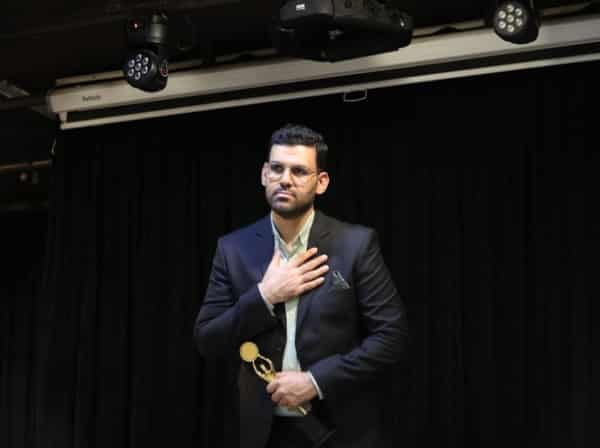
“I don’t see awards as achievements,” Vahid Mirzaei says, “but as opportunities.” He speaks from his studio in Tehran. The room feels work-worn. No plaques hang on the walls. Instead, there are unfinished prints taped in uneven rows, a few old posters curled at the edges, and sketchbooks open to pages that may never be finalised. This is where most of his work starts, and often where it stays, long before anyone abroad might see it.
Over the past few years, several of his pieces have been recognised by international design juries, including institutions in Europe and Asia. The awards are real, but they are not on display. He mentions them carefully, more as context than achievement. What matters, he says, is that they sometimes help the work move further and land in places it otherwise couldn’t. He accepts them, but not for prestige. What they offer him, he says, is volume. A louder voice. A wider audience. For him, design is not a career milestone. It is a platform to tell stories that matter, and recognition is only meaningful if it helps those stories move further.
In a global industry where awards often signal professional arrival, this approach is unusual. But it reflects a deeper conviction about what visual design can do. The poster, for Mirzaei, is not a decorative object or a promotional tool. It is a vessel for memory. A place where public silence becomes visible.
When a poster he created on endangered species received international recognition, he didn’t talk about technique or visual choices. Instead, he spoke about timing. “This kind of work matters more when it comes from here,” he said. From a place where headlines are usually about war or protest, a simple image of an animal disappearing into negative space carries different weight. It suggests that even under pressure, political, economic, and personal, there is still room to care about what’s disappearing. Not just here, but everywhere.
His visual language is shaped by this contradiction. It comes from within a context marked by censorship and scarcity, yet insists on global relevance. His compositions are clean, but heavy with implication. A silhouette might carry both ecological loss and cultural erasure. A broken grid might echo urban trauma or fractured identity. These are not gestures for gallery walls. They are attempts to document the emotional architecture of crisis.
When one of his posters addressing violence against women received recognition abroad, the response was similarly deliberate. He used the moment to reframe the conversation. The image was not simply about gender-based violence. It was about geography, access, and accountability. From inside Iran, the piece travelled. The award became a channel. The message crossed borders.
“The point of the recognition,” he tells me, “is not that I did something well. It is that now someone else might hear what I’m trying to say.” For him, awards are not markers of success. They are tools. A microphone passed briefly into his hands.
In one of his more stark designs, which addresses the theme of war, there are no bombs or weapons. Just space. An absence that can be read a dozen ways. He says this one mattered most because it came, in his words, “from inside the disaster.” That framing is key. His work does not speak about conflict from a safe distance. It speaks from it. And that gives it an unsettling clarity.
Designers in Iran work within narrow margins. Materials are expensive and hard to access. Internet tools are often restricted or outdated. Even exhibiting a poster can involve risk, depending on the theme. But rather than push him toward safer or more abstract directions, these limitations have shaped his process. If resources are limited, the idea must carry more weight. If language must be careful, the image must speak clearly on its own.
He does not consider himself an activist. He avoids the term. What he prefers is witnessing. The work does not aim to provoke, but to preserve. It invites viewers to remember things they would rather forget. The goal is not to trigger outrage, but reflection.
Still, urgency is never far from the surface. Many of his projects begin in research and end in silence. There is no launch campaign. No social media countdown. Some works sit for months before they are shared, and even then, only in spaces where the tone feels right. “Some images,” he says, “need time to breathe before they speak.”
Throughout the interview, his voice remains calm. There is no bitterness in how he talks about limitations, only clarity. He is not trying to escape his country. He is working from within it, using what little mobility design offers to carry stories further than a single place or time.
And in doing so, he offers a different model of what a designer might be. He does not treat design as something to explain or decorate. For him, it is closer to a way of thinking. A way of asking, quietly, what we are choosing not to see.
That is also what gives the work a particular resonance beyond Iran. The posters do not separate visual clarity from moral weight. They are not urgent, but they hold your attention. And once they have it, they ask for more. Not just to be seen, but to be carried.
Toward the end of the conversation, he pauses for a moment, then says something that stays with you. “If you’re honest with the image, it will speak for itself.”