
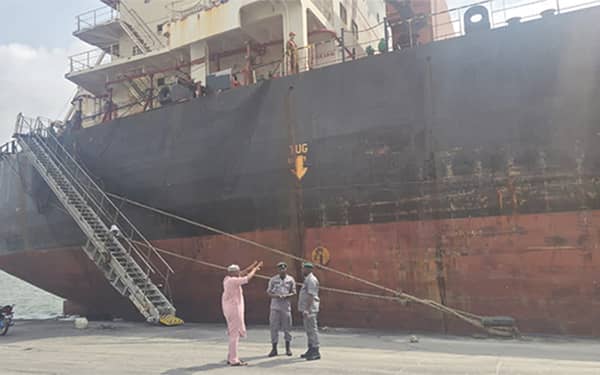
• Stakeholders seek legal reform as traffickers, shipowners, cargo evade justice
Increasing trend of baseless prosecution of seafarers for drug-related offences as real culprits escape accountability is seriously threatening the future of seafaring, worsening the global shortage of skilled labour and undermining the entire maritime trade, stakeholders have warned.
According to stakeholders, seafarers are essential to the global economy as they operate over 100,000 merchant vessels that transport 90 per cent of the world’s trade by sea.
The warning follows an order by the Federal High Court for the continued detention of 22 recently-arrested crew members and the Brazilian vessel, MV Aruna Hulya, after the seizure of 31.5 kilogrammes of cocaine and the public disclosure of the crew members’ identities.
Speaking on the issue, Secretary General, Merchant Seafarers Association of Nigeria and USA, Prof. Alfred Oniye, said seafarers are increasingly detained whenever narcotics are found on board commercial vessels, often without any evidence linking them to the crime.
He said the detentions are frequently on the basis of assumption rather than concrete evidence in clear violation of the fundamental legal principle of “innocent until proven guilty.”
According to him, in many cases, crew members do not know the presence of narcotics, which are usually smuggled onto vessels by organised criminal networks employing sophisticated concealment methods.
Oniye, who is also the Dean of Faculty at City University, Cambodia, said the consequences for seafarers are devastating, noting that affected crew members can spend months or even years in foreign detention facilities, cut off from their families, legal representation and sources of income.
He added that the emotional and psychological trauma of such detentions is immense, stressing that even after eventual release, many seafarers face social stigma and struggle to secure new employment within the industry.
Beyond the human cost, Oniye warned that the trend is inflicting wider damage on the maritime sector.
He explained that the fear of wrongful arrest and prolonged detention is discouraging young people from choosing seafaring as a career, thereby worsening the global shortage of skilled maritime labour.
Oniye further noted that shipping companies also suffer significant losses, including operational delays, reputational damage and increased insurance costs, whenever vessels are seized and crews detained.
He called for urgent reforms to address the situation, urging authorities to strengthen port security, establish clearer legal protocols, and implement stronger protections for seafarers.
Managing Director and Founder of Izonibe Oil and Gas Marine Limited, Capt. Douglas Zakana, called on the Federal Government and relevant security agencies to shift focus from seafarers to ship owners and cargo owners in cases involving drug trafficking aboard vessels.
Zakana stressed that the larger responsibility rests with the authorities, urging the government to investigate the cases beyond the ship’s crew and identify those who finance and own the vessels involved.
He noted that vessels are properly registered, carry International Maritime Organisation (IMO) numbers, and are traceable to registered owners and companies.
Zakana, however, acknowledged that seafarers have responsibilities under the International Ship and Port Facility Security (ISPS) Code, which empowers crew members to monitor and check cargoes loaded on board vessels.
According to him, strict adherence to security procedures, including vigilance over unaccompanied bags and suspicious cargoes, could help in detecting concealed illicit substances before vessels sail.
“If seafarers are very dogged in their duties, they can detect suspicious cargoes and alert the authorities before departure. Early reporting could prevent wrongful arrests and prosecutions of innocent crew members,” he stated.
He further advised seafarers to be more cautious in choosing employers, urging them to conduct background checks on shipping companies and vessel owners before accepting employment.
“Seafarers should find out the antecedents of the company they want to work for. That way, they can protect themselves from being dragged into crimes they did not commit,” he said.
President of Maritime Security Providers Association of Nigeria (MASPAN) and the Alumni of Maritime Academy of Nigeria (AMANO), Emmanuel Maiguwa, elaborated on the financial implications of maritime crime, citing the high costs associated with legal battles and operational disruptions for vessels involved in drug incidents.
He said the legal and operational expenses can amount to $6 million, a significant financial burden for small operators, especially when compared to the vessel’s market value, with a second value costing $15 million.



