 Follow Us on Google News


 Follow Us on Google Discover
There was a time when learning felt more straightforward.
A child went to school, listened to the teacher, finished homework, and prepared for exams. If marks were decent, most adults assumed everything was working.
That is no longer enough.
Children today are growing up in a very different world. Their attention is pulled in ten directions at once. They are surrounded by fast content, short-form videos, instant answers, and tools that can explain almost anything in seconds.
But strangely, all this access has not made learning easier for every child. In many homes, it has made one problem clearer: information is everywhere, but deep understanding is not.
That is why digital learning platforms are becoming more important. And that is also why platforms like Debsie are starting to reflect a deeper shift in what modern children actually need from education.

The new problem is not lack of content
For years, the education gap was often about access.
Some children did not have the right teacher nearby. Others did not have extra help outside school. In many cases, strong academic support depended on location, budget, or luck.
Now the situation is different.
A child can watch a science lesson online, ask an AI tool for help with mathematics, and find endless explanations for almost any topic. Yet many still feel stuck. They may watch, read, and revise for hours, but when the question changes slightly, confidence disappears.
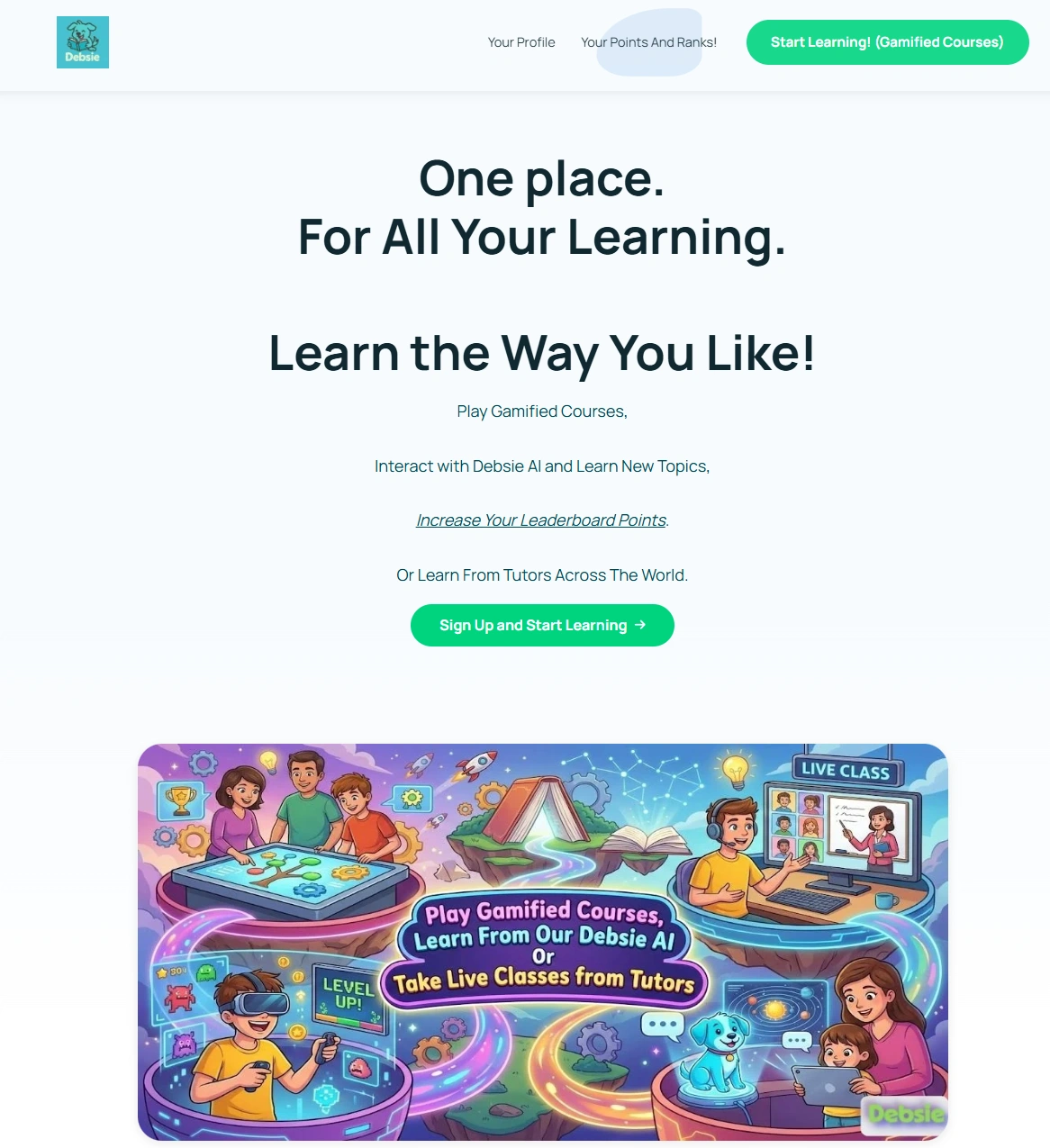
That is where a platform like Debsie starts to matter. Debsie is not built simply around giving children more things to watch.
Its strength is that it brings together several kinds of support in one place: structured courses, one-on-one tutors through teacher partners, an AI learning assistant, and a leaderboard system that keeps motivation alive.
That combination matters because modern children do not only need content. They need a system that helps them keep going.
Children need learning that responds to them
One of the biggest weaknesses of old-style learning support is that it often assumes every child learns the same way.
They do not.
One child needs a concept explained in a slower and simpler way. Another understands quickly but loses focus. Another is capable but becomes nervous the moment they feel confused. Another knows the answer only when someone guides them step by step.
Debsie’s model reflects this reality quite well. A child may begin with one of Debsie’s online courses, which gives structure and direction. That alone solves one common modern problem: scattered learning. Many children today consume bits of information from many places and never build proper foundations. Courses help reduce that chaos.
But structure alone is not enough. A child also needs to ask questions the moment confusion appears.
That is where Debsie AI becomes useful.
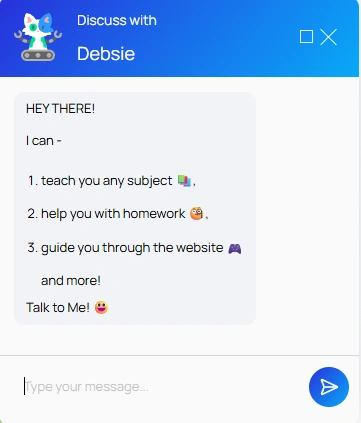
Instead of waiting until the next class or staying stuck for days, the learner can ask for a concept to be broken down, explained again, or simplified.
That sounds small, but it changes the emotional experience of learning. When a child feels that help is available immediately, they are less likely to shut down.
Motivation now matters as much as explanation
A lot of modern learning struggles, including in STEM subjects, are not caused by low intelligence. They are caused by low momentum.
A child begins well enough, then gets one chapter wrong, loses confidence, falls behind, and slowly starts associating the subject with stress. Once that happens, even a good teacher has to fight not just confusion, but resistance.
This is why motivation systems are becoming more important in digital learning.
Debsie understands this through something many traditional learning setups still ignore: children often need to feel progress in order to stay interested. Its leaderboard and progress elements tap into that need in a smart way. When learners can see that they are moving forward, earning points, or advancing through effort, learning stops feeling like endless struggle and starts feeling more like momentum.
That does not mean learning becomes a game in a shallow sense. It means the platform recognises a basic truth about modern children: engagement is not a luxury. It is part of the learning process itself.
The rise of AI in education should be understood properly
Whenever AI enters the education conversation, people become cautious — and rightly so.
No serious parent wants children to become dependent on shortcuts. No thoughtful educator wants machines replacing human teaching. But that is not the most useful way to understand what AI can do in learning.
When used well, AI is not there to replace the teacher. It is there to reduce friction – much like broader discussions around AI companionship in care settings and how AI is being used in senior living, where the technology works best as a layer of support rather than a substitute for human presence.
Debsie AI is useful in this sense because it gives learners a place to ask freely. A child can ask, “Why does this work?” or “Can you explain that in a simpler way?” or “Can you help me with this homework question?” without fear of embarrassment. For many children, that freedom matters more than adults realise.
In a physical classroom, a child may stay quiet. In a tutoring session, they may feel pressure to “keep up.” But with an AI layer inside a platform like Debsie, they can keep probing until the idea begins to click.
That does not eliminate the need for human teachers. In fact, it makes the human role clearer.
Human tutors still matter — perhaps even more now
The more digital learning grows, the more obvious it becomes that children still need human guidance.
Not for everything. But for the moments that really matter.
A good human tutor notices hesitation. They can tell when a child is pretending to understand. They can spot repeated mistakes, rebuild weak foundations, and adjust the pace in real time. That kind of attention can transform a learner’s confidence.
This is why Debsie’s tutors through teacher partners are such an important part of the larger picture. A child may use Debsie’s courses for structure, rely on Debsie AI for quick clarification, and then work with a tutor when deeper correction or personalised teaching is needed. Debsie takes a lot of effort in partnering with only the best teachers across the world. Let’s take an example of chess. Debsie’s chess coach partners are all FIDE certified and teach students all across the world from Austin, Dublin to Doha, Qatar!
That is a stronger model than relying on only one format.
Modern children often do best when support comes in layers. They need the stability of a course, the immediacy of AI, and the accountability of a human tutor. Debsie brings these layers together in a way that mirrors how learning actually happens in real life.
Why digital learning is no longer a backup option
There is still a habit among many parents of thinking of online learning as the second-best option.
That assumption is fading for good reason.
A well-designed digital platform can remove several of the barriers that make learning harder. The child does not need to travel. The family does not need to build the day around commuting. The learner can revisit material, ask for help on demand, and continue progressing even outside formal class time.
Debsie fits into this shift because it is not trying to imitate a classroom badly. It is trying to use the strengths of digital learning properly.
Its courses create direction. Its tutors create personalised support. Debsie AI creates continuity between sessions. Its leaderboard creates the visible sense of progress that many children need in order to stay engaged.
That is not a small improvement. It is a different learning environment altogether.
What parents are really looking for now
Parents today are becoming less impressed by big claims and more interested in practical outcomes.
They want to know whether their child is asking better questions. Whether they are becoming less afraid of difficult subjects. Whether they are learning with more independence. Whether support feels consistent instead of scattered.
That is one reason platforms like Debsie fit the moment. It is not only that Debsie offers courses, tutors, an AI layer, and a leaderboard. It is that these pieces answer real problems parents see every day.
A child needs a course because random learning creates weak understanding.
A child needs Debsie AI because confusion should be addressed when it appears, not after it becomes frustration.
A child needs tutors because some problems require a real human to step in and guide properly.
A child benefits from the leaderboard because motivation is easier to sustain when progress feels visible.
Seen this way, Debsie is not just another edtech platform. It represents a broader educational idea: that modern children need learning systems that are more responsive, more flexible, and more complete.
The needs of modern children are changing, and education has to change with them.
Children now live in a world shaped by AI, digital tools, short attention spans, and constant distraction. But they still need the same core things they always needed: clarity, confidence, guidance, and a reason to keep trying.
That is why platforms like Debsie matter. Not because they are digital for the sake of being digital, but because they bring together the different forms of support modern learning now demands.
Courses for structure. Debsie AI for instant help. Tutors for human guidance. Leaderboards for engagement, community and momentum.
The future of learning will not belong to platforms that simply provide more information.
It will belong to those that help children learn in a way they can actually sustain.

