 Follow Us on Google News
 Follow Us on Google Discover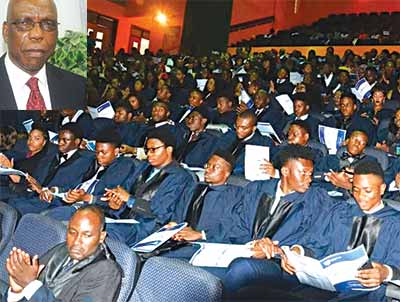
The World Bank in a 1992 report entitled, “Governance and Development,” defined good governance as “the manner in which power is exercised in the management of a country’s economic and social resources for development.”
This presupposes that sustainable development can only take place if a predictable and transparent framework of rules and institutions exist, for the conduct of private and public businesses.
The report added that the essence of good governance was “predictable, open and enlightened policy, together with a bureaucracy imbued with a professional ethos and an executive arm of government accountable for its actions.”
With the country bleeding on several fronts as evidenced by the present state of affairs, hallmarked by gross mismanagement of public resources, the crave for good governance at all tiers of government could not have reached a crescendo other than now.
Perhaps, it is in the light of the aforesaid that calls for the introduction of good governance into tertiary education curricula in the country is gaining currency.
While the protagonists are of the view that teaching good governance to undergraduates would help imbue them with most of the good attributes that future leaders should be filled with, the antagonists think otherwise as they opine that those who embezzle public funds do not engage in that owing to ignorance, but rather do so conscientiously and deliberately.
For those in support, they seem to have an ally in the person of President Muhammadu Buhari, who at the combined 27th and 28th convocation ceremony of the University of Jos, called on tertiary institutions in the country to introduce courses that would teach undergraduates morals and leadership traits.
Buhari, who was represented at the convocation by the Executive Secretary of the National Universities Commission (NUC), Prof. Julius Okojie said, “Government is determined to fight corruption at all levels including corruption in academics in our tertiary institutions. Vice chancellors must endeavour to introduce courses that would teach morals and leadership qualities to students.
“We must all endeavour as citizens and members of the academic community to enthrone the spirit of hard work, honesty and inspirational leadership which are the hallmark of any citadel of learning.”
Editor-in-chief, Lead Times Africa Magazine, Dr. Samuel Ogar, is also of the view that teaching good governance in schools would help prepare Nigerian youths for the all-important task of responsible leadership/governance and equip them on how to transparently manage public resources.
“I will suggest the restructuring of the university system by way of introducing good governance into the curriculum as a course to be taken by the undergraduates so that virtues like honesty, transparency and accountability will be taught to the students at that early stage.
“The most common trend among Nigerian graduates and undergraduates, is how to make quick money and when this is not forthcoming, they resort to do anything possible to make that money. This of course would come through corrupt means,” Ogar stated.
He continued, “So, I feel the NUC should look at it very well and see that this course is introduced as part of measures aimed at reshaping the minds of our youths and as a form of reorientation.”
He urged the NUC and all concerned to act fast regarding the introduction of this course because the get-rich-quick syndrome, which has penetrated the very fabric of the nation has left the country suffused with public officials, who have helped in bringing the country to its knees.
For Executive Director, Alfred Komolafe Educational Foundation (AKEF), Mr. Alfred Komolafe, good governance should not only be introduced as a course, but should also be made compulsory for first and final year students.
He said, “I do not think corruption can be eliminated in any society because no matter what is done as some people would still indulge in the act. However, it could be reduced to where it would be hard to notice. Even in the United States, corruption exists but can hardly be felt. Sadly enough, corruption is written boldly on the faces of millions of Nigerians, most especially Nigerian youths.
“The mindset of most Nigerian youths has been re-structured to automatically adapt to corruption and they see it as a normal thing. So I strongly believe that this course will help in re-aligning the mindset of many students and prepare them for corruption-free-mind during their stay on campus and before they enter the job world.”
Noting that Nigerian youths have what it takes to live above corruption, Komolafe stressed the need for their minds to be redirected to good virtues thus: “Like the treatment of cancer, the journey to winning the fight against corruption starts internally. There’s a need to change the mindset of the youths. The mindset of Nigerian youths has been conditioned to involuntarily get accustomed to corruption. When faced with corrupt challenges, many young people lack the inner strength to refuse and their immune system is so weak to reject it.
“In light of this, there is an urgent need to start the process of stimulating and restoring the ability of the body’s immune system of Nigerian youths so it will start to willingly reject corruption. The mindset of Nigerian youths needs to be restructured to automatically adapt to patriotism and place nationhood above self. So I believe the good governance concept will work a great deal.”
National Coordinator, Education Rights Campaign (ERC), Hassan Taiwo Soweto, begs to differ and insisted that the introduction of good governance or any such course does not have the capacity to stem corrupt practices among youths.
He said, “I think its fanciful idea that will not work. So those who are looting our collective patrimony are only doing this because they are ignorant or illiterate? Corruption and mis-governance are inevitable consequences of the inequitable capitalist economic system.
“No matter how much you prettify and dress up a he-goat, the head would smell. No matter how much you reform capitalism; it cannot but make a few rich richer at the expense of the mass majority. Large-scale looting of public treasury is just one of the means of primitive accumulation of wealth in the neo-colonial capitalist world, and the capitalist politicians who engage in it do it, not ignorantly, but consciously.”
He said what Nigeria needs to ultimately defeat corruption and inoculate the younger generation against its pervasive influence is to put an end to the capitalist economic system, which promotes corruption.
“Even without large-scale looting by politicians and other corrupt practices, capitalism will still not be able to ensure that the vast majority of people have better lives. This is because it is a system that is inherently unequal and prioritises profit over human needs. Just look at the unequal and unjust wage system in Nigeria. A worker who works daily all year round cannot in a year make up to 20 per cent of what big politicians and chief executive officers earn in a month.
“I recognise that due to the pervasive corruption in society, there is the feeling that perhaps if the new generation of young people can be inoculated from this influence by educating them on the ideals of good governance, slowly society could rid itself of it. Good! But it is not a proposition that can work. Such teachings will have no effect and in the end our education system will still continue to produce future treasury looters,” he stated.
“A socialist society which places resources under democratic control; redistribute wealth, creates jobs and ensures that those who work earn enough to maintain a decent existence, will prove far more educative for the young generation to learn that conscientious labour actually pays than trying to educate young people on the ideals of good governance whilst they are surrounded by a wide ocean of capitalist corruption,” he added.

