 Follow Us on Google News


 Follow Us on Google Discover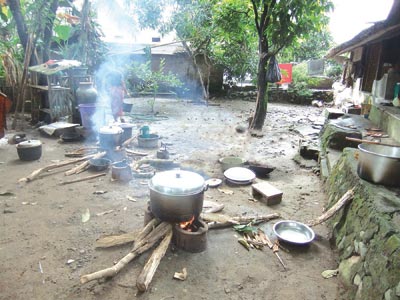

It’s been four years since Felicia Okpara, last cooked with her kerosene stove. The price of kerosene is so high that she sought and found an alternative in firewood as she considered cooking gas a commodity out of her reach.
Just like Felicia Okpara, many other women in Nkpehi, Emii in Owerri North Local Government area of Imo State, prefer to cook with fire wood, not because they don’t have cooking stoves, but because kerosene is far out of their reach.
A housewife, Mrs. Thelma Obi, told The Guardian that she has decided to do away with her stove when kerosene became very expensive, even when available at all. “I decided to turn to using firewood, when it was becoming too expensive to cook with kerosene”.
Investigation by The Guardian showed that though the filling stations in Nigeria advertise kerosene for N50 a liter, it actually sells for about three times that amount.
A consumer, Adesuwa Isoken, told The Guardian, while waiting on the queue at filling station that she had spent over three hours queuing for the product at NNPC mega station and doubts if she will be able to get it before the end of the day. “I have been here since morning with the hope of getting kerosene at N50 per litre. It is only at the NNPC filling stations that the product can be bought at N50. All other filling stations are selling at N150 per litre.” She bemoaned
NNPC mega stations sometimes sell at price N50 per liter, but they seldom have kerosene to dispense and when they do, people queue up for days just to buy a few liters of kerosene. Most of the time, they go home disappointed, since strong and interested parties would have bought the available kerosene, with extra tips, to sell at the market price of N150.

Nigeria has over 30 million households; 90 per cent of these cook at least once everyday with fuels like kerosene.
The Bureau of Statistics says an average household spends about N500 on food daily, but spends half that amount on kerosene.
Although there are huge health, environmental and economic benefits of switching from kerosene to gas for cooking, but gas is perceived as a rich man’s product.
When told that the Federal Government is actually subsidising the product and it is actually supposed to be sold at N50 per litre, she laughed and said: “I am hearing this for the first time”.
According to the Petroleum Products pricing and Regulatory Agency (PPPRA), pricing template for House hold Kerosene, as at July 2, the Federal Government is paying N77.53 as subsidy. The landing cost of the product is N112.04; regulated price, N50 per litre; depot price, N34.51 while expected open market price is N127.53.
Because of government subsidy on kerosene, the product is expected to cost N50 a liter, but middlemen are reselling it so many times among themselves that it reaches the end-users at highly inflated cost.
When The Guardian visited some of the retail outlets in Lagos, it noted that filling stations like Nipco, Sabola, Total, Forte Oil, Safetrip, Rain oil, Petroleum Manager advertised the product at N50 but sells at between N130 to N150. Some of them said they have not been supplied the product for over six months.
The Federal Government approved N43. 91Billion as kerosene subsidy in the 2015 budget. A subsidy, the consumer may not get to enjoy.
Before now, the Federal Government had been spending huge amount of money to subsidise kerosene.
For instance, about N634 billion was paid by the Federal Government in the 2010 to 2012 on kerosene subsidy, which is about a third of the country’s capital budget.
Giving the break down, the former Chairman, House Committee on Petroleum (Downstream), Dakuku Peterside, revealed that in 2010, Nigeria spent over N110.068 billion to subsidise kerosene.
“There were also some investigations that showed that the downstream sector is entrenched in deep corruption in Nigeria in 2011. That year, we spent about N324.1billion on kerosene subsidy. In 2012, although we are yet to reconcile this, we spent N200 billion subsidising kerosene.
“And so, in three years, we’ve spent N634 billion subsidising kerosene. But we do not spend up to N4.5billion on capital budget in a year,” Peterside said.
The Guardian learnt that kerosene is not being sold at the official price of N50 per litre because of diversion of the product by some marketers to other uses.
The other reasons for the high price of kerosene, include sharp practices by middlemen, usage for road construction and aviation fuel, among others.
The Guardian checks revealed that the conversion of kerosene to aviation fuel was possible because the kerosene currently in circulation is a dual-purpose kerosene.
Investigations revealed that DPK could be used both as household kerosene, and as aviation turbine kerosene, otherwise called aviation fuel or Jet A-1.
The only difference between the two is that whereas the HHK is almost colourless, some additives are added to the DPK to enable it meet ATK specifications.
With these additives, ATK is said to have a higher flash point than HHK, which is the main determining standard for the type of use the kerosene would be applied.
“As a marketer I’m faced with the option of selling my dual purpose kerosene as household kerosene or as jet fuel. Most settle for jet fuel and inadvertently create the scarcity that leads to household kerosene being sold at about the same price,” a marketer said.
The Executive Secretary, Major Oil Marketers Association of Nigeria (MOMAN), Femi Olawore, told The Guardian, that the NNPC had been the sole importer of kerosene.
According to him, major oil marketers did not import the product, and did not collect subsidy payment for DPK.
PPPRA had in a statement, identified long chain of handling, smuggling because of the huge arbitrage in price, use of kerosene in diesel blending and fuelling aircraft as well as blending cut-backs to produce emulsion used in road construction, among other factors.
According to the agency, due to the complexity of the kerosene value chain, it has one of the longest handling challenges and at any point it changes hand, it is at a premium, hence the very high cost at the retail end.
It explained that there were two grades of kerosene, which are Aviation Turbine Kerosene (ATK) and House Hold Kerosene (HHK).” ATK is used in fuelling aircraft while HHK is used in domestic cooking and lighting homes.
The agency stated that it was the global trend for refineries to produce mainly ATK for the aviation market. “However, Nigeria, Venezuela, India and Libya are among the few countries, whose refineries are still producing HHK.”
It noted that due to the inability of Nigeria’s refineries to produce enough kerosene to meet the increasing demand, it became necessary to import the ATK grades Kerosene commonly referred to as Dual Purpose Kerosene (DPK).
“This grade meets also the HHK which actually is a lower grade of kerosene.”
It described DPK as superior diesel as it blends perfectly well with diesel, noting that just blending one litre of Kerosene gives the marketer N100/litre extra profit.
“Consequently the temptation to blend DPK with AGO is very high.”
It identified this as the beginning of the kerosene challenge, saying that imported kerosene went into many uses — part of it finding its way into the aviation market while a substantial quantity finds its way into the blending of cut-backs to produce emulsion used in road construction.
“A sizable quantity makes its way through the boarders into neighbouring countries because of the huge arbitrage opportunity, while the remaining goes into diesel blending.
“Consequently, what is left entering the real domestic market is very much restricted,” he added.
The executive secretary explained that a typical Kerosene transaction starts from the discharge into marketer’s tanker on the shore.
“The marketer in turn sells the product in trucks; the big truck transfers into peddling trucks that are of 10, 000 litres capacities.
“These peddling trucks move the product to road side tanks and from the road side tanks, the product is sold to jerry can retailers and ultimately to bottle retailers.
NNPC attributed the high cost of kerosene to diversion of the product to neighbouring countries, industrial use, aviation fuel, sharp practices by middlemen and pipeline vandalism.
It maintained that due to a number of issues ranging from incessant pipeline vandalism and diversion of the product to road construction, the product, which is meant for the average household is not readily available.
“There are quite a number of competing demands for kerosene and until these are addressed by other relevant agencies, the issue of kerosene not being readily available for domestic use will continue to reoccur every now and then. The way out is for this committee to collaborate with the NNPC to encourage the sale of liquefied petroleum gas otherwise known as cooking gas,”it said.
The Managing Director of the Pipelines and Products Marketing Company, PPMC, a subsidiary of the NNPC, Prince Haruna Momoh, said that kerosene is sourced for the Nigerian market through importation and domestic refining adding that Dual Purpose Kerosene is sold to coastal marketers, Major Marketers Association of Nigeria, MOMAN, Depot and Petroleum Products Marketers Association, DAPPMA and NNPC Retail.
“I can confirm to this committee the statistics for the supply of DPK is as follows. In 2010, NNPC supplied 2,515,582.44 metric tonnes of DPK, in 2011, NNPC 1,922,263.56 metric tonnes, in 2012, NNPC supplied 2,622,843.20 metric tonnes and in 2013, NNPC supplied 2,671,747.97 metric tonnes making a total of 9,732,437.17 metric tonnes,” Momoh revealed.
President, Nigerian Association for Energy Economics and Director, Centre for Petroleum, Energy Economics and Law, University of Ibadan, Adeola Adenikinju, said that “the subsidy has provided a conduit pipe for some highly placed and connected people to swindle the country.”
Adenikinju noted that the poor who ordinarily should benefit from the subsidy struggle to get the product even at much higher price. “In the rural areas where most of the poor live, kerosene prices are far beyond their ability, and have had to continue to depend on the forest for the energy supply.”
According to Adenikinju, the overall implications of removing the kerosene subsidy on the poor will be minimal since they currently do not benefit from the subsidy. “It is those that fraudulently benefit from the existing practices that will lose out. However, that is not to suggest that we should not find a better approach that will assist the poor directly to enable them access modern energy sources for their energy services like cooking, lighting and heating, for which they currently depend heavily on biomass that have negative impact on the environment, their health and economic productivity.”
Lagos Chamber of Commerce and Industry, LCCI, believed that it is necessary for Federal Government to scrap subsidy on kerosene regime while the NNPC should be directed to disengage from the business of importation, distribution and retailing of Kerosene.
LCCI President, Remi Bello, said the Chamber has watched with keen interest recent developments following investigations into alleged unremitted funds into the Federation Account, and demanded that the present administration direct the immediate scrapping of the Kerosene subsidy regime to save the economy from further fiscal leakages and inherent mismanagement.
“From all indications, the continuation of the Kerosene subsidy regime has profound consequences both for the health of the Nigerian economy and the integrity of fiscal operations of government. In the light of this, the LCCI submits as follows:
“The NNPC should be directed to disengage from the business of importation, distribution and retailing of Kerosene. The private sector is well placed to take on this responsibility.
“The current model of Automotive Gas Oil, AGO, importation and distribution should be adopted for kerosene while the statutory regulatory agencies in the oil and gas sector should exercise the desired oversight functions to ensure quality assurance of products imported or produced locally,” said LCCI.
According to the Chamber, the National Assembly should expedite action on the passage of the Petroleum Industry Bill to provide the legal platform for the much needed reform in the oil and gas sector of the economy.
“We urge president to act without further delay on the recommendations of various committees and audits reports

