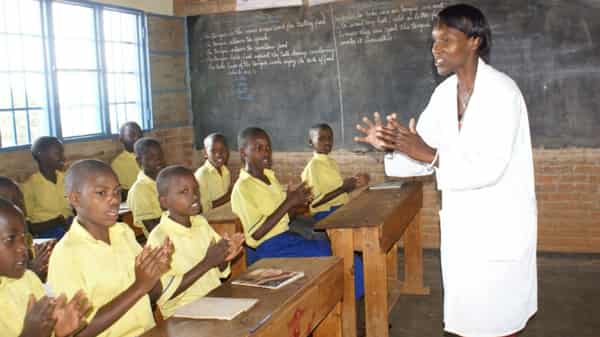

Africa is experiencing a shortage of teachers in many schools due to poor funding of education in the region over the years.
Despite some gains in teachers’ recruitment in the last five years, the agency, at a workshop for educators in the region, lamented that progress has been slow, and tasked governments in sub-Saharan Africa to increase the number of teachers being recruited yearly.
A senior education analyst at UNESCO, Patrick Nkengne, said only a few teachers are attending to millions of students in Africa.
“When a classroom welcomes more than 100 instead of the about 50 pupils it was built for, or as opposed to a ratio of 40 to 50 students per teacher recommended by the norms and standards, it shows a shortage. As the number of classes in this condition increases, the issue of shortage becomes acute,” Nkengne said.
In secondary education, a higher number of teachers is required in many African countries.
Emmanuel Manyasa, an education expert, said many schools are producing uneducated children due to lack of teachers.
“So, you have both dissatisfied teachers and learners. The learners are not getting the attention and support they need, while teachers are overwhelmed by the number of students and long hours of teaching, which don’t even give them time to prepare for lessons. So, they come to class unprepared, disenfranchising learners even more. And eventually, our schools just become growth centres, where children go to grow with very little learning happening there.”
In countries with enough teachers, Nkengne said schools struggle to provide quality education to learners due to poor qualifications.
“In a normal situation, a teacher must be adequately equipped to care for the students so that they can effectively acquire knowledge. Unfortunately, it was demonstrated that in many cases, a considerable number of those who are supposed to play the role of teachers do not even have the mastery of the subjects they are supposed to teach.
“In those cases, students cannot learn because basically, they don’t have a teacher. Those cases are not easy to identify. To do so, the system needs to make teachers pass a test.”
Manyasa said teachers should be encouraged to bridge the gap for those not getting education.
He said: “We need to ensure that there is a fair distribution of teachers across the country. And with that goes the issue of, how do we incentivise teachers to work in areas that are generally not preferred?
“Mostly, they are not preferred because of harsh climatic conditions. perennial insecurity problems or because of the fact that they are rural. How do we incentivise teachers to work in those areas? I think this is critical.”
The agency subsequently urged African governments to assess teachers’ requirements for the next three to 10 years, reflect on the training approach and ensure adequate resources for the recruitment and training of additional educators.