 Follow Us on Google News


 Follow Us on Google Discover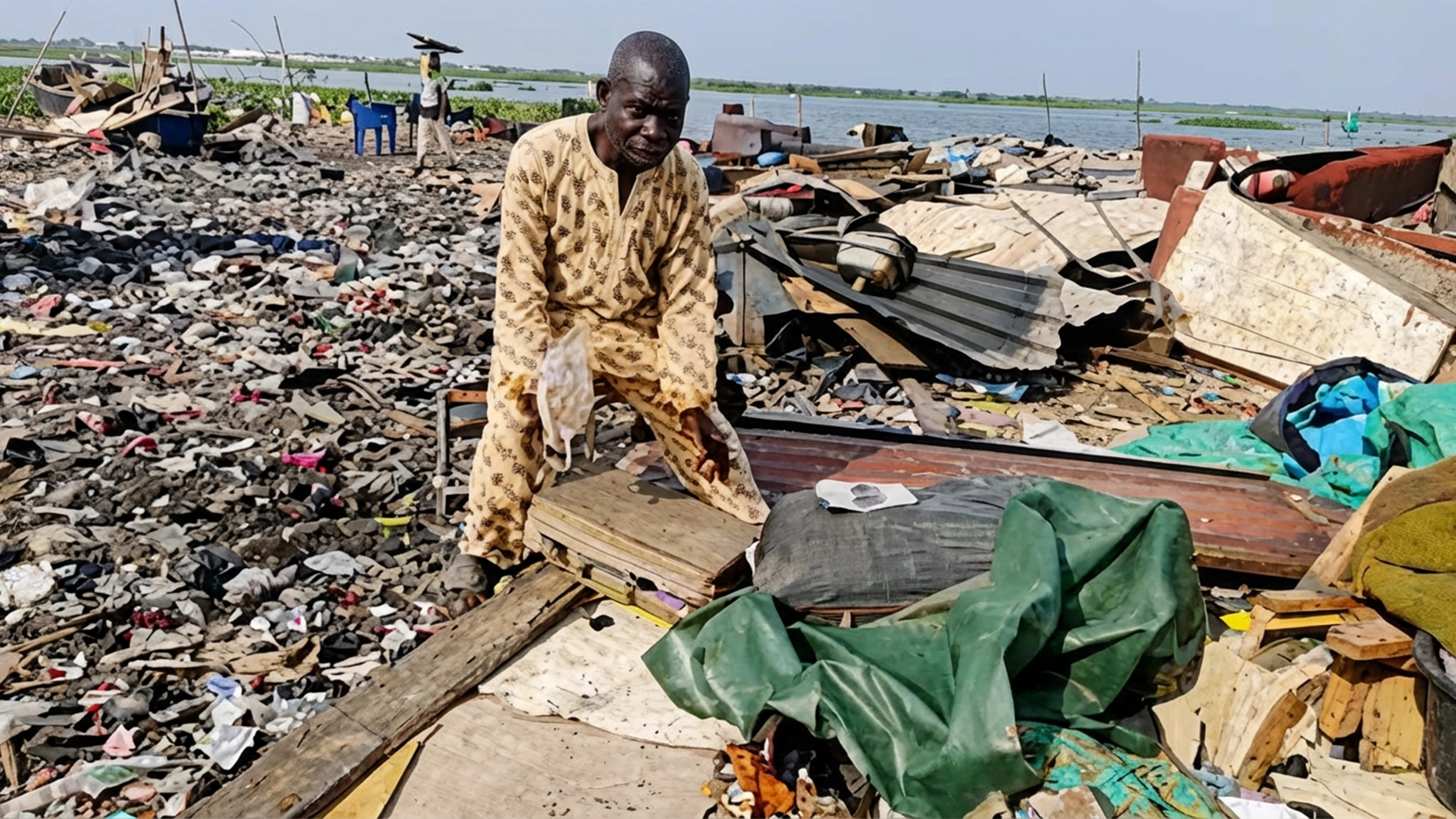
Across urban centres in Nigeria, thousands of residents have been displaced owing to government-led demolitions. Families have lost their homes, livelihoods and personal belongings, because government’s warnings are either too sudden or because there are no compensation. Although existing laws require notice and resettlement plans for displaced persons, weak enforcement has left many struggling to meet basic needs such as food, water, and shelter. MOYOSORE SALAMI explores the human cost of these demolitions and the government’s failure to support affected citizens.
Recently, communities in Lagos such as Ifesowapo, Ifedapo, Ifeoluwa, Jones, Otumara Village, Oworonsoki, Ijora Badia and some waterfront settlements, informal inner-city neighbourhoods, and peri-urban areas faced a series of demolitions, which have led to displacement of tens of thousands of residents over the years and their homes reduced to rubble.
In Ibadan and other urban centres, demolitions linked to road expansion, flood mitigation, or environmental enforcement have similarly left residents stranded, often with little or no assistance from the authorities responsible for their displacement.
Following the state-sanctioned demolition exercise in Abuja, over 10,000 shantytown residents have been displaced, while countless livelihoods have been destroyed.
The affected shanty communities—Ruga I, II, and Yangyada—offered refuge to settlers for decades. Now, they are desolate, bearing scars of chaos and destruction, with only debris and scorched earth as remnants of their existence.
In November 2024, Nyesom Wike, the FCT’s Minister, launched Operation Sweep to demolish settlements “that pose a security threat” in the capital city. Such demolition exercises are not new to Abuja. Between 2003 and 2007, more than 800,000 residents were forcibly evicted from their homes in a four-year campaign to restore order to the city’s chaotic urban planning.

A spokesperson of the shanties disclosed that the communities have been demolished 22 times in over 40 years, but the settlers have always returned since they do not have alternatives.
Already, a coalition of indigenous groups and residents of the Federal Capital Territory (FCT) has appealed to the FCT Administration to halt what they described as forceful and indiscriminate demolitions of property.
The appeal, made under the banner of the Senior Citizens Forum of the FCT, warned that public interest projects must not be pursued at the expense of citizens’ fundamental rights to shelter and human dignity.
The group described the rising spate of demolitions as inhumane and unconstitutional, urging authorities to adopt humane alternatives that prioritise dialogue, compensation and resettlement.
In Enugu State, residents of the Centenary City also raised concerns in 2024 following the demolition of several buildings within the area. While affected residents lamented the destruction of properties they described as legitimately acquired, the Enugu State government defended the exercise.
In a statement, the Senior Special Assistant on Media to the Governor, Dan Nwomeh, said the enforcement operation involved the demolition of illegal structures, including a facility allegedly used as a kidnapper’s den. He maintained that the action was carried out in line with the rule of law and aimed at curbing unauthorised developments within the capital territory.
The human toll of demolition exercises was further highlighted in Kano State, where at least four persons were reportedly killed in Rimin Azuinawa during a clash between residents and security operatives enforcing a demolition order.
According to reports, the victims were allegedly shot after security personnel opened fire as residents attempted to resist the destruction of their homes. Although the Kano Urban Planning and Development Authority reportedly marked 49 buildings under construction for demolition, residents claimed they had earlier been assured that their properties did not encroach on land belonging to Bayero University Kano (BUK), as reported in the media.
However, rights advocates and affected residents argue that demolishing people’s homes cannot be justified solely on the basis of disputed land titles or alleged criminal activities, especially where occupants were not directly implicated. They insist that due process, proper investigation and alternative measures should precede such drastic actions.
Despite Nigeria being a signatory to international human rights treaties that protect the right to adequate housing, the country still lacks a clear national framework for resettlement or compensation for people displaced by state actions. As a result, victims of demolition are often left to fend for themselves, relying on relatives, religious institutions or informal support networks. For many displaced families, the most painful loss is not just their homes, but the absence of government accountability in the aftermath of their suffering.
These forced evictions and mass dislocations executed without adequate compensation or relocation alternatives have drawn widespread concern over their legality and disregard for basic human rights.
Data from world population review show that Nigeria has the world’s largest number of homeless people with 24 million of its population not having homes to live in and many more not having appropriate access to some of the basic services such as water and electricity.
Amnesty International also documented millions of people forcibly evicted in Nigeria since 2000, many of them without consultation, compensation, or resettlement.
Streets Without Homes, Lives Without Safety
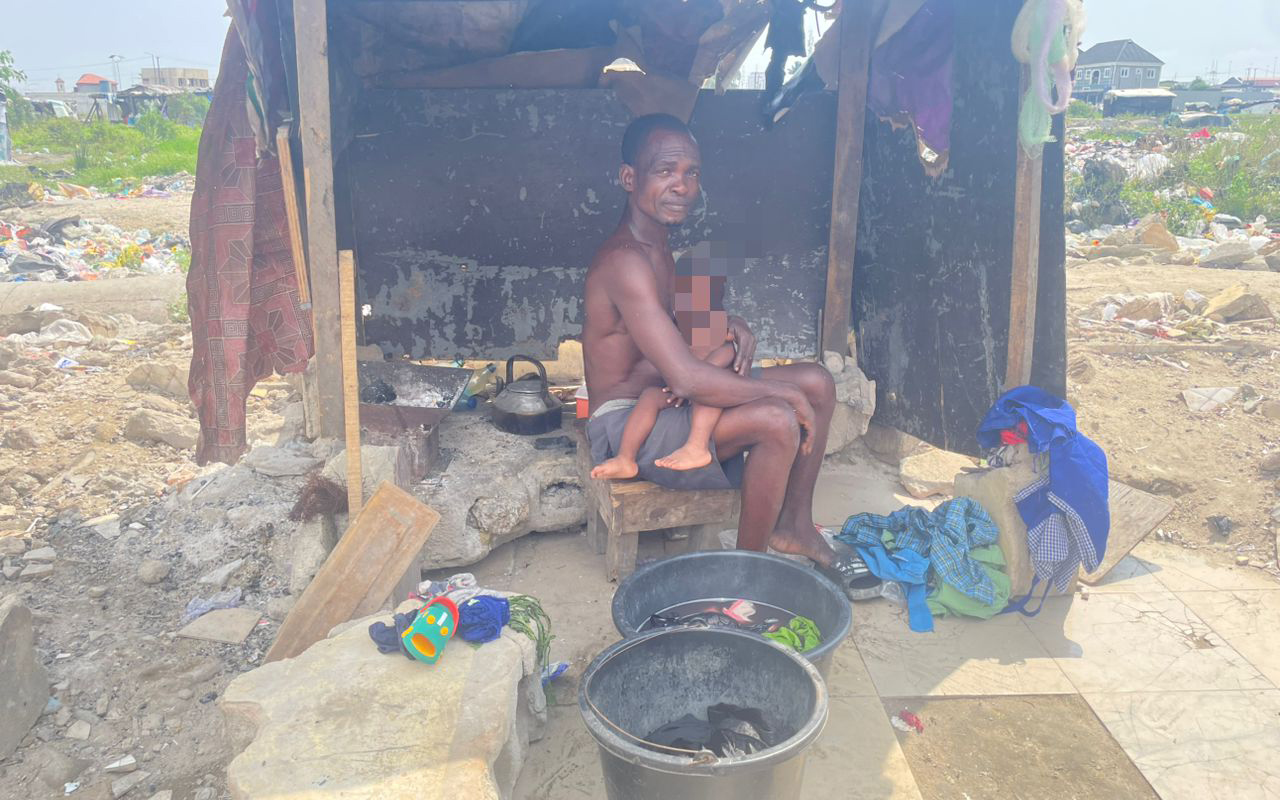
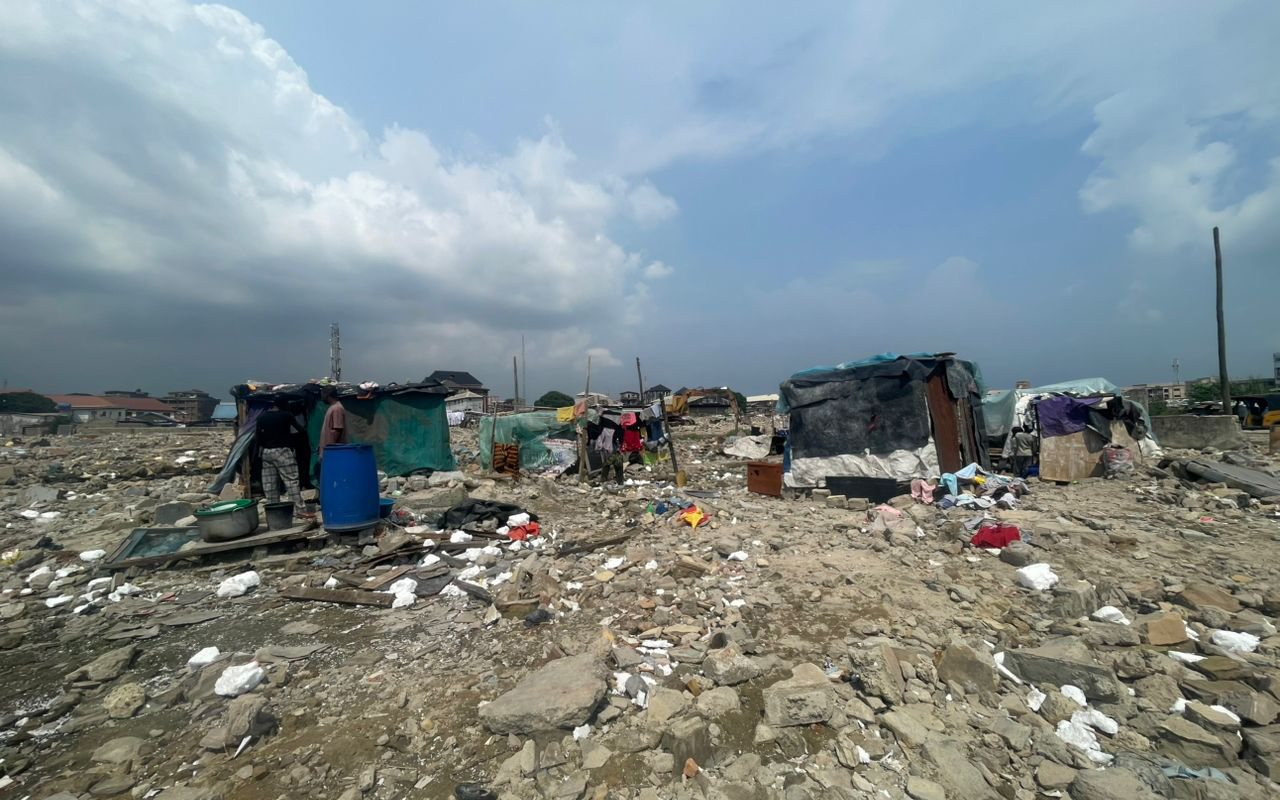
Since the demolitions, many residents have been left with no alternative shelter, forced to sleep under tarpaulin sheets or in open spaces and under the bridge. The absence of even temporary housing exposes them to rain, biting mosquitoes, and the hazards of unsafe sanitation, leaving families in a daily struggle to survive.
A displaced resident and father of three, Kingsley Udoka, described how life has taken a turn since the demolition. He said the family of five now sleeps in the open, exposed to weather and insecurity, and that the stress of displacement has started affecting his wife’s health. He explained that the family struggles with basic needs like water and food, and that attempts to rebuild temporary shelters keep getting destroyed.
Udoka said that although they are not being charged any money for staying in the makeshift space, it has not made survival easier. He lamented that he would relocate if he had the financial means, but for now, they have nowhere else to go. “We are five. I have my children with my wife. Yes, it’s my wife. She has internal bleeding according to the hospital we went to which later led to an operation. It’s not easy at all. Because if we say we are going to do business, before we come back, we won’t find our shelter. So, it’s not easy. If I see money, I will find a better place to stay but there is no place to stay.”
A 74-year-old fisherman, Augustus Orofin, said he was forced to sleep in the open after his house in the Oworosoki area of Lagos was demolished by government officials.
Orofin, who said he had lived in the community for decades, told The Guardian that the demolished structure was his only home, adding that he had continued to stay on the site since the incident because he had nowhere else to go. “This is where I am sleeping now,” he said, pointing to the remains of the building. In the morning, I stay here. I have no other place.”
He explained that he acquired the property many years ago, noting that he bought it from individuals who claimed to be the rightful owners before taking steps to regularise the ownership with the National Inland Waterways Authority (NIWA). “I bought this place around 1999. I didn’t just buy the land and sit down. After buying it, I went to NIWA at the Inland Waterways to process the necessary documents,” he said.
Orofin added that he eventually obtained official documents between 2022 and 2023, which made the demolition a shock to him. “This land is mine. I have almost one and a half plots here. The house had 10 rooms, and altogether they demolished about 18 rooms, including other structures. I was surprised because nobody told me anything,” he lamented.
According to him, no prior notice or reason was given before the demolition exercise, and he was also denied the opportunity to salvage building materials from the house. He said no form of compensation, relocation plan or alternative shelter was provided after the demolition, leaving him stranded at old age noting that while most of his tenants have found alternative accommodation, he has been left behind with nothing.
The septuagenarian, who also depends on fishing for survival, said the demolition has further worsened his livelihood, as he lost valuable fishing equipment in the process.
He pleaded with the government to consider his age, years of labour, and contributions to the community, urging authorities to provide compensation or alternative housing.
“At 74, I should not be sleeping outside. They should help me with compensation or somewhere to stay,” he appealed.
Similarly, another displaced resident, Godwin Otozi, said he has been repeatedly uprooted by successive demolition exercises, leaving his family in a state of uncertainty and hardship.
Otozi told The Guardian that he previously lived in Ilaje Otumara, before the community was demolished, forcing him to relocate to Jones Street. He said the new settlement was also pulled down, leaving his family without shelter or means of livelihood.
Since the demolition, he said he has been unable to work, noting that he and his family now sleep in the open and depend on chance for daily survival.
He explained that before the demolition, he paid N650,000 for an apartment where he lived with his wife and five children, only for the building to be pulled down barely three months later.
According to him, access to basic necessities such as food and water has become irregular, as survival now depends on whether money is available on a given day.

 He disclosed that one of his children fell ill following the displacement but later recovered, while his children’s education has been severely disrupted due to the demolition of their school.
Otozi said only his first daughter, who attends a government secondary school, has been able to continue her education, while the rest of the children are currently out of school. “They don’t know where to go again. Their school was demolished,” he said, pointing to his children gathered around the site.
He listed household items lost during the demolition to include clothing, cushions, cooking pots and other personal belongings, many of which were either destroyed or damaged beyond use.
The father of five said returning to the demolition site fills him with sadness, especially as he struggles to care for young children in the open. “It is not easy to stay like this, especially with babies,” he lamented.
A mother of two, Peace Bright, said the demolition forced her family into living conditions she never imagined.
She explained that her children have been frequently falling ill owing to exposure to cold and mosquitoes, and she has had to choose between buying medicine or food.
Bright said that the mental burden of not having a proper shelter weighs on her daily, and the uncertainty of when and how they will leave makes planning impossible. She said that while authorities claim the demolition was for public good, no provision was made for those displaced, leaving them abandoned.
“When they demolished the place, everything we had scattered. My children have been sick on and off because we are outside like this. Sometimes I have a fever, sometimes cough, and when I buy drugs like this, we may not even have food again. Every night, I think of where we will sleep if rain starts. We are here because we don’t have another option. The government said they were doing it for the right reason but what about us? Nobody asked where we will go. If we had help or support, we wouldn’t still be here like this.”
She explained that the destruction went beyond buildings, wiping out livelihoods that were closely tied to the community. “Everything I had inside that house was destroyed. People were crying because some of them had shops in front of their houses. That was how they fed their families. When the demolition happened, that was the end. No shop, no house, no money. From that day, suffering increased.”
Since the eviction, she said many families have been forced into overcrowded rooms or temporary shelters, while others sleep in churches or with distant relatives. “The government did not give us anywhere to go. They did not ask how we would survive. They just left us like that up till now, some people have not recovered. We are just managing to survive.”
According to UNICEF, the living conditions have serious health consequences. The UN body said children and adults living in informal settlements or outdoors due to displacement face heightened risks of malaria, diarrhoea, respiratory infections, and other water and vector-borne diseases, adding children exposed to rain and stagnant water are particularly vulnerable, and the stress of displacement exacerbates existing health conditions.
Another affected resident, fisherman Raphael Ezekiah, said those displaced by the demolition were temporarily relocated to another section of the waterfront, stressing that the arrangement was not permanent.
He told The Guardian that former residents now live across the water, a location he described as largely inaccessible and uninhabitable. According to him, reaching the area requires travelling by boat or making a long detour through neighbouring communities, a journey he said was unsafe and impractical.
Ezekiah, who said he has fished in the area since 2003, explained that he lived in Oworosonki with his family there. He recalled that the demolition began on July 27, 2023, an exercise he said directly affected him as his residence and church building were set ablaze.
“Everything was destroyed,” adding that although his fishing equipment survived, his family had to relocate while he continued to return occasionally to fish and interact with fellow fishermen.
On the agency responsible for the demolition, Ezekiah said residents were unable to clearly identify the authorities involved, but noted that officials of the Lagos State Task Force were present during the exercise.
Ezekiah explained that though their canoes and fishing nets were not destroyed, the demolition of their waterfront homes has severely disrupted their livelihoods, as fisherfolk need to live close to the water to operate effectively. “Our homes are part of our work, once you take that away, you have crippled our fishing activities.”
Govt Insists Demolitions Lawful, Rules Out Resettlement
Responding to concerns over the lack of alternative accommodation for displaced residents, the Lagos State Commissioner for Information and Strategy, Gbenga Omotoso, said the government could not provide compensation or resettlement for what he described as illegal structures.
Omotoso said residents who build shanties or houses on power lines, drainage channels, and other restricted corridors do so without government approval and must bear responsibility for the consequences.
He argued that compensating owners of such buildings would amount to encouraging illegality, questioning whether the structures were ever approved by the government in the first place.
Drawing parallels with past demolitions in areas such as Makoko and other informal settlements, he maintained that enforcement actions were necessary to prevent Lagos from descending into disorder.
Omotoso insisted that the government’s actions were in line with global urban planning standards, arguing that no major city in the world allows settlements on critical infrastructure corridors.
In Ibadan: Circular Road Project Leaves Families Displaced
A widow, Felicia Oladapo, told The Guardian that residents affected by the Circular Road project in Ibadan were given a two-week notice before their homes were demolished on May 12, 2024. She said she was not at home when the notice was served and only became aware of it upon her return.
Oladapo said residents expected government officials to engage them and explain the reasons for the demolition but claimed no such engagement took place adding that efforts by residents to seek clarification from the government were unsuccessful.
She added that since the demolition, she and her two children have been relying on neighbours for shelter, as they have had no alternative accommodation. Oladapo also said that despite expectations of compensation, she has received nothing from the government.
A community leader, Abayomi Adekunle said the demolition linked to the circular road project affected about 11 communities across the local government area, even though the axis is made up of more than 24 communities in total.
Adekunle said the process had been brutal and unethical, adding that the journey began in November 2023 when government officials started marking houses for the circular road project.
He explained that many residents were away at the time, with some only returning on weekends, and only learnt about the markings through phone calls from neighbours.
The community leader added that after the initial markings, officials returned around May to show residents the marked buildings and issue demolition notices, but noted that before this stage was completed, houses had already begun to be pulled down as part of the second phase of the circular road project.
According to him, the demolition left thousands of residents displaced, forcing families to crowd together for shelter, as no single household was spared.
He said the situation have been physically and emotionally draining, adding that some residents had died as a result of the trauma and loss suffered during the displacement.
Adekunle added that he could recall the case of an elderly resident, Papa Mustafa, whose death he linked to the shock of losing his home, noting that many others have since developed health complications, including high blood pressure.
He said several affected residents were forced to relocate far from their original communities because they could no longer cope with the hardship, describing the experience as deeply distressing for the people.
The community leader said residents were appealing to the government for timely intervention, particularly in the payment of compensation, noting that delays had worsened their suffering as the cost of building materials continues to rise.
He added that while the government had paid compensation to some residents affected by the first phase of the project, the number fell far short of those impacted.
Abayomi added that residents were pleading with the government to act swiftly and fairly, urging authorities to ensure adequate and prompt compensation in order to restore trust and ease the hardship faced by the displaced communities.
Legal And Policy Failures
A representative of the Justice and Empowerment Initiatives (JEI), Megan Chapman, mentioned that affected communities were taken by surprise during recent demolitions, despite existing court orders requiring engagement and resettlement before any eviction could take place.
Speaking with The Guardian, Chapman said that although notices were served in the case of the Otumara community, they fell short of legal requirements.
She said residents had also engaged higher authorities within the Lagos State government and received assurances that no demolition would take place. “Only for caterpillars to show up one morning unexpectedly and start demolishing, everyone was relaxed and thinking that nothing like this would happen. In fact, our organisation even convened a large community meeting the evening before to discuss how to begin updating the community house numbering so they could move forward with partnership with the government. So, everyone in Otumara and Ijora Badia was taken completely unawares.”
Chapman noted that the situation at Precious Seed community was even more troubling, as no formal process preceded the demolition. She said there were no house markings or official notices issued to residents. “The only warning they got was when Task Force officials came to threaten them the day before, even then, they had no idea who exactly was being targeted or whether it was a real threat or mere intimidation.”
She stressed that in both Otumara and Precious Seed, the communities were protected by subsisting orders of the Lagos State High Court, which expressly required the government to engage with residents and make plans for resettlement before any eviction or demolition could occur. “Those court orders were wholly disregarded and violated. This is a perpetual injunction that has been in place since 2017. It is a final judgment. It has not been overturned.”
According to her, all respondents named in the suit had been duly served with Form 48, a statutory notice warning of the consequences of disobeying court orders. She argued that obtaining fresh court orders was unnecessary, as valid and binding judgments already exist.
Chapman added that even in cases where communities secured fresh injunctions, demolitions still proceeded. She cited the October demolition of parts of Oworonsoki along the expressway, where human rights lawyer, Femi Falana (SAN), had obtained an injunction restraining the government.
Legal experts and urban planners agree that demolitions carried out without alternative housing or resettlement plans undermine the rule of law, violate human rights, and worsen urban inequality.
A lawyer who spoke to The Guardian, Olaleye Fayese, said demolitions carried out without obeying court orders or following due process strike at the heart of the rule of law. He explained that where courts have issued injunctions or orders maintaining the status quo, the government has no lawful basis to proceed with demolition until such orders are set aside.
According to him, ignoring court orders erodes public confidence in justice and pushes society towards self-help, as citizens lose faith that the law can protect them. He noted that the Nigerian Constitution guarantees citizens the right to acquire and own immovable property, and while the government may acquire or demolish properties for overriding public interest, such actions must strictly follow due process.
Fayese said that where the government acts outside the law, affected property owners are entitled to remedies such as injunctions and damages. However, he explained that in today’s Nigeria, many displaced citizens are trapped in survival mode and unable to seek legal redress due to the high cost of litigation and weak judicial independence in some cases. He warned that development pursued without respect for the rule of law ultimately undermines economic growth and social stability.
From an urban planning perspective, chairman of the Membership Committee of the Nigerian Institute of Town Planners, Emmanuel Ikechukwu said demolishing residential communities without providing alternative accommodation amounts to forced eviction and constitutes a gross violation of human rights, particularly, the right to adequate housing.
He explained that international human rights law is clear that evictions should occur only in exceptional circumstances and must never result in homelessness or destitution, regardless of whether occupants hold formal land titles.
According to him, where eviction is unavoidable, governments are under a binding obligation to provide temporary shelter or resettlement options, give adequate notice, consult affected communities, ensure access to legal remedies, and offer fair compensation.
Ikechukwu noted that relocating residents far from their livelihoods exposes deep failures in urban planning, including the separation of housing from employment and the neglect of informal economies that sustain millions of households.
He said such practices entrench poverty, destroy social networks, and turn public development projects into instruments of exclusion rather than shared prosperity.
He further explained that development-induced displacement must be treated differently from routine urban renewal. He said because such displacement is involuntary and state-driven, it requires a rights-based resettlement framework that views resettlement itself as a form of development.
According to him, preventing homelessness requires advance provision of adequate housing before demolition, recognition of all affected persons including non-title holders, near-site relocation where possible, livelihood restoration, and long-term post-resettlement monitoring. He warned that demolitions carried out without these safeguards amount to state-produced homelessness rather than legitimate urban development.
He added that although Nigeria’s Urban and Regional Planning Act provides a legal basis for removing non-compliant structures, authorities frequently bypass the safeguards embedded in the law. This, he said, results in violations of constitutional property rights and international treaties to which Nigeria is a signatory.
Another urban planner, Temiloluwa Somefun, said demolitions are often treated as solutions when they are actually symptoms of deeper urban failures such as housing shortages, weak land governance, and inequality. He explained that informal settlements in cities like Lagos and Ibadan are largely driven by structural factors rather than individual choices.
Somefun said that where demolition is unavoidable, governments must first carry out social impact assessments, community enumeration, and transparent engagement with residents, and most importantly, ensure that viable alternatives exist.
According to him, demolitions carried out without affordable housing, temporary shelters, or livelihood support simply push displaced residents into other informal settlements.
He explained that forced demolitions without resettlement plans weaken urban order over time, as displaced people rarely leave cities but resettle under worse conditions. She said this creates a cycle of displacement, overcrowding, and renewed enforcement failures, eroding public trust in government institutions.
Legal practitioner Tobi Fatoki also noted that said the right to shelter is a fundamental human need and that the Nigerian Constitution guarantees citizens the right to acquire property, subject to the law.
He explained that while governments can revoke property rights for overriding public interest under the Land Use Act, such actions must be accompanied by compensation and due process.
Fatoki noted that demolishing homes without providing alternative accommodation violates human dignity, especially where property belong to lawful owners. He explained that compulsory acquisition is not illegal in itself, but the government must put measures in place to cushion the impact on affected persons, including adequate notice, clear communication, and compensation based on market value.
Drawing from historical examples, he said past government projects such as the resettlement linked to the IITA in Ibadan showed that displacement can be handled lawfully when compensation and resettlement are prioritised.
He warned that when the government fails to act in trust and displaces citizens without alternatives, it creates social tension, protests, and prolonged legal disputes.

