 Follow Us on Google News


 Follow Us on Google Discover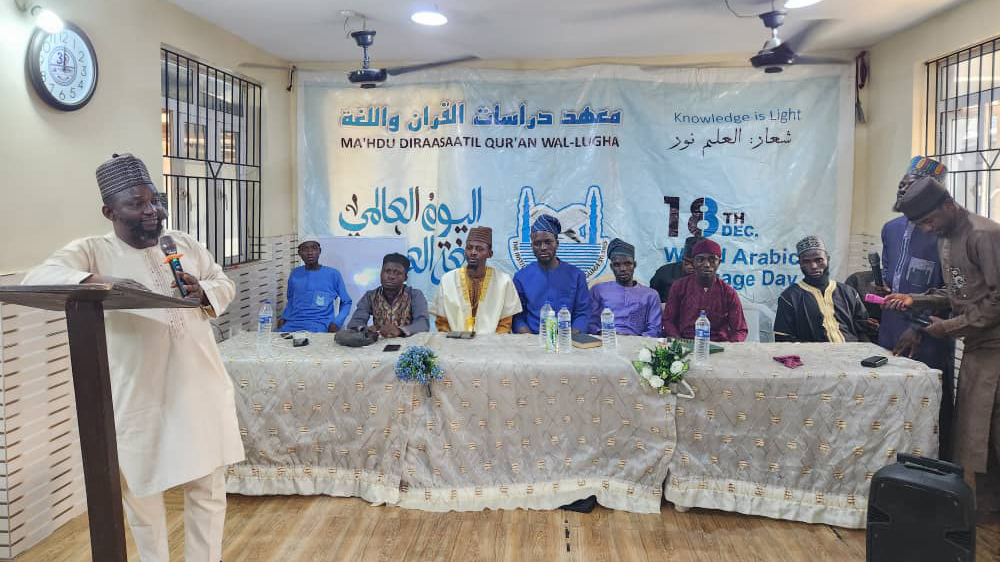
Islamic scholars have emphasised the importance of the Arabic language to Islam and human civilisation, saying it remains vital to religious understanding and societal development.
They asserted that the language has continued to exert significant and far-reaching influence on human endeavour, shaping education, driving economic activity, and fostering development.
Addressing the gathering of Muslim men and women who converged on Oworoshonki, Lagos, to celebrate the second edition of the World Arabic Day (marked annually every December 18), and organised by the Ma’hdu Diraasatil Qur’an Wal-Lugha (Institute of Qur’an and Language Studies), the Chief Host and Deputy Registrar of Yaba College of Technology, Salmon Adebayo, argued that Arabic is not restricted to Islam alone, describing it as a rich language that has contributed significantly to humanity and stood the test of time. He stressed that Arabic is indispensable to Islam, stressing that the Qur’an cannot be properly recited or understood without it.
According to him, key Islamic disciplines such as Tafsir, Usul al-Fiqh, Mustalah al-Hadith and Ilm al-Qira’at require sound knowledge of Arabic for proper comprehension.
The Chief Host observed that Arabic has significantly influenced local languages such as Yoruba and Hausa, adding that the language remains relevant in modern sectors, including the oil and gas industry, where Nigerians with Arabic proficiency have worked serving as translators to international organisations.
Despite the pride associated with the Arabic language, Adebayo expressed his disappointment over some Muslims who, though understand the Arabic, yet feel reluctant or ashamed to express themselves in it, urging them to embrace the language with confidence and use it wherever they find themselves.

“Anybody who reads history will appreciate the fact that Arabic language has been consistent in contributing to human civilisation. When you talk about medicine today, we talk about Ibn Sina, who wrote a book titled Al-Qanun fi al-Tibb. It is called Canon of Medicine. And for several centuries, the book is being used by the Europeans to understand medicine. Then we talk about Al-Khwarizmi. He’s one of our scholars who studied mathematics. Then you talk about other scholars, countries, using the Arabic language to contribute to development of human civilisation,” he stressed.
In his lecture titled: ‘The Contribution of Arabic to Science and Civilisation’, the Director, Walking Quran, Sheikh Ismail Adebayo, emphasised that Arabic language plays central role in the development of science, civilisation and modern economies.
He explained that prior to the advent of Islam, Arab civilisation was largely centred on poetry and writing, but the revelation of the Qur’an in Arabic transformed the language and elevated it as a medium of knowledge, science and innovation.
“The Qur’an enriched the Arabic language and gave it a unique status. From the time of Prophet Muhammad, Muslims began to advance in science, technology and civilisation because the Qur’an encouraged reflection, investigation and understanding of nature,” he said.
According to him, several Qur’anic verses call attention to natural phenomena and scientific realities that were unknown at the time, inspiring Muslim scholars to explore astronomy, medicine, mathematics and other sciences.
He cited the development of scientific tools such as the astrolabe, which was used to study the movement of stars, determine prayer times and locate the direction of the Qiblah.
On the language contribution to economic development, he explained that Arabic-based Islamic financial principles are already contributing to Nigeria’s economy through instruments such as Sukuk, which have been used to fund major infrastructure projects, including federal roads.
“These financial contracts, rooted in Qur’anic principles, promote transparency and accountability and have helped to reduce fears of mismanagement in public projects,” he said.
He urged Nigerians, both Muslims and non-Muslims, not to view Arabic as a religious weapon but as a global language that enhances intellectual capacity and access to civilisation.
Arabic is not a tool for Islamisation. It is a language of civilisation, just like English or Chinese. Learning it will not make Nigeria backward; it will advance our development and expand our access to global knowledge,” he said.
Director of the Institute of Qur’an and Language Studies (IQLS), Imam Ridwan Ibrahim, said that the public lecture was organised to commemorate World Arabic Language Day to raise awareness and improve interest in Arabic language learning.

