 Follow Us on Google News


 Follow Us on Google Discover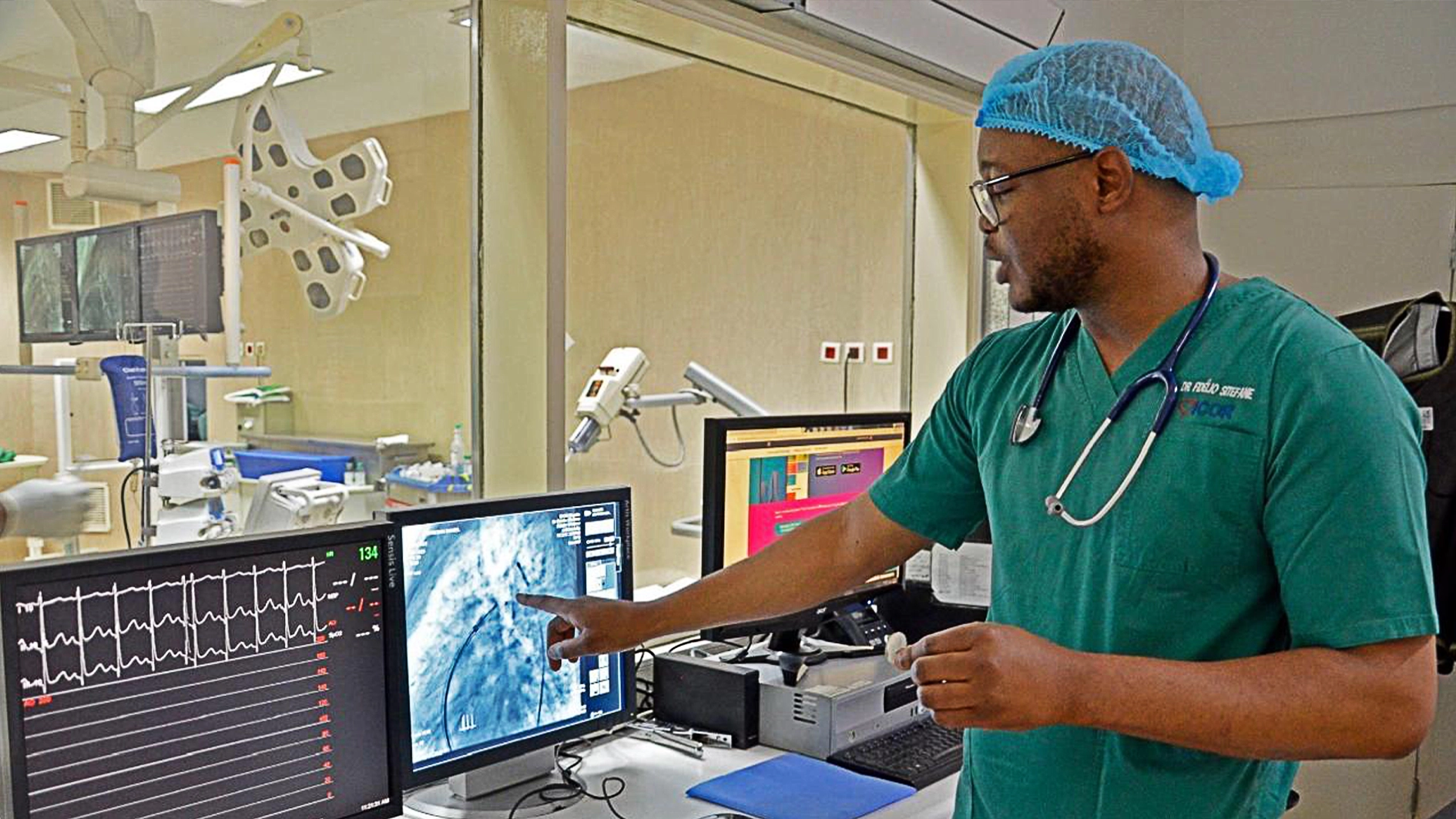
Every year, International Day for Interventional Cardiology draws attention to Internationally recognized specialists whose precision and technical skill are quietly transforming how serious heart conditions are treated. In high-income countries, catheter-based cardiac procedures have become so standard that their revolutionary character is easy to forget: the ability to repair a structural defect in a child’s heart, dilate a narrowed valve, or restore blood flow to a blocked coronary artery through a small incision rather than an open chest has fundamentally changed the risk calculus of cardiac medicine. Recovery times shortened. Complication rates fell. Populations who once could not safely undergo surgery gained access to treatment.
Across much of Africa, that transformation is still arriving. Access to interventional cardiology remains uneven, specialist density is thin, and the infrastructure required to sustain catheterization laboratory services is present in only a fraction of the facilities where it is needed. Against that backdrop, the clinicians who have built permanent interventional capacity within African health systems represent something more than individual clinical achievement. They represent proof that the gap is closable.
Mozambique’s Dr. Fidélio Sitefane is among the clearest examples of what that proof looks like in practice.
A Fellowship That Changed What Was Possible
Between October 2014 and October 2016, Dr. Sitefane completed an Interventional Pediatric Cardiology Fellowship at Hôpital Necker Enfants in Paris, one of Europe’s foremost pediatric cardiac centers. Over the course of that training, he completed more than 1,200 catheter-based interventional procedures with a 98 percent success rate, building competence across complex congenital heart disease interventions, device implantations, structural heart procedures including ASD, VSD, and PDA closures, pulmonary and coarctation stenting, balloon valvuloplasty, and hemodynamic assessment. The fellowship also developed his capabilities in percutaneous coronary intervention, peripheral vascular procedures, and catheterization laboratory leadership.
That combination of volume, complexity, and subspecialty breadth positioned Dr. Sitefane to do something that very few African physicians returning from European fellowship training are equipped to do: not just perform advanced procedures, but build and sustain the program around them.

Ending the Mission Dependency
When Dr. Sitefane joined Instituto do Coração (ICOR) in June 2017, Mozambique’s pediatric cardiac catheterization services existed only in the form of periodic humanitarian missions organized by teams from Portugal, France, and the United Kingdom. Those missions were valuable and genuinely life-saving. They were also structurally fragile: dependent on the scheduling, funding, and availability of foreign physicians whose primary institutional commitments were elsewhere. Between missions, Mozambican children with conditions requiring catheter-based intervention had no in-country pathway to treatment.
Dr. Sitefane ended that dependency. As Mozambique’s first pediatric interventional cardiologist, he established a permanent program at ICOR that operates year-round, responds to patients as they present, and delivers catheter-based treatment for conditions that previously required either a mission visit or open-heart surgery. ICOR’s humanitarian mandate, providing free cardiac procedures to patients under 21, added an access dimension to what he built: the program was designed from the outset to serve the population most likely to be excluded by cost.
The procedural shift he enabled matters clinically as well as structurally. Many congenital defects now treated through catheter-based closure or dilation at ICOR would previously have required open-chest surgery, with longer recovery, higher risk, and greater demand on surgical infrastructure that remains limited in Mozambique. The availability of minimally invasive alternatives changes outcomes in direct, measurable ways.
Rheumatic Heart Disease and the National Reference Role
Dr. Sitefane’s impact extends beyond the pediatric population. Mozambique continues to face a significant burden of rheumatic heart disease, a condition caused by repeated streptococcal infection that damages heart valves and disproportionately affects young women of reproductive age in low-income countries. He serves as the national reference physician for percutaneous mitral balloon valvuloplasty, a catheter-based procedure that dilates a narrowed mitral valve without surgical intervention.
The clinical significance of this role is specific and substantial. For young women with rheumatic mitral stenosis who wish to become pregnant, the hemodynamic demands of pregnancy on a stenotic valve carry serious risk. Valvuloplasty can relieve that obstruction, allowing patients to proceed safely with pregnancy before surgical valve replacement becomes necessary. In a country where access to cardiac surgery is limited and the patient population is predominantly young, a specialist who can offer this intervention is addressing a need with no adequate alternative.
Diagnosis Before Birth
Since 2019, Dr. Sitefane has also practiced at Clínica Materno-Fetal, where he is the only clinician performing fetal cardiac morphology ultrasounds. This subspecialized application of ultrasound technology enables diagnosis of structural cardiac abnormalities in utero, before delivery. The clinical value of that timing is straightforward: families and delivery teams who know a child will be born with a congenital cardiac condition can plan accordingly. Deliveries can be routed to centers with neonatal cardiac capability. Resuscitation teams can be prepared. Immediate postnatal intervention can be arranged before decompensation occurs. In conditions where the window between birth and cardiac crisis is measured in hours, that preparation is the difference between survival and loss.
Dr. Sitefane introduced this service to a clinic that did not previously offer it and continues to be its sole practitioner. His diagnostic portfolio at both institutions is equally comprehensive: echocardiography for pediatric and adult patients, transesophageal echocardiography, electrocardiography, Holter monitoring, stress testing, and advanced imaging interpretation, giving him end-to-end clinical capability across assessment, planning, and intervention.
What This Day Is Really Marking
International Day for Interventional Cardiology is a recognition of technical excellence, but it is also a recognition of what that excellence makes possible when it is deployed where the need is greatest. The advances in catheter-based medicine over the past three decades have been extraordinary. Their distribution has been uneven. The physicians who are closing that distribution gap, who complete rigorous training in leading global centers and return to build permanent services in under-resourced systems, are doing work that extends well beyond their individual patient outcomes. They are demonstrating that advanced cardiovascular care is not the exclusive province of high-income health systems. Dr. Fidélio Sitefane has spent nearly a decade demonstrating exactly that in Mozambique.

