 Follow Us on Google News
 Follow Us on Google Discover
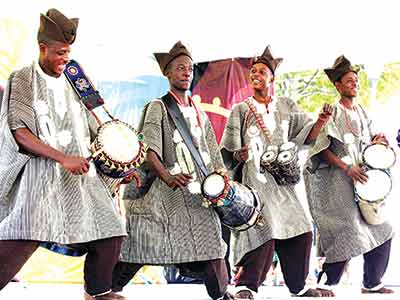 It’s A Rewarding Part-Time Job
EVER been to a party gaily dressed and just as you step out of the venue after the party ended and you are accosted by a duet or quartet, drumming, singing and dancing around you?
In case you have not experienced such, it is one of the side attractions of social life in cosmopolitan cities. These itinerary artistes survive by dancing and singing the praise of their clients, who in most cases might be seeing them for the first time. And they usually go about as solo performer or in small groups of two, three or four, roaming from one party to another looking for clients. Surprisingly, in most cases, this constitutes their main source of income.
And this informs why they always target rich and wealthy people to service. Indeed, they are choosy and usually go after a man or woman ostentatiously dressed, as they associate good dressing with wealth.
Aside singing and dancing around their clients, they also shower accolades and cognomen on their unsuspecting clients, who often respond by ‘spraying’ them with Naira notes and sometimes dancing to their music. Having raked in some money from a client, they move to another, repeating the process and this they do all through the day until night falls.
On how they pick their clients, Babatunde Ayanwale, who has been in the business for over 30 years said, “we assess the social status of a client and give him/her songs that befit his/her class. No matter how much one pretends, wealth cannot be hidden. It shows in their manner of dressing and quality of dress, the carriage of an individual or the type of vehicle driven. We use these as our yardstick and more often than not, we are right.”
Aside classical music, which for lack of technical known-how they cannot play, these artistes are capable of improvising any song or music genre to suite their needs.
Ayanwale explained that the drum and dance business is a part-time venture that has supplemented his monthly income.
“I do it on a part-time basis from Friday to Sunday, except during public holidays when it could be done any day. There is no weekend that I do not come home with at least N10, 000, which goes to say from Friday to Sunday, I make N30, 000 in addition to my income. I even make more during festive periods,” he said.
Expatiating on some of the tricks he has adopted to enable him succeed in the business, Ayanwale disclosed that it all boils down to knowing how to praise people, put a smile on gloomy faces and lift them out of depressive mood for a while.
“Though the economy is hard, yet some people cannot do without enjoying themselves. They go to drinking spots to socialise with friends and we supply them live performance, moving from table to table. When you massage the ego of a man that has gulped some bottles of beer, he ends up spraying us with good money, while dancing to our songs.
“As we move around tables, we study the countenance of a would-be client and make our songs reflect it. For instance, if it was a moody person, we play to liven him up and make him laugh or even get up to dance. People enjoy being praised. So, the magic is in understanding one’s client and meeting his needs.
“As soon as you understand the fact that every human being has an ego to feed, you will excel in this business. I also try to assess a client from his dressing, which is a reflection of the real self and from there begin the praise singing. There is no one, no matter how rigid, that would not dance or laugh when praised in a public space. And if you do it very well, you will win the heart of a lion and once the heart is won, the pocket or purse also opens for us.
“Society women love to be appreciated. So, if you tell them how beautiful they look in their gorgeous outfits and flatter them with words, you will get the dough. Even when some may not want to listen, just be persistent in your action, do some funny dance steps and because it is a public space, the woman, because of her status will giggle and give out some money,” he said.
For Danladi Musa, who plays a horn instrument at drinking joints and events, entertaining people goes beyond praise singing. In his view, knowing how to crack jokes and making one’s songs and dance to reflect current issues would make a listener readily give out his money.
“People enjoy dirty jokes. So, when I go to places dominated by men, especially drinking joints, I crack jokes about women and do the reverse in a place dominated by women. I ensure that my songs reflect current issues, while spicing it with old skool music, as a way of worming myself into the hearts of my listeners,” he said.
On what inspires him to carry on with the business, Musa disclosed that the monetary reward has been the driving force.
“I sometimes make N15, 000 per night. At a very low outing, I go home with at least N3, 000, which is rare. Though the income is not fixed, the money I make is enough to meet my needs. The money I make from Sunday to Monday playing at joints and event could be between N60, 000 and N80, 000. But the real thing comes from event centres, where one can make about N30, 000,” he disclosed.
With simple musical instruments such as the talking drum, bata, gongon, shekere or local guitar and flute, these itinerary artistes are able to make handsome amount of money entertaining people, and sometimes behaving like clowns.
On what one needs to be in the business, Bode Giwa said knowing how to play a simple musical instrument is key.
“The gongon and talking drums may look simple, but you’d be surprised to know that it could take up to one and seven years or more to learn how to play it very well. The bata dance is another phase. Knowing how to dance it very well puts you ahead of others in any Yoruba event. One has to learn to be on top of the game to excel.
“Aside knowing how to handle the instruments, one also has to know different praise songs and the cognomen of different communities, title holders and even individuals, especially those whose names are associated with particular ethnic groups such as Taiwo, Kehinde and Alaba among others among the Yoruba people,” he said.
On the future of the business, Lasisi Ige, whose group plays regularly at shows, said it would continue to grow so far there are human beings. Since people would always celebrate one event or the other, people in his line of business are guaranteed their regular income. What is required is getting the information of where an event is happening.
“We are not always invited to an event. We only observe and from there begin our song. When we visit cemeteries, where there are burials taking place, we chant dirges. The age of the deceased and cause of death determine the type of song we sing. If the person died at an old age, we reflect on that and to our surprise, we sometimes make more money at cemeteries than birthdays and housewarming ceremonies.
“Another nice spot is the registry, where we hang around to play for newly weds. The performance space is endless, but the major thing is being connected to events,” he explained.
Comparing the nature of their performance to that of a bandstand, Timothy Agbabiaka, said they are not on the same pedestal. According to him, the itinerant artiste is flexible, when it comes to composition of lyrics and could perform at any given space including markets.
“We use simple local instruments and could perform for anybody. We usually sing and dance for different persons or groups in the same party. Our performance is based on how much an individual could offer. Though we entertain, the main interest is in money; how much of it we make in an event.
“People associate with us more and even dictate the tunes to sing for them. Some people enjoy those songs generally considered dirty and do call on us to sing them. The business has no ethics, as any song goes just as any dance goes, so long it does not hurt my person or tarnish my reputation,” he said.

