 Follow Us on Google News
 Follow Us on Google Discover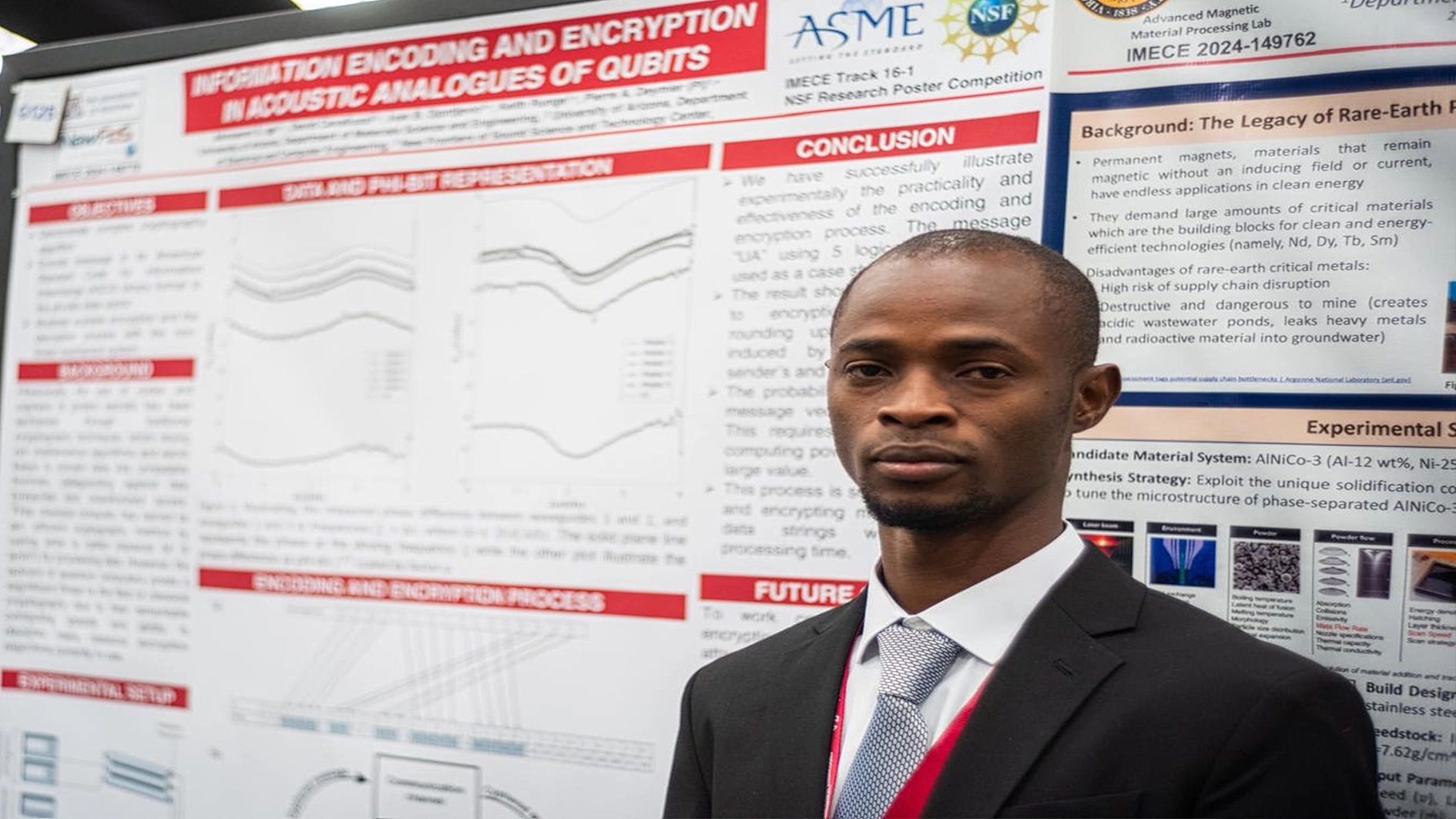
For most of the twentieth century, the ambitions of materials science ran along a familiar path: stronger metals, lighter composites, more efficient semiconductors. The discipline made civilization’s hardware faster, cheaper, and more durable. What it did not do, for the most part, was compute.
That is changing. Over the last two decades, materials scientists have begun to engineer materials whose internal structure is designed not merely to withstand forces, but to guide them, bending sound, light, and mechanical vibration in ways that no naturally occurring material can.
These engineered materials are called metamaterials, and the branch concerned with sound is called acoustic metamaterials. Their applications range from the practical, noise cancellation, medical ultrasound, underwater imaging, to the ambitious: building physical systems that can perform quantum-like operations at room temperature, using acoustic waves in place of the fragile, cryogenically cooled hardware that dominates quantum computing today.
The economics of this research have long been forbidding. Quantum computing systems that push the field forward cost tens of millions of dollars to build and maintain. Acoustic-metamaterial approaches, if they can be made to work, would not replace those systems, but they would give many more laboratories a way in.
That possibility has drawn a new cohort of researchers into materials science from adjacent fields. One of them is Akinsanmi Samson Ige.
Ige, a doctoral candidate in the Department of Materials Science and Engineering at the University of Arizona in Tucson, arrived in the United States with an undergraduate degree in physics from Ladoke Akintola University of Technology in Ogbomoso, Nigeria, and the habits of mind that come with it. Today, he is applying those habits to the design of engineered materials capable of hosting the kind of complex, quantum-like behavior that once required far more elaborate machinery.
His doctoral work sits at the intersection of two disciplines that rarely meet in the same laboratory. From physics, he brings the mathematical framework for describing how waves interact when they travel through structured environments. From materials science and engineering, he brings the tools to build the structures themselves, choosing which materials to use, how to arrange them, how to bond them, how to test them, and how to interpret their behavior.
“The physics tells you what should happen. The materials science tells you how to make it happen. Neither discipline is complete without the other,” Ige has said in describing the direction of his work. His contribution to this direction has appeared in Scientific Reports, a peer-reviewed journal from Nature Portfolio, where he is listed as lead and corresponding author on a paper describing a method of encoding information in acoustic systems using quantum-inspired protocols, work aimed, in part, at widening access to a field long confined to well-funded institutions.
That intersection is where the field’s most consequential questions now live. It is also where progress depends less on any single laboratory’s budget than on the presence of researchers trained to move between disciplines fluently, a description that fits Ige and, increasingly, the emerging cohort of materials scientists reshaping what engineered acoustic materials can do.
For Nigeria, Ige’s rise is more than a personal success story. It is fresh evidence that an undergraduate physics degree earned at a Nigerian university can carry a researcher to the front line of a demanding, well-funded field abroad.

Nigerian universities and science agencies now have a live example to point to when arguing for stronger laboratory funding and postgraduate scholarships in the physical sciences. His standing as lead and corresponding author in a Nature Portfolio journal also gives Nigerian institutions something concrete to build on: a name and a body of work that can anchor future research partnerships and student exchange arrangements with American universities. Diaspora scientists in his position tend, over time, to become bridges rather than exits, co-supervising graduate students back home, reviewing papers from Nigerian laboratories, and returning periodically to teach, all of which feed a research culture that has long struggled with funding and visibility.
For the United States, Ige’s work reflects a longstanding pattern in which American research strength depends heavily on recruiting scientific talent trained elsewhere. The University of Arizona gains a productive doctoral researcher whose publications add to its standing in materials science, and the federal and institutional funders behind that work, principally the National Science Foundation, receive published, citable results that advance the mission of his research group and institution.
The practical dimension is broader still. Because acoustic-metamaterial platforms offer a route to computation without cryogenic cooling, progress in this direction would matter well beyond any one research group. It would lower the cost of entry for the many American universities and companies that cannot afford quantum-scale equipment, and it fits squarely into the broader American effort to build up the country’s capabilities in next-generation computing and to train more researchers who can work at that frontier.
Ige’s stated aim of widening access to a field long confined to well-funded institutions serves American research infrastructure as directly as it serves the discipline itself.
The story of Akinsanmi Ige is, in one sense, a story about materials science and the widening ambition of what engineered materials can do.
It is also a story about what happens when a Nigerian physics graduate refuses to accept that the frontiers of a global research field must belong only to those who arrived at them first.
The world is waiting to see what he does next. On present evidence, the wait will not be long.

