 Follow Us on Google News
 Follow Us on Google Discover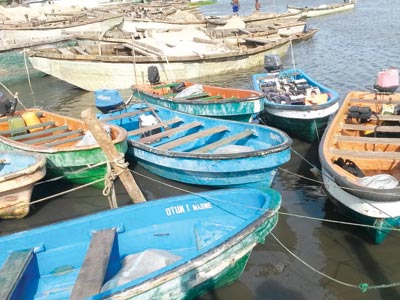

… Pupils walk three hours to get to school
… then cross the lagoon with non-motorised boat
YOU could be the most brilliant boy or girl in the world, but if you are living in Igbolobi, Taffi, Ishahai, Mobi and many other riverine towns and villages – excluding Irewe – in the Ojo Local Government Area of Lagos State, going to school would be disinteresting, as it is like being in a permanent state of war, every day.
That “war” ended, rather sadly for Jonathan Fiankyu, Nelson Fiankyu, Josephine Ajigbo, Patience Ajigbo, Imonina Bright and Kayode Nathaniel, on July 1, 2015, when the non-motorised boat conveying them to their school, capsized.
That Wednesday morning tragedy ended the hardship that these pupils underwent everyday as they navigated the barriers that stood between them and their fundamental right to education.
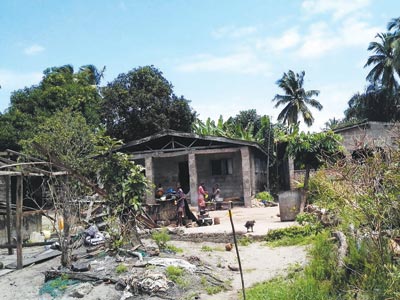
Their school, Osolu Junior and Senior High School, is located in Irewe, and is only accessible to many of the children from these coastal towns through a boat-ride and a long walk, as the lagoon separates Iwere from majority of the 35 communities, which constitute Osoluland.
An island at one of the Badagry’s creeks, Irewe is the nucleus of Osoluland. It sits at the epi-centre of all other towns and villages including Petepete, Egira, Olomometa, Alemuwo, Viaku, Igbo-Oja, Sodanu, Agaja, Alaguntan, Christopher Beach, Ikate, Ajigbo, Zanu, Okolundun, Erekun and Itogbesa
The urban-rural disparity between Irewe and its neighbouring towns is glaring. The fact that Irewe is the birthplace of the former Lagos State deputy governor, Mrs Sarah Adebisi Sosan, might dispel any suprise about rapid development that the island has witnessed in recent times.
Ironically, investigation shows, mainly pupils from these other communities populate Osolu High School. The victims of the July 1 boat mishap were from Viaku (Jonathan Fiankyu, Nelson Fiankyu, Josephine Ajigbo, Patience Ajigbo) and Olomometa (Imonina Bright and Kayode Nathaniel).
On that fateful day, they boarded the wooden boat at Egira and, usually, it takes about 10 minutes to cross the lagoon to the shore of Irewe before walking down to school.
But that journey was cut short as a motorised boat on a top speed from Alaworo market waterside hit their 12-passenger wooden boat. A few minutes later, it was news of their death that reached the school. The other six passengers who were pupils survived with varying degrees of injuries.
That tragedy exposed the deplorable living standards of dwellers in these communities, bringing to the fore the absence of basic amenities and the suffering pupils undergo in accessing elementary and secondary education, a situation, which has invariably contributed to a high rate of out-of-school children in the area.
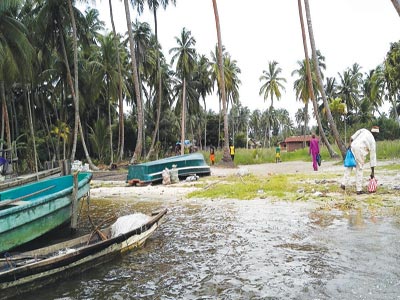
Many of the pupils, especially those living at the extreme of the island – Igbolobi, Taffia, Ishahai, and Mobi, would trek for at least three hours to Egira, which has become a local jetty for the students, before boarding the un-motorised boat.
In most cases, they spend an average of six hours on the road – going and returning – time they ought to spend in the classroom. Most times, they get late to school, arriving there around 9am or even 10am.
The six-hour walk to and fro school is as a result of poverty as they could not afford the fare of the speedboat that could convey them to Irewe, which cost on the average, about N300 on a trip.
Building a hostel is part of what the King (Osolu of Irewe) has suggested, so that if they (students) want to go home, it will be at the weekend. All these demands have been forwarded to the state government. It is not that the local government cannot handle them, it will take time to execute because of the dwindling revenue. The state government has promised to intervene.
Besides the N300 fare, the availability of the Irewe-bound speedboat is another headache: it is usually not available. When that is the case, the pupils would first take a boat to Alaworo Market waterside, then to Irewe. That means spending N1,000 on that day.
With most of them children of peasant farmers and fishermen, this burden has meant increased school drop-out in these communities.
A community leader in Alaguntan, Chief Muritala Bakare, alluded to the dropping-out of school when he spoke with The Guardian. Besides, he noted that some of the students struggle to make 10 appearances in a month, which is affecting the overall performance of the students.
Our quest to get the school register to get the actual figure of those who had dropped out in the last three years and the absenteeism rate was not successful as the administrative heads of the school did not co-operate.
When you add no electricity supply, no pipe borne water and no primary health care facilities, then you can imagine how short and brutish life for the pupils in those communities is.
“Do they really care about us and our future?”
Mufutau Ali, an SSS 2 student of Osolu Senior Secondary School, Irewe, said he leaves home on the average by 6am, Monday to Friday, walking from Igbolobi through some other communities to Egira to join a boat that would convey him and others across the water to Irewe. Still, he hardly gets to school before 9am. As a result, he is not usually part of the first lesson in the classroom. In addition, the first 30 minutes of the second lesson is usually with less attention, as he would still be grappling with settling down for studies mentally.
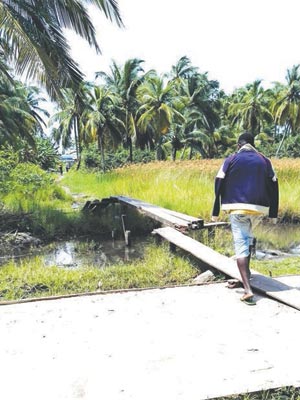 After school hours, to return home, it is still the same experience: wooden boat ride from Irewe to Egira and thereafter trekking through communities such as Sodanu, Viaku, Agaja, Alaguntan, and Christopher Beach to get home in Igbolobi. According to him, it is only when he gets a help in form of a free boat ride that walking home is erased from his experience for the day.
Fatai Tijani, also in SSS 2 and resident of Igbolobi, said that, on a school day, on getting home, the first thing he does is to sleep to regain strength and relief from body pains. On a rainy morning, he, like most others, stays away from school, because navigating through the routes is usually tougher.
Another SS2 pupil, Sarah Amure, said that walking that route has not been terrifying for her because she goes to school in a group. And this is deliberate, because it is not safe walking through the bush path and sea shore alone. As she always missed the first and sometimes, the second classes, she said that her classmate and friend provided her notes for her to copy. “But, sometimes, before I get to school, a test would have been conducted and this is affecting my performance at the end of the term. Going through that stress and putting it side by side with the fact that we have a right to education, I usually feel bad about my government and leaders because it seems they do not care about us and our future.”
While in primary school, and walking an average of 30 minutes to school in Alaguntan from Igbologbi, Suliat Ali always heard her older brother complain about the stress of the six-hour walk to and from school. So, when she got admission into Osolu Junior School, she indeed felt bad. It was that bad. Now in second year at Osolu Junior School, and doing the six-hour walk, she is forever wishing that the “nightmare would end one day.”
Anifat Oseni, an SSS 1 pupil of Osolu Senior High School, lives in Okolundun. Her walk to school takes two hours. She is bitter because after completing her primary education in a private school in Ojo, her parent had to send her to a public secondary school because to continue in a private secondary school would require paying the school fees and N500 daily to take boat to and fro school.
“For primary school pupils, the rule within the communities is for the boat drivers to convey them to their destination for free, but a secondary school student is expected to pay his or her fare. So, my parents could not afford to pay my school fees and daily commit N500 for my transport fare. So, I was sent to a government school, where I would walk for about two hours to get to school.”
Unlike other pupils on the Igbolobi-Alaguntan-Agaja-Egira-Irewe route who must ride a boat to get to school, Oseni is a little bit lucky as he only needs to walk all through to Irewe. But another challenge that confronts her and other colleagues whose route is the Okolundun-Erekun-Itogbesa-Irewe route is the dilapidated state of the wooden bridges linking these communities. In such circumstance, and where Oseni and her likes could not walk through the water, she would need a compassionate person to pay N20 to cross any of the damaged spot of the wooden bridges.
A teaching staff at Osolu High School who pleaded anonymity said that he stopped flogging the students for late-coming after he experienced what they went through coming to school. “They usually said that they had left home as early as 6am. I always wondered why they still came late, but after taking the trip myself, I felt it would be unfair for me to flog them when they come late.”
Not everyone can bear the burden
Tijani, Ali, Oseni and their likes might still soldering on but not Idowu John Yao, Toib Moroof and Abigail Friday: they have dropped out. While Yao stopped going to school in JSS 2, Moroof could not continue after primary school, and Friday had to terminate her education abruptly in SSS 1.
 Yao said that walking to school from Alaguntan was not his problem but paying the little daily token for boat ride across the water at Egira and other minor expenses in school forced him out of school. He said there was nobody to assist him. His case is now compounded. After dropping out of school, Yao later got enrolled as an apprentice in a tailoring shop but also had to stop midway because he could not pay the apprentice fees demanded by his boss.
Though Morrof completed his primary education in Saint Michael School, Ojo he could not continue with his secondary education because his aunt sent him back home to his mother in Alaguntan who could not shoulder the responsibility of sending him to a secondary school. His father died some years ago.
Friday, a resident of Sodanu Village, was attending a private secondary school in Shibiri, along Okoko-Badagry area. She abandoned school because her father could no longer afford to pay the school fees. Almost a year after her dad withdrew her and her brother from the private school, largely for lack of funding and because of the alleged maltreatment from the relative they were staying with in Shibiri, she has been idle, though she is now planning to enrol in an informal catering school.
Unfortunately, her brother, Nelson Fiankyu, who had been re-enrolled in the LA Primary School, Irewe, was the only primary school pupil among the victims of the boat mishap of July 1, 2015. Ironically, there is a primary school, adjacent to the home of the Fiankyus: Salvation Army Primary School. So, why was Nelson attending the LA Primary School in Irewe? During The Guardian’s visit to the creeks for this repot, Nelson’s mother, in tears, pointed at Nelson’s tomb saying that the decision was informed by the desire to get quality education for her son. She said that the primary school within her community had no committed teachers.
According to her – and another resident of Viaku corroborated her – the teachers always came late and spent not more than two hours with the pupils before they closed for the day. Pupils, she added, are, most times, left alone with no teachers to teach them. The teachers do not live at Viaku, because of the absence of basic amenities. They come on boat ride from Ojo.
“Sometimes, you don’t blame the teachers,” allowed Mr Rafiu Adesegun Oyefolu, a resident of Olomo-meta, where two of the victims of the boat mishap came from, “because they could wait for hours to get a boat to convey them to this place.” He noted that there was a time a boat was bought by the Ojo Local Government to transport these teachers but when the boat got damaged, it was not repaired.
According to Oyefolu, it is because of the teachers’ lateness to class and absenteeism that many parents now send their children to private primary schools within the communities, which are usually tuition-free. Oyefolu, who passed out of Osolu High School in 1994, said he was assisting to teach in one of the private schools, even as he is pre-occupied with coconut farming. He said he concentrated more on farming because when he was teaching full time in one of the private schools located within the community, his N6,000 monthly salary was not regular.
Poverty is a key factor
Unnanna Uwigwe is the senior pastor of Life Compass Christian Assembly who arrived to settle in Olomo-meta on May 28, 1994. To help provide some quality education for pupils of the community, he set up a fee-paying nursery and primary school, 16 years ago.
He recalls: “Accessing education was difficult; I could even say there was nothing like education when I arrived here. You couldn’t get primary and secondary school students to speak good English; the only government school around here was Salvation Army, but it was not imparting quality teaching. Many of the children would go and return home without being able to say this is what they learnt for the day.” (Even the Head of Department of Education in Ojo Local Government, Mr Shakirudeen Idowu Lawal, corroborated the people’s grouse against the Salvation Army School.)
To him, the block of classrooms on the school premises could be described as misuse of infrastructure. He noted: “Currently, they are short of staff. Besides, most of the teachers posted there will not show up. They claim they have phobia for water. Irewe is semi-urban that is why they prefer to go to Irewe, there are public utilities there; police station, mini-clinic, electricity. So, if there is anything they could easily be attended to. The issue of illiteracy is terribly high in Viaku and those other coastal communities, as they are not yet convinced that education is important.
But in Irewe, Kabiyesi (the King) also monitors activities and often assists in his own ways. That is why people prefer to send their pupils to Irewe. If government can put quarters there (Viaku), some teachers would stay because the trouble of going home across water will be removed and they will be closer to the children and that will instil fear in the pupils to be in school. The waves of the water to Egira was high and I was a bit scared too, in spite that I am always on water.”)
Back to the pastor: “After watching them for a while, I started an evening school and each parent was asked to pay 10 kobo; it was to make them committed to it. Yet many were not able to pay. We continued, but by February 1999, we started a day school, Perissosland Nursery and Primary School. Before starting, we asked parents what they could afford, and we arrived at N325 per term, but many still struggled to pay. When the school fee was increased to N550, some parents withdrew their children.”
At present, the school fee is N2,500 per term, yet there are just 20 pupils in the school, which, according to him, is because many of the residents cannot afford it. “There is poverty and what is much more is the poverty of managing resources. The major means of living is fishing, which is seasonal and coconut farming, which is harvested every three or four months.”
But to encourage indigent students, Pastor Uwigwe has devised another strategy, “a total of 13 pupils from parents who are poor will be given scholarship,” beginning from this season. “So when the school resumes, we would be having about 33 pupils. Many of the parents do not see the importance of education. They tell you, I did not attend a school; I could feed, when my children become adults, they will also feed themselves.”
Like some of the community folk who spoke with The Guardian, Uwigwe also felt that a secondary school is needed along the Igbolobi-Egira coastal route because pupils trek for about eight to nine kilometres from Taffi to Egira to link Irewe.
“There is no other means; no boat by government to pick these students from their villages to Irewe neither is there a communal effort to provide a boat. When you walk pass any of these students, you could see that they are exhausted. Majority of people going to school in Irewe are from this axis. So, if they have a secondary school, it will be better. The only time government remembers them here is during election. They feel the impact of not having a secondary school but making the move to demand for it is the big issue.”
Perhaps, some succour in the horizon
THE Executive Secretary, Ojo Local Government, Alhaji Sikiru Lawal, said efforts were being made to prevent any other boat mishap. He said palliative measures within the reach of the LG were being considered to address the immediate needs of the pupils from those riverside communities such as provision of two motorised wooden boats dedicated mainly to them.
“They will only be for the students to cross the river. We have identified take-off points where the boats will be stationed,” he said. If that promise was kept, then the boats would have been started running by September 21 when a new school session began. Lawal, (HOD, Education) provided further details on where the boats would be stationed for easy access to the students. There are two major routes: Onigale-Irewe-Onigale, and Ibode-Egira-Irewe. With this arrangement, he said, it would be easy to convey students to school in time.
But capital projects such as the building of a new secondary school within the vicinity of the coastal communities or constructing a hostel for students at Irewe, he said, would be too expensive for the LG to undertake. “If we say secondary school for those villages, the population is small. They only have about 10 students, reason why they are crossing the water.
“Building a hostel is part of what the King (Osolu of Irewe) has suggested, so that if they (students) want to go home, it will be at the weekend. All these demands have been forwarded to the state government. It is not that the LG cannot handle them, it will take time to execute because of the dwindling revenue. The state government has promised to intervene,” Lawal said.
The Education HOD said: “Last week, when we went for budget review, I also raised it including the need to have a befitting primary school at Egira to service about ten communities in that axis.”
He added: “We are starting the construction (of another primary school at Okolundun) any moment.” The idea, he said, is to discourage sending pupils to Irewe for primary education, because he distance between Okolundun and Irewe, “is far and tedious. It will be unfair to expose our kids to that kind of nasty experience.”
So, why has government not considered provision of basic amenities such as electricity for those communities a priority, Lawal said, “It is a bit expensive to take electricity there and a capital project that cannot be executed by the LG. Only state government can do it. I know, proposal has been written to that effect. What made Irewe’s electricity project faster was because of the former deputy governor who hails from there.
Also, the then member of the House of Representatives was from a community that is a stone’s throw from Irewe. So, it was easy for the two of them to join forces to bring in electricity. It is unlike those other communities, where majority of people are from Ghana, except the ones that have got married to Aworis. If it is dominated by indigenes, something would have been done, majority of them are settlers.”
 School drop-outs
A survey conducted by UNICEF in 2012 revealed that about 10.1 million Nigerian children were out of school. Of that figure, Lagos State accounted for 90,915. A further breakdown of the Lagos State’s figure showed that about 54,421 children who were supposed to be in primary schools were not, of which 22.1 per cent dropped out and 27.5 per cent were expected to never have entered school, while 50.4 per cent were expected to enter school at age 17. Also, about 36,494 children who were supposed to be in junior secondary schools were not. Of this figure, 83.6 per cent dropped out and 16.4 per cent were expected to never have entered school.
Ojo is one of the 20 local governments in Lagos State. With the cumbersome process of accessing primary and secondary education in the local government, a sizeable portion of the out-of-school children in the state could be from Ojo. Indeed, the barriers identified by UNICEF as factors inhibiting children from going to school which include social barriers such as discrimination against girls; financial barriers such as school fees; and practical barriers such as the sheer distance to the nearest school, have been established as the reasons many of the school age children in the creeks of Ojo are not in school.
The Guardian will shortly be back in the Ojo Local Government to know if all the promises made by the LG authorities were kept and to find out how this has affected school attendance.
Without doubt, these coastal communities need help from the State Government – and that help should be now.
Ojo is one of the 20 local governments in Lagos State. With the cumbersome process of accessing primary and secondary education in the local government, a sizeable portion of the out-of-school children in the state could be from Ojo. Indeed, the barriers identified by UNICEF as factors inhibiting children from going to school which include social barriers such as discrimination against girls; financial barriers such as school fees; and practical barriers such as the sheer distance to the nearest school, have been established as the reasons many of the school age children in the creeks of Ojo are not in school.

