 Follow Us on Google News


 Follow Us on Google Discover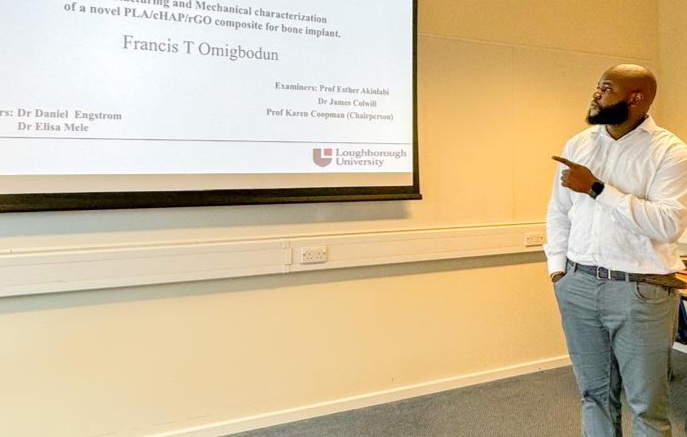
 In a remarkable stride toward revolutionizing medical implants, Dr. Francis Tobi Omigbodun, a doctoral researcher at Loughborough University’s prestigious Wolfson School of Mechanical, Electrical, and Manufacturing Engineering, has successfully defended his PhD thesis, unveiling a novel composite material for bone implant applications. His work, described as a fusion of engineering ingenuity and biomedical innovation, could redefine the future of bone reconstruction surgeries and tissue engineering.
[ad]
The research, defended on July 25, 2024, introduces tailored PLA/cHAp/rGO composites, an advanced class of biomaterials capable of mimicking and surpassing the minimum mechanical properties of human cortical and cancellous bones. Utilizing 3D printing techniques, Dr. Omigbodun’s groundbreaking approach paves the way for cost-effective, customizable, and highly effective bone scaffolds that could transform patient outcomes worldwide.
The Fusion of Engineering and Medicine
Modern medicine is increasingly intertwined with engineering disciplines, including tissue engineering, bioengineering, and materials science. These fields provide the tools and methodologies to address critical medical challenges, such as bone regeneration. Dr. Omigbodun’s research builds on this interdisciplinary approach, leveraging advanced materials engineering to address the dual demands of structural integrity and biological compatibility in bone implants.
Bone reconstruction grafts, commonly used in orthopedic surgeries, rely on scaffolds that mimic the porous structure of human bone. These scaffolds must not only support blood flow and cell growth but also withstand the mechanical loads that bones endure daily. Dr. Omigbodun’s innovative research utilizes Material Extrusion Additive Manufacturing (MEAM), a 3D printing technology, to develop scaffolds with tailored mechanical properties, porosity, and degradation rates.
Tailored Biomaterials: PLA/cHAp/rGO Composites
At the heart of this pioneering study lies the development of PLA/cHAp/rGO composites. These materials combine Polylactic Acid (PLA), calcium hydroxyapatite (cHAp), and reduced graphene oxide (rGO) to create a versatile and bioactive material. Each component plays a crucial role:
PLA: A biodegradable polymer that provides structural support and serves as the matrix for the composite.
cHAp: A mineral that closely resembles the natural composition of human bone, enhancing biocompatibility.
rGO: A highly conductive material that reinforces the composite, boosting its mechanical strength and enabling tunable degradation rates.
Through meticulous experimentation, Dr. Omigbodun formulated these composites in varying ratios to optimize their properties for specific biomedical applications.
3D Printing Revolution in Biomedical Engineering
Dr. Omigbodun’s research utilized MEAM to transform these innovative composites into 3D-printable filaments. This breakthrough enabled the creation of intricate scaffold designs, including gyroid and Schwartz primitive lattice structures. These designs were carefully selected for their ability to enhance the mechanical and structural properties of the scaffolds.

“3D printing has opened new horizons in biomedical engineering,” Dr. Omigbodun remarked during his thesis defense. “It allows for the precise customization of scaffold geometry, which is critical for achieving the desired mechanical properties and biological performance.”
The scaffolds produced in this study underwent rigorous testing to evaluate their mechanical attributes, such as modulus of elasticity, ultimate tensile strength, and compressive strength. The results demonstrated that the composites closely mimic human cortical bone, making them suitable for load-bearing applications in tissue engineering.
Comprehensive Characterization and Insights
Dr. Omigbodun’s research went beyond material formulation and scaffold fabrication. A comprehensive characterization of the composites was conducted using advanced techniques such as Fourier Transform Infrared Spectroscopy (FTIR), Scanning Electron Microscopy (SEM), and thermal analysis. These methods provided valuable insights into the compositional, structural, and thermal properties of the materials.
Additionally, the in vitro degradation behavior of the scaffolds was studied in a simulated physiological environment. By adjusting the matrix and rGO concentrations, Dr. Omigbodun demonstrated the ability to control the degradation rates of the composites. This tunability is a crucial feature for ensuring that the scaffolds degrade at a rate compatible with bone regeneration processes.
Simulation and Predictive Modelling
One of the most innovative aspects of this research is the integration of simulation and experimental validation. Dr. Omigbodun utilized predictive modelling to enhance the understanding of the mechanical behavior of PLA/cHAp/rGO composites. This approach not only streamlined the biomaterial design process but also reduced the need for extensive experimental iterations, saving time and resources.
The research highlighted the importance of lattice structure selection in influencing the mechanical properties and degradation profiles of the scaffolds. These findings could guide future biomaterial development and optimization efforts.
Implications for Medicine and Engineering
Dr. Omigbodun’s work represents a significant advancement in the field of biomaterials and tissue engineering. The tailored PLA/cHAp/rGO composites introduced in this study offer a promising solution for bone implant applications, combining superior mechanical properties with controlled biodegradation.
“This research bridges the gap between engineering and medicine,” Dr. Omigbodun explained. “By developing biomaterials that meet the mechanical and biological requirements of bone implants, we can improve patient outcomes and contribute to the advancement of regenerative medicine.”
The potential applications of these composites extend beyond bone implants. Their versatility and tunability make them suitable for various biomedical scenarios, including cartilage repair, dental implants, and load-bearing prosthetics.
A Vision for the Future
Dr. Omigbodun’s research sets the stage for future advancements in biomaterials and additive manufacturing. His innovative approach to scaffold fabrication and material characterization provides a roadmap for developing next-generation medical implants.
As the medical community seeks solutions to address the growing demand for advanced implant technologies, the work of researchers like Dr. Omigbodun offers hope and inspiration. His contributions not only advance scientific understanding but also hold the potential to improve the quality of life for patients worldwide.
Dr. Omigbodun’s achievement is a testament to the power of interdisciplinary collaboration and the transformative impact of engineering on medicine. His groundbreaking research has earned him recognition as a leader in the field, and his work will undoubtedly continue to inspire future innovations in biomaterials and regenerative medicine.
About the Researcher
Dr. Francis Tobi Omigbodun is a dedicated researcher with a passion for advancing biomedical engineering. His PhD research at Loughborough University’s Wolfson School of Mechanical, Electrical, and Manufacturing Engineering focused on developing innovative solutions for bone implant applications. With a commitment to improving patient outcomes, Dr. Omigbodun’s work exemplifies the transformative potential of engineering in modern medicine.

