 Follow Us on Google News
 Follow Us on Google Discover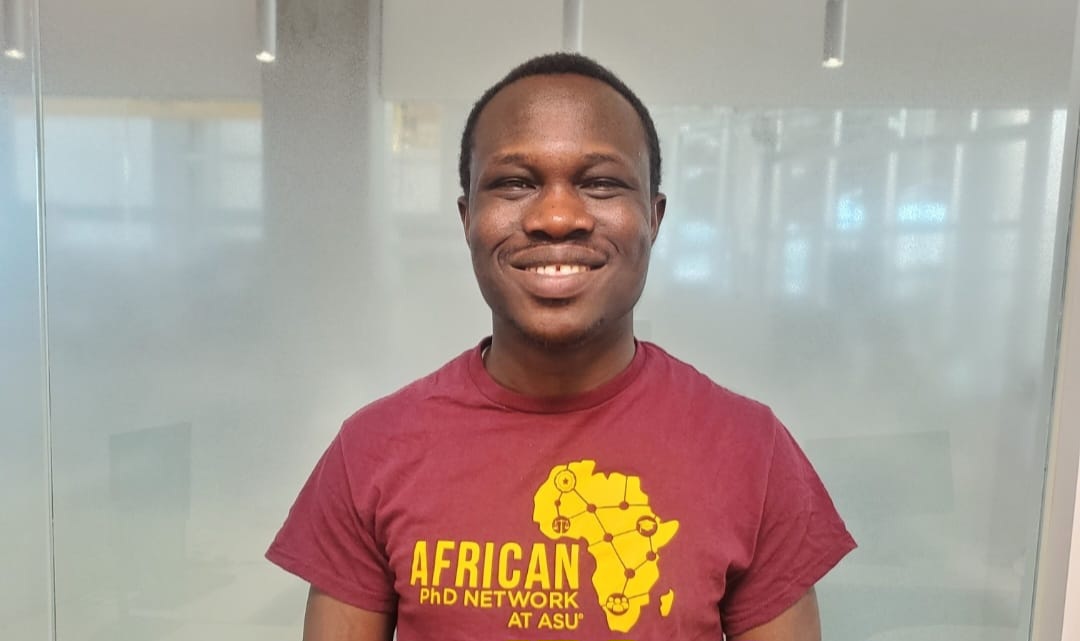
 As the global community faces unprecedented environmental challenges, individuals like Saheed Oluwasegun Raheem are stepping forward with innovative solutions to combat climate change.
[ad]
Saheed is a second-year Ph.D. student in Materials Science and Engineering at Arizona State University (ASU), United States of America. His research is driven by an unwavering passion for environmental sustainability, shaped by personal experiences. Growing up in Lagos State, Nigeria, Saheed witnessed the devastating impacts of climate change firsthand, as his childhood home was repeatedly flooded. These events ignited his commitment to finding lasting solutions to mitigate the effects of greenhouse gases (GHGs).
Before his doctoral studies, Saheed spent four years working as a Scientific Officer with the Ogun State Government in Nigeria’s Ministry of Industry, Trade, and Investment. There, he played a key role in combating illegal mining and reducing environmental degradation across the state. His work ranged from providing technical support for mineral-based industries to exploring and documenting new deposits of economic mineral resources, ensuring that operations adhered to environmentally friendly practices. While this role was impactful, Saheed’s desire to contribute more profoundly to environmental challenges motivated him to pursue advanced education.
Transitioning from his background in Physics—where he earned both undergraduate and master’s degrees—Saheed’s Ph.D. research at ASU focuses on a cutting-edge area: carbon dioxide (CO₂) removal from seawater. His work involves the synthesis of polysulfone membranes embedded with redox-active compounds to capture CO₂. He is also developing an experimental setup to measure CO₂ concentrations in liquid under varying pressure conditions. Saheed emphasizes the interdisciplinary nature of his work, drawing connections between his master’s thesis—“Vibrational Resonance Analysis in Josephson Junction Subject to Biharmonical Forces”—and his current research. Reflecting on the parallels, he explains:
“Josephson junctions are extremely sensitive to small changes in external fields, such as electric or magnetic fields. Incorporating similar sensitivity into membrane systems could enable dynamic control of gas transport or adsorption, which is critical for addressing CO₂ emissions.”
Saheed’s academic journey reflects his dedication to excellence. At Lagos State University, he graduated among the top 1% of his class, earning recognition as a University Scholar. At ASU, he taught undergraduate classes in his first year as an international student before dedicating himself fully to his research at the Center for Negative Carbon Emissions.
In addition to his research, Saheed’s professional background spans significant teaching and mentorship roles. From tutoring undergraduate Physics students to preparing secondary school students for external exams, his teaching has consistently yielded measurable academic improvements. As an education consultant, he guided schools in Lagos and Ogun States, helping students achieve higher academic standards.

Saheed’s passion for youth development extends beyond academics. In his community, he organized football and quiz competitions to foster unity among young people and motivated them to prioritize education. His efforts led to a significant increase in the number of students gaining admission into tertiary institutions.
With his interdisciplinary expertise and unwavering commitment to environmental sustainability, Saheed continues to contribute toward innovative solutions in the global fight against climate change. His work embodies a vision of a world where science and engineering address humanity’s most pressing challenges.

