 Follow Us on Google News
 Follow Us on Google Discover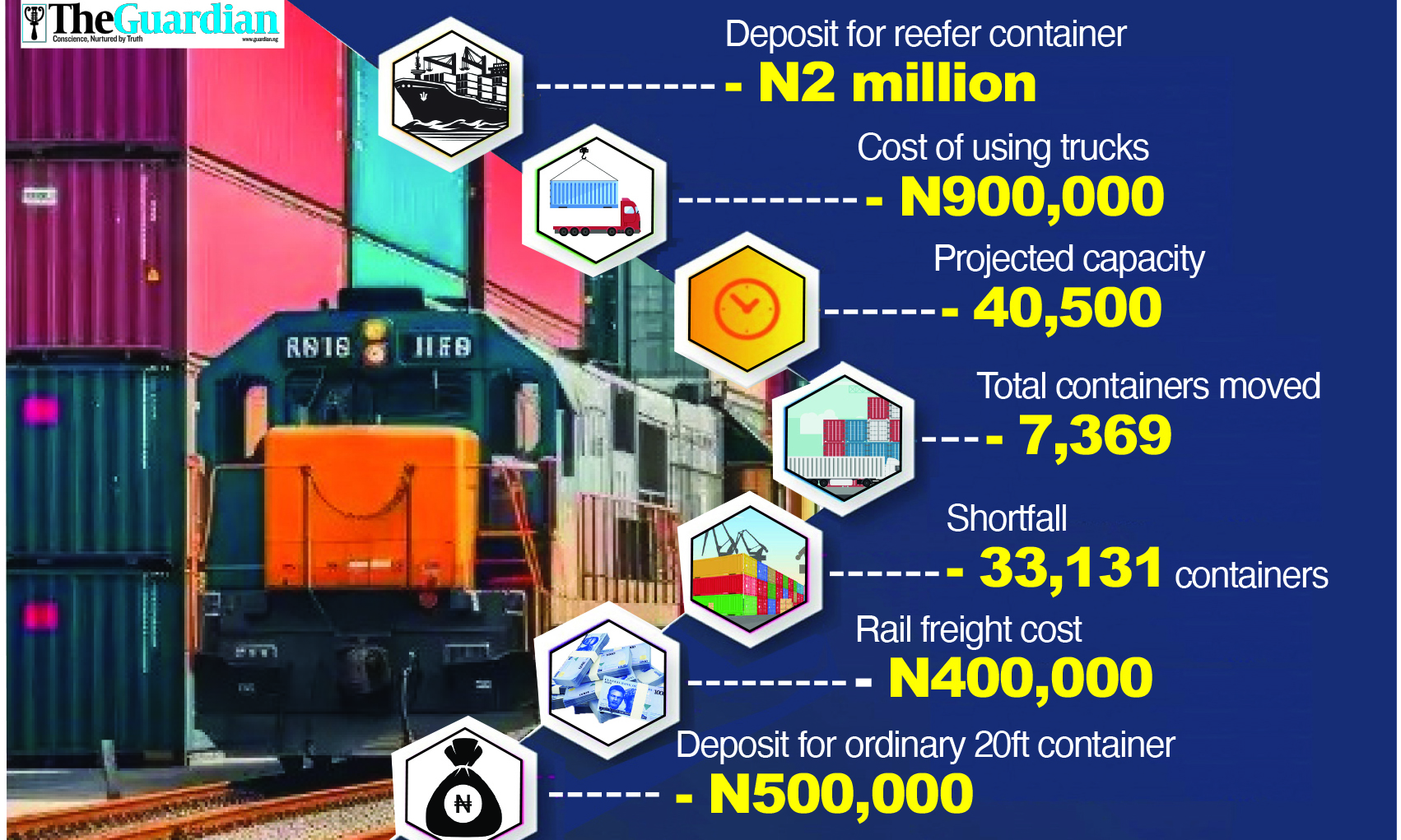

• Complex processes, cost responsible for 18% capacity utilisation
• Importers lose N3m per container to rail inefficiencies, freight delay
• High cost, logistics failure choke activities
Fifteen months after the commencement of operations on the Apapa Port-Ibadan cargo freight service, only 7,369 containers have been moved on the rail, underscoring the low utilisation of the $1.5 billion project.
[ad]
The number is about 18 per cent of the projected traffic during its conception. The Minister of Transportation, Saidu Akali, during the flag-off of the freight movement in September 2023, put the daily traffic at 90 containers.
That would have translated to an estimated 2,700 containers in a month and 40,500 from inception. But data obtained from the Nigeria Ports Authority (NPA) Lagos Port Complex, showed that cargoes moved monthly so far are merely 18 per cent of the capacity.
From October to December 2023 a total of 470 import, export and empty containers were moved through the rail. A further breakdown down showed that in October, there were 69 containers of exports, 49 containers of import with no empties moved, while in November there were 60 export and 82 import containers with no empties.
In December, there were 60 empty containers, 40 export and 119 import containers moved. The total moved in 2023 was 60 empties, 169 containers of export and 250 containers of import.
A total of 6,890, including 217 empties, 5,186 export and 1,487 import containers, were moved on the tracks.In January, 40 were empty, 513 export and 19 import containers were moved, while February recorded 563 export and 84 import containers.
March recorded three empties, 880 exports and 71 import containers, April had 93 empties, 825 export and 141 import containersjust whereas May recorded no empty containers but had 762 export and 116 import containers.
Data for June showed no empty containers were moved, while 62 export and 535 import containers were recorded. July saw 81 empties, 490 export and no import containers, while August had 470 export containers.
[ad]
For September, only 231 export containers were moved with zero empty and import containers. October had only 177 export containers with no empty and import containers.
The data revealed that November recorded no empty but had 161 export and 402 import containers. So far, December recorded no empty containers. It, however, recorded 52 export and 119 import containers.
From the number of containers moved within the 15 months, there has been a shortfall of 33,131 containers when weighed against projected capacity. The Guardian learnt that low patronage of rail freight is caused by high costs, inefficiencies and complex processes, which leave shippers exploring other options. This time-consuming process causes delays in delivering cargoes, causing importers N400,000 to N3 million losses on container deposits, depending on container type.
The National Coordinator of the Save Nigeria Freight Forwarders, Importers, and Exporters Coalition (SNIFIEC), Osita Chukwu, decried the financial and logistical bottlenecks in the rail freight system, highlighting exorbitant costs and inefficiencies in the rail-to-truck transition process as factors hindering the smooth rail movement of cargo.Chukwu noted a significant cost disparity between rail and road transport, noting that rail freight is expected to be cost-effective and efficient, but is not.
The Guardian learnt that aside from the rail freight cost, the additional cost of transporting the container from the Ibadan rail terminal to the destination makes using rail expensive.
Chukwu said transporting containers from the Ibadan rail terminal to their destination incurs an additional N600,000 to N700,000 after paying N400,000 to N450,000 for rail freight from Apapa port.
In contrast, Chukwu said using trucks directly from Apapa port to the destination in Ibadan and other connecting states costs about N900,000. He also noted that additional costs arise from the need to truck containers from the rail drop-off points at the Apapa port to the ship, which cost between N500,000 to N600,000 per trip.
[ad]
Chukwu stated that truck drivers exploit the situation, knowing shippers have no alternative, which doubles the cost for shippers, who are already burdened with rail freight and other expenses.
“When a truck enters the port to drop a container, the driver often doesn’t get another job immediately, so they charge double. This is the trick and tactic they use,” he said.
Chukwu described the rail system as time-consuming, noting that rail operators often wait for all containers to be loaded before departure and then stop at different points for export containers to be loaded. He also highlighted the mechanical breakdown of the train causing delay in delivering the cargo for up for five days or more, while trucks take just hours to deliver the same cargo to the destination.
Chukwu also criticised the financial strain caused by demurrage charges, which accumulate daily as cargo delays persist from loading and unloading cargoes multiple times before reaching its destination.
He said shipping companies take over the container deposit funds due to the delay in returning the containers to the port.
The Guardian learnt that for a reefer container, the deposit is about N2 million, while fast-track container require N3 million. Ordinary 20ft containers need about N400,000 to N600,000.
Chukwu stated that these deposits begin running as soon as delays occur, and shippers are left bearing the losses.
“The shipping companies don’t have anything to lose. The importers are the ones that pay in the money as a deposit. You will be worried and the train will be wasting time. At times some trains will be stuck, they will spoil and then they will be fixed. It will waste all the time before they get it done and then your money is gone,” he lamented. He urged authorities to incentivise shippers, streamline processes and address operational bottlenecks to reduce delays and associated costs.
“Other countries encourage shippers, but here, policies burden them. It’s time for a rethink. If the government provides express train like it is used abroad, it means that within one to two hours your cargo will be delivered to you and people will start using it,” he said.
The Head of the Customs and Trade Facilitation Committee at the Importers Association of Nigeria (IMAN), Ajanonwu Vincent, said importers are discouraged from utilising facilities such as the Ibadan Inland Container Depot, which was originally intended to serve the Lagos-Ibadan trade axis.
He said due to anti-trade policies of the Federal Government, many importers in this region have ceased operations, leading to low patronage of the Apapa-Ibadan rail project.
[ad]
Vincent highlighted several costs associated with moving cargo via the rail system that further deter importers, such as tracing and fork lifting fees for containers, freight charges by the Nigerian Railway Corporation (NRC), Federal Operations Unit (FOU) of the Nigeria Customs Service (NCS) escort charges, offloading, storage, terminal handling, and other operational expenses. He said the $1.5 billion rail project faces the same challenges that have plagued bonded terminals across Nigeria, struggling to attract significant patronage.
The General Secretary of the Association of Bonded Terminal Operators of Nigeria (ABTON), Haruna Omolajomo, expressed frustration over the inefficiencies hampering the effectiveness of the $1.5 billion cargo rail investment, attributing the problem of low patronage to poor planning, lack of stakeholder engagement and the absence of supporting legislation.
Omolajomo, who is also the Managing Director of Harsecom Logistics Limited, stressed that stakeholders and businesses are eager to leverage the rail system due to its freight cost-effectiveness and safety advantages. Still, numerous operational bottlenecks and inadequate government support, deter them fromfully utilising the system.
Omolajomo emphasised the need for government collaboration with stakeholders to address these issues and unlock the full potential of cargo rail transport.
Omolajomo urged the government to take drastic steps if it wants the cargo rail project to be effective, noting that failure to address these issues will continue to cost Nigeria revenue,employment and economic growth. He also urged the government to demonstrate political goodwill to ensure the success of the $1.5 billion cargo rail investment.
[ad]

