 Follow Us on Google News


 Follow Us on Google Discover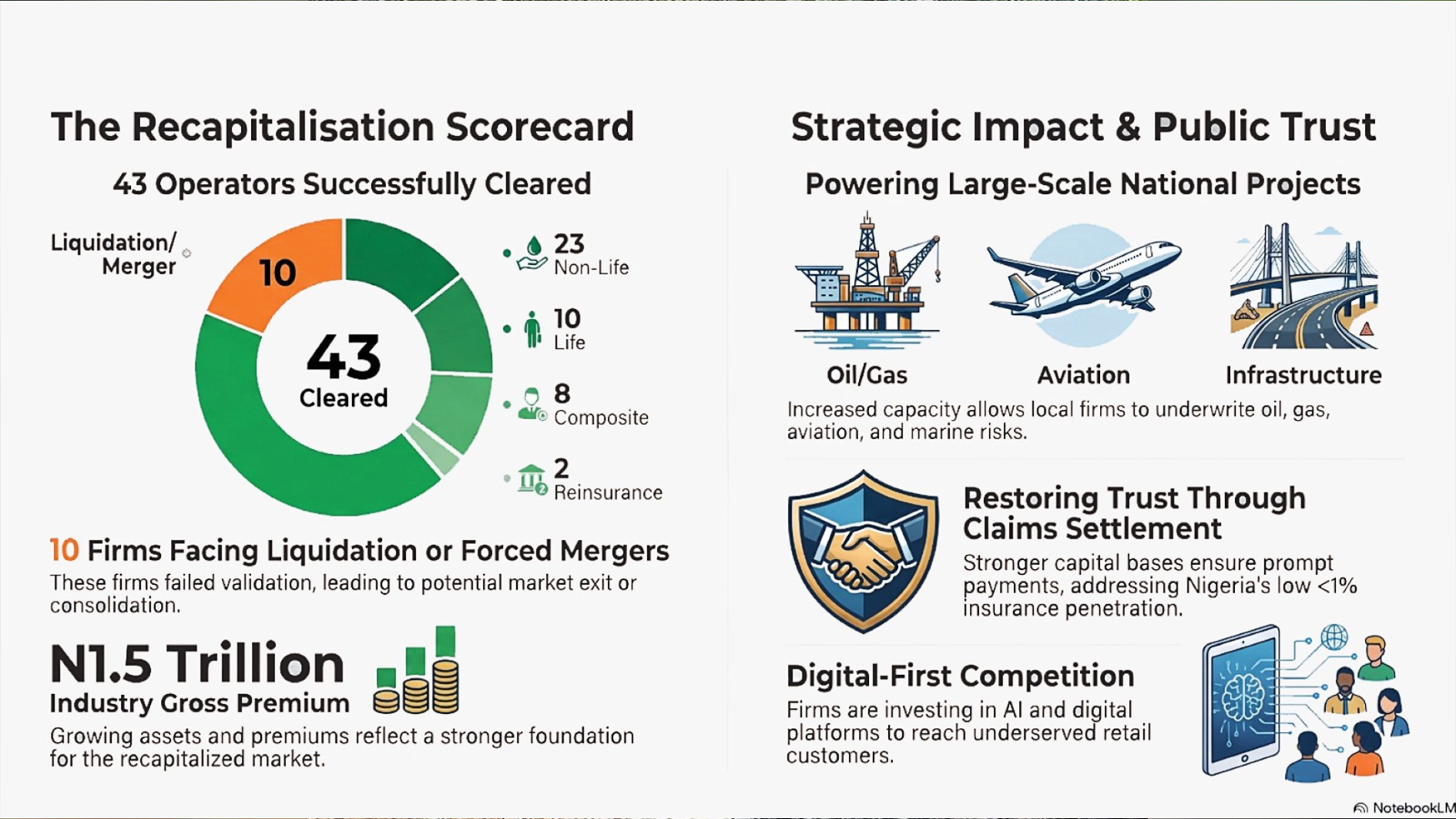
• Anxiety over possible forced merger, acquisition
• Structural legacy challenges confine insurance adoption to less than 1%
• Regulatory focus shifts to governance, trust building
• 23 to operate as non-life insurers, 10 life
A regulatory axe is still hanging over at least 10 insurers that have yet to complete capital adequacy verification, even as 43 operators have been cleared by the regulator at the close of the fund-raising window on July 31.
A status report seen by The Guardian at the weekend said eight are currently undergoing capital validation, a process that would be completed in 14 days.
In the interim, 23 operators have been cleared under the non-life category while 10 will operate as life. The reinsurance category has two cleared under it, while eight firms will operate as composite insurers.
Whereas the industry regulator has not given the names of companies yet to be validated, findings revealed that about 10 active firms have not been given clean bills of health. They are African Alliance Insurance, Universal Insurance, Sovereign Trust Insurance, Guinea Insurance Plc, Goldlink Insurance and emPle General Insurance Company Nigeria.
Others are Regency Alliance Insurance, Alliance and General Insurance and Royal Exchange Prudential Life.

With eight firms said to have filed for capital verification and validation, the burden is on the regulators and their appointed auditors to prove that the firms have the regulatory room to continue operation or otherwise, while giving a final directive on the ones that have not submitted themselves for the verification exercise.
But with the National Insurance Commission (NAICOM) yet to release the list of companies that are yet to comply, there is no closure to the apprehension that has caused a significant dumping of insurance stocks since the beginning of the year.
Quoted insurance firms rallied in the second half of last year following the passage of the Nigerian Insurance Industry Reform Act (NIIRA) 2025. At the close of the year, the sector’s index outperformed the NGX’s all-share index (ASI) by about 20 percentage points to finish the year at over 1200 points.
Whereas ASI had gained approximately 58 per cent year-on-year (y/y) at the close of July, the insurance index was trapped at 1,200 points, with its growth potential undermined by recapitalisation anxiety.
Yesterday, NAICOM unveiled the list of successful operators to include Zenith (non-life), Leadway (composite), Custodian (life), Custodian and Allied (non-life), NEM (non-life), Aiico (composite), CHI (life), Heirs General Insurance (non-life), Heirs Life (life), Fin (non-life), Cornerstone (composite) and Mutual Benefits (non-life).
Others are Tangerine (non-life), Capital Express (non-life), Continental (reinsurance), FBS (reinsurance), Sanlam-Allianz (non-life), Prudential Zenith (life), Consolidated Hallmark (non-life), Stanbic IBTC (life), Sanlem-Allianz Life (life), Sterling Assurance (non-life), Axa Mansard (composite) and Great Nigeria (composite).
Unlike the banking recapitalisation, updates about the capital verification exercise have been scanty – from both the regulator and operators. Until the window closed, only 15 companies were said to have been cleared, raising questions on whether the directive was merely symbolic and whether the regulator would extend the window.
Until the weekend, operators were still calling for a six-month extension to help increase the success of the programme and give the country a chance at a more efficient insurance sector.
The NAICOM announcement marks the conclusion of one of the most ambitious reforms undertaken by the Commission since the introduction of risk-based supervision and signals the beginning of a new phase for NIIRA 2025.
Unlike previous capital verification exercises, the reform was designed not merely to increase shareholders’ funds but to create insurers with stronger financial capacity to underwrite larger risks, improve claims settlement, strengthen policyholder protection and support national economic development.
Industry observers believed the exercise would produce fewer but stronger insurance companies with sufficient financial capacity to participate more actively in infrastructure financing, oil and gas projects, aviation, marine insurance, agriculture, renewable energy and emerging climate-related risks.
Several insurance companies concluded multi-billion-naira rights issues, while others secured strategic investors or entered merger negotiations to comply with the new capital regime.
Industry sources, however, said some of the most significant developments occurred behind closed doors as merger and acquisition negotiations intensified among operators seeking stronger balance sheets and long-term competitiveness.
Stakeholders described the consolidation as the biggest restructuring of Nigeria’s insurance industry since the banking sector consolidation of 2004 and subsequent recapitalisation exercises.
Despite sustained improvements in profitability over recent years, insurance penetration in Nigeria remains below one per cent of gross domestic product (GDP), with contribution and penetration hovering around 0.6 per cent – one of the shallowest in the world.
This contrasts sharply with South Africa, where insurance penetration exceeds 10 per cent. Several African economies continue to outperform Nigeria despite having significantly smaller populations.
The industry’s gross written premium has exceeded N1.5 trillion, while total assets have continued to expand steadily, reflecting stronger earnings, improved investment income and growing capitalisation among leading operators.
Yet, the impressive financial indicators have not translated into widespread insurance adoption. Millions of Nigerians remain uninsured, while compulsory insurance classes – including public buildings, buildings under construction, occupiers’ liability, group life and motor third-party insurance – continue to suffer weak enforcement.
Announcing the outcome of the exercise, the Commissioner for Insurance, Olusegun Omosehin, said the recapitalisation programme had strengthened the financial resilience of operators, attracted substantial domestic and foreign investment and laid the foundation for a stronger, more resilient and policyholder-focused insurance industry.
According to him, stronger capital bases will improve insurers’ ability to honour claims promptly, absorb emerging risks, support infrastructure financing and compete more effectively in regional and global insurance markets, while strengthening risk-based supervision.
For decades, Nigerian insurers ceded substantial portions of large oil and gas, aviation, marine and infrastructure risks to offshore reinsurers because of inadequate underwriting capacity.
Stakeholders believe stronger capitalisation should enable operators to retain a greater proportion of such risks within the domestic economy, conserve foreign exchange and create additional investment opportunities.
Former Managing Director of FSL Insurance Broker Limited, Alfred Daudu, said the consolidation wave should not be interpreted as evidence of distress but as an inevitable stage in the evolution of a modern insurance market.
According to him, larger institutions would benefit from economies of scale, stronger risk diversification, better operational efficiency and improved access to investment opportunities, while well-structured mergers would enhance shareholders’ value and position Nigerian insurers to compete more effectively under the African Continental Free Trade Area (AfCFTA).
He added that companies emerging from the exercise with stronger governance structures, healthier balance sheets and clearer strategic direction are likely to attract greater institutional and foreign investment.
The Chairman of the Nigerian Insurers Association (NIA), Ebelechukwu Nwachukwu, has consistently maintained that public confidence in insurance will depend not only on stronger capital but also on prompt settlement of genuine claims, improved customer experience and innovative products capable of deepening insurance penetration.
Digital underwriting, artificial intelligence, automation, cyber security, predictive analytics and embedded insurance are expected to define the industry’s next phase of competition.
Companies emerging from the recapitalisation exercise with stronger capital are expected to invest more aggressively in digital distribution platforms capable of reaching underserved retail customers, small businesses and informal sector operators.
Industry observers argue that technology will become one of the biggest differentiators among recapitalised insurers.
Nevertheless, experts caution that mergers and acquisitions present considerable execution risks. Integration challenges, cultural differences, governance conflicts, technology harmonisation and workforce restructuring have historically undermined corporate mergers across sectors.
Although NAICOM confirmed that 43 companies met the new capital requirements, the Commission disclosed that eight insurers remain under final verification after submitting evidence of compliance shortly before the deadline. The regulator said the review would be concluded within 14 days as it continues post-recapitalisation supervisory actions and industry restructuring.
For many operators, recapitalisation represents not the end of a regulatory exercise but the beginning of a more competitive market where capital strength, innovation, governance, technology and customer trust will increasingly determine market leadership.
The challenge before NAICOM now is to ensure that the post-recapitalisation transition remains transparent and orderly, while the challenge before operators is to demonstrate that stronger balance sheets could translate to stronger institutions, better claims settlement, deeper insurance penetration and a more meaningful contribution to Nigeria’s economic development, which are legacy gaps in the sector.

