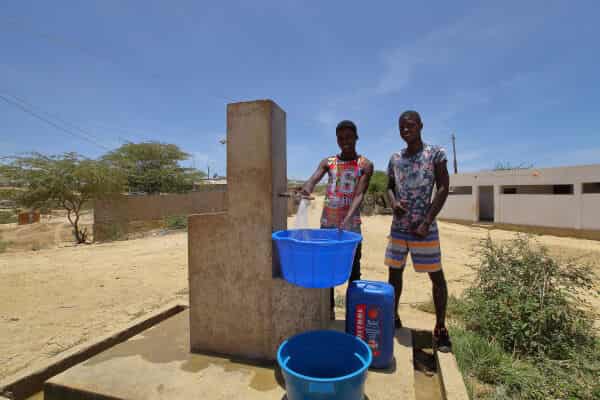
As concerns continue to rise over possible outbreaks of cholera and other water-borne diseases, the Federal Government says it has developed innovative solutions, leveraged technology, and strengthened collaboration with local and international partners to address the issue.
The Minister of Water Resources and Sanitation, Prof. Joseph Utsev, stated this in Abuja on Wednesday while delivering a keynote address at the launch of the Nestle Water Quality Advocacy Campaign.
The minister said that while appreciable strides in expanding water supply infrastructure have been recorded, ensuring the safety of available water for consumption remains a critical challenge.
He disclosed that the Federal Government has established 12 laboratories nationwide for water quality monitoring and surveillance under the National Water Quality Reference Laboratories and Monitoring Network Programme.
He also revealed that the Nationwide Assessment of Drinking Water is designed to collate national data and track Nigeria’s progress toward SDG 6.1.1, the proportion of the population with access to safe drinking water.
His words: “Although the journey to achieve universal access to safe water for sustainable public health is long and challenging, it is also filled with opportunities. To overcome the obstacles that stand in our way and create lasting change, this advocacy by Nestlé highlights a shared responsibility. It challenges us—the government, private sector, academia, civil society, and development partners—to take decisive steps.”
He stressed the need for robust investment in water quality monitoring, enforcing standards, raising public awareness, and empowering communities to be custodians of the water they drink.
While quoting Corporate Accountability and Public Participation Africa (CAPPA) research, the Corporate Affairs and Sustainability Lead, Nestle Nigeria, Victoria Uwadoka, said more than 113 million Nigerians lack access to safe drinking water, hence the need for collective effort at boosting the availability of safe water in Nigeria.
According to reports, an estimated 87,000 children under five die annually from diarrhoea linked directly to inadequate water, sanitation, and hygiene.
Indeed, broader studies suggest that over 70,000 lives are lost each year to waterborne diseases.
She noted that poor sanitation costs the economy an estimated ₦455 billion every year, straining families and institutions alike.
She explained that water quality is not just a technical or policy issue, but about basic needs, human dignity, and socio-economic sustainability.
While Nigerians believe that ‘water is life,’ and ‘water does not have an enemy,’ it is only quality water that is life, and unsafe water is a real enemy to health and well-being.
She added that the Quality Water Advocacy Campaign aims to create awareness and to catalyse action to address the water quality challenges.
“Our objective is clear: to close the knowledge gap on water quality and safety, a topic that is not discussed often enough despite its supreme importance. The advocacy campaign is not just about Nestle Nigeria; it is about all the stakeholders. The change we need requires multi-sectoral action. Each of us—government, industry, media, academia, civil society, and indeed every individual—has a role to play,” she stated.
On his part, Business Executive Officer, Nestle Waters and Premium Beverages, Olutayo Olatunji, maintained that quality water cannot exist without a healthy environment.
While food is existential, Olatunji submitted that food cannot achieve its purpose without water, adding, “Safe water is the starting point—for health, for nutrition, for community development, and for sustainability.”