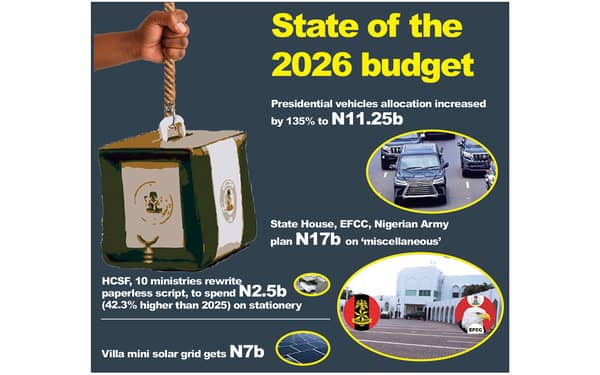
• Presidential vehicles allocation increased by 135% to N11.25 billion
• HCSF, 10 ministries rewrite digitalisation script, to spend N2.5b on stationery
• Cost jumps by 42 per cent this year
• Villa mini solar grid gets N7 billion
• State House, EFCC, Nigerian Army plan N17b on ‘miscellaneous’
For a strained economy, the Federal Government’s appropriation proposal appears less like a national economic rescue plan than a tool for elite official comfort, with hundreds of billions of naira earmarked for vehicle upgrades, office maintenance, miscellaneous and sundry frivolities that add nothing to efforts to halt the slide.
Detailed allocations to ministries, departments and agencies (MDAs) as released by the Budget Office of the Federation show a mockery of the call for a cut in the cost of governance to reflect the urgency of the moment, including increasingly uncertain revenue performance, a wide infrastructure gap and rising need for sensitivity among public officials.
Across MDAs, the proposal is rife with official indulgence, and frivolous allocations thrive. Numbers that raise questions about the government’s commitment to fiscal discipline and mask its priorities in a year when the administration is expected to wean itself of the legacy crisis and articulate its clear path.
Miscellaneous, a term often loosely used for a basket of infinitesimal items, has assumed a more dignified space in the budget.
The State House Headquarters, Nigerian Army and the Economic and Financial Crimes Commission (EFCC) alone are earmarking N16.78 billion for ‘miscellaneous’ expenditure this year.
The Nigerian Army alone will spend N10.52 billion on miscellaneous items in the year. Understandingly, the Army, an institution whose spending items are largely confidential, has the largest miscellaneous spending in this year’s appropriation. The EFCC and the State House Headquarters will spend N3.09 billion and N3.17 billion, respectively, in the year.
The Nigerian Navy also earmarked over N1 billion on the loose expenditure line. While the cases of the armed forces are understandable, it is difficult to understand why it has also become a tradition for diplomatic outstations to vote hundreds of millions of naira on miscellaneous items.
The same question goes for the Bureau of Public Procurement (BPP), whose miscellaneous expenditure is projected at N300 million and the Nigeria Extractive Industries Transparency Initiative (NEITI), with a budget of N584.27 million in the increasingly popular item. The Defence Missions and the Ministry of Foreign Affairs also voted N1.86 billion and N1.14 billion, respectively.
Many resources are also being frittered away through luxury vehicle procurement. Last year, the government earmarked less than N5 billion for presidential vehicle procurement. This year, the figure has more than doubled to N11.25 billion, raising concern about the priority of the government at a time when its reforms have made three square meals per day a luxury for many households.
Where the government seems to have achieved modest progress in cost of governance reduction, the budget shows a significant relapse.
The Head of Civil Service of the Federation (HCSF), which had committed to paperless operation, and 10 ministries, will collectively spend a whopping N2.46 billion on papers and other office materials. That figure is N731.85 million or 42.3 per cent higher than the N1.73 billion budgeted last year.
Going paperless, a policy thrust that is both informed by climate adaptation and cost minimisation, presupposes that the institution would significantly scale down its budget for paperwork or at least start gradually. Sadly, they have raised the estimated cost in a year, the naira has gained modestly and reduced the foreign exchange (FX) pass-through effect on inflation.
Last year, the HCSF rolled out the 1Gov Enterprise Content Management System (ECMS) to fast-track Nigeria’s shift to a paperless, digitally-driven public service.
The initiative was said to be a key driver of the Federal Civil Service Strategy and Implementation Plan (FCSSIP 2025).
By December 31, 2025, the Head of Service, Didi Esther Walson-Jack, announced that all 38 ministries and extra-ministerial departments were operating digitally and that any physical paper submissions would no longer be accepted in registries.
Part of the objectives of the digitalisation is to curb the huge sums of money spent on paper and other office consumables.
However, an analysis of the 2026 budget proposal submitted to the National Assembly by the President shows that the country is far from achieving the savings from stationery.
The Head of the Civil Service, which championed the digital migration, proposed to spend N300.88 million on stationery this year, a figure that is N101.1 million above what it spent in 2025.
Also, the Ministry of Defence, which allocated N350.57 million for stationery last year, proposes to spend N638 million this year. This figure is 82 per cent above last year’s spending proposal.
The Ministry of Justice, which spent N125 million on papers last year, has had its yearly budget quadrupled to N525 million this year, just as the Ministry of Budget and Economic Planning also marked up its stationery budget from N90 million to N117 million this year.
Ministry of Police Affairs raised its budget from N45.45 million to N60.47 million for the year. Women Affairs stands out as the only ministry that cut its budget for stationery – from N138.47 million last year to N40 million, a 71 per cent reduction.
Five other ministries, including Agriculture and Food Security, Communication and Digital Economy, Foreign Affairs, Education and Environment, simply copied and pasted their 2025 stationery budgets – N67.25 million, N45.96 million, N463.58 million, N100.19 million and N105.5 million respectively.
The reproduction underpins the growing and increasing casualisation of budgets across different tiers of government.
Spending on stationery, an item many private organisations have successfully eliminated, has become a major drain on the government purse. It is estimated that the entire public sector in Nigeria spends about N50 billion yearly on paper and allied accessories.
In 2024, only 10 ministries, including Finance, Defence, and Foreign Affairs, among others, collectively spent N969.37 million on stationery. The figure jumped to N1.52 billion last year.
The Federal Government initiated the digital transformation system under the 1Gov Enterprise Content Management System (ECMS), according to the Head of the Civil Service of the Federation, which was designed to reduce the revenue spent on stationery as well as speed up workflow in MDAs. It was also expected to boost transparency/efficiency and encourage MDAs to share documents seamlessly.
“It is a cultural shift – moving from file-walking to real-time digital decision-making,” the Head of Service said of the new system, which comes at a huge cost to the government as well.
The budget details, currently before the National Assembly, show significant developmental capital being moved to high-cost luxury procurements, office reconstruction or makeover, a pattern that undermines President Bola Ahmed Tinubu’s promise of fiscal prudence and accountability.
From 2024, the first budget prepared by Tinubu, to 2026, billions have been consistently channelled toward luxury vehicle purchases, bloated maintenance costs and constituency projects, effectively, making the budget a vehicle of elite comfort rather than national economic development.
The most glaring is the allocations for the State House Headquarters. Across the three years, N17.74 billion was allocated to vehicle procurement alone and another N36 billion for the rehabilitation and maintenance of its offices and residences.
In 2024, the State House budgeted N6.35 billion for vehicles, including N2 billion for SUV replacement and N4 billion for operational vehicles. This pattern continued in 2025 with a N4.76 billion allocation for car purchases. The 2026 bill proposes a staggering N11.23 billion for vehicle procurement – more than double the previous year’s allocation.
Similarly, maintenance expenditures have remained persistently high, with N13.7 billion in 2024 and an enormous N25 billion in the 2025 budget, followed by N8.48 billion in the 2026 proposal.
Experts argued that annual, large-scale maintenance allocations indicate either highly inflated contracts or a lack of accountability for previous spending.
The three-year budgetary cycle also reveals the institutionalised use of MDAs for projects that fall outside their core mandates, often referred to as ‘zonal intervention’ or constituency projects.
In the 2026 appropriation bill, the Centre for Management Development (CMD), an agency focused on training and leadership, is set to spend N560 million for the supply of HiJet trucks for empowerment to youths and constituents of Borno North Senatorial District and another N840 million for the supply of empowerment items to SMEs to alleviate poverty in various selected locations. These apparently attempt to turn a specialised training institution into a vehicle of political patronage.
Comparative analysis against the two preceding years highlights the systemic nature of high-cost recurrent expenditures. While the overall allocation to the presidency dropped nominally from N466.1 billion in the 2025 Act to N355.1 billion in the 2026 proposal, funding for high-value capital maintenance under the State House remains substantially high.
The capital budget for rehabilitation/repairs of office buildings has been a consistently high-cost item on the budget, overstating what the government categorises as capital expenditure.
The government plans to spend N1.28 billion on an ongoing office complex for SAs and SSAs at the State House this year alone, while the maintenance of the Presidential Villa itself (an ongoing project) gets a provision of N3.84 billion in the budget proposal. Previous budgets for the same projects had turned heads, with critics questioning the rationale of voting money for repair every year.
“The solarisation of the Villa with mini solar grid”, at the cost of N7 billion, takes a lion’s share in the projects under the State House Headquarters. The ongoing project received attention last year when it received a hefty N10 billion.