 Follow Us on Google News


 Follow Us on Google Discover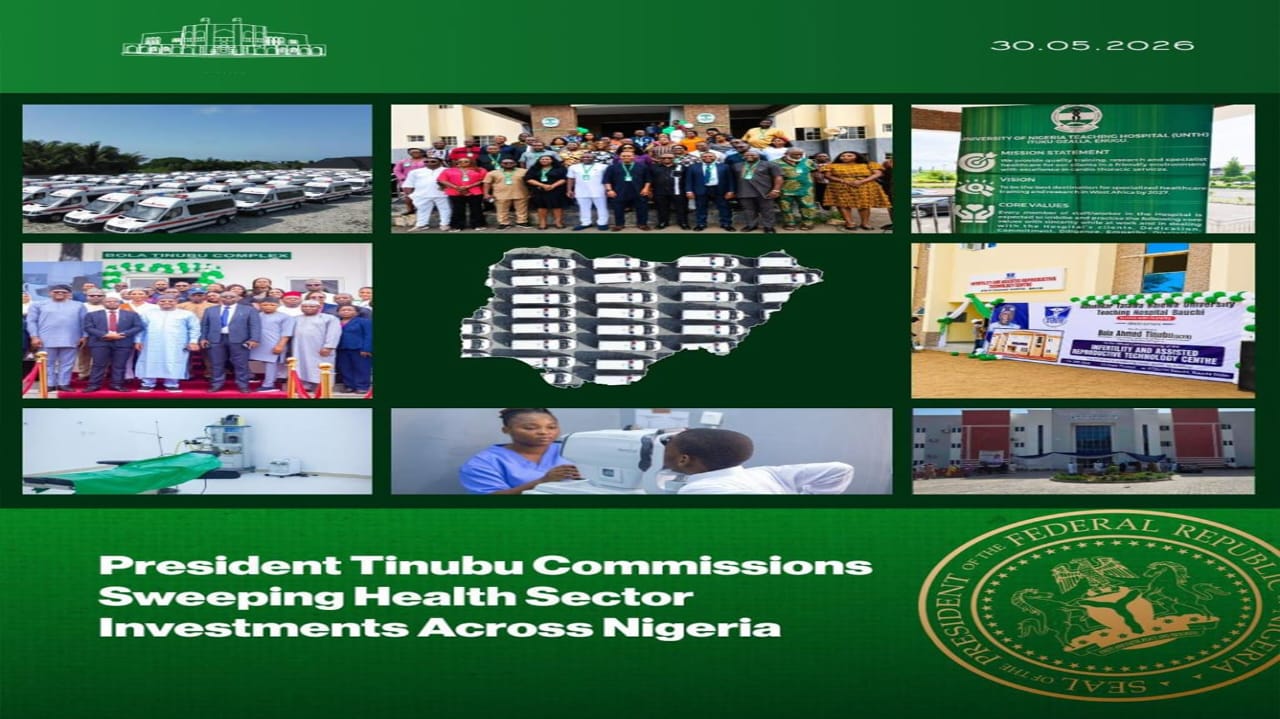
President Bola Ahmed Tinubu has commissioned sweeping package of new and upgraded health infrastructure across all six geopolitical zones of the country, in what government officials described as the most extensive single-day rollout of federal health projects in Nigeria’s history.
The commissioning formed part of activities marking the third anniversary of his administration and was anchored at the Federal Medical Centre, Jabi, Abuja, where the President inaugurated the Bola Tinubu Specialist Complex.
The facility includes consulting rooms, theatre suites, ophthalmology and ENT units, laboratories, pharmacy services, VIP wards, and general wards designed for integrated specialist care.
From the Federal Ministry of Health and Social Welfare headquarters, the President also flagged off the National Emergency Medical Service and Ambulance System (NEMSAS) emergency response fleet. The rollout includes tricycle ambulances, boat ambulances, digital coordination tools, and communication equipment supported under the World Bank-backed IMPACT programme.
Seventy-nine compressed natural gas (CNG) ambulances were also commissioned for federal tertiary health institutions to strengthen emergency response capacity and reduce operational fuel costs.
The NEMSAS framework is aimed at improving pre-hospital emergency care and strengthening referral systems across rural, urban, and hard-to-reach communities.

In Lagos, additional CNG-powered ambulances were commissioned along the Lekki–Epe corridor to further expand emergency medical response coverage nationwide.
In the North-West, three Polio Emergency Operations Centres (PEOCs) in Katsina, Kano, and Sokoto were upgraded and re-equipped to improve disease surveillance, immunisation coordination, and outbreak response.
The centres were originally established in 2013 with support from the Bill & Melinda Gates Foundation and are managed by eHealth Africa.
Also commissioned was the Gadon Kaya Primary Health Centre in Kano State under the IMPACT programme, alongside the Aboh Primary Health Centre in Delta State. These projects form part of a nationwide effort to revitalise primary healthcare delivery.
Across tertiary institutions, major infrastructure projects were inaugurated, including:
A new laboratory complex at the University of Uyo Teaching Hospital
An administrative complex at the University of Nigeria Teaching Hospital, Enugu
A pharmacy quality control laboratory at Ahmadu Bello University Teaching Hospital, Zaria.
In the North-East, two specialist centres were commissioned: a Mental Health and Drug Rehabilitation Centre at the University of Maiduguri Teaching Hospital, and an Infertility and Assisted Reproductive Technology Centre at Abubakar Tafawa Balewa University Teaching Hospital, Bauchi, equipped with advanced fertility diagnostics.
In the South-West, the Lagos Immunization Supply Chain Hub at Oshodi was also inaugurated as part of a national three-hub vaccine logistics system designed to improve storage and distribution efficiency.
Speaking at the event, President Tinubu said the reforms reflect a commitment to ensuring Nigerians have access to quality healthcare within the country.
“We are determined to give Nigerians the kind of care that, for too long, only those who could travel abroad enjoyed,” he said.
The Coordinating Minister of Health and Social Welfare, Muhammad Ali Pate, said the projects represent major progress toward achieving Universal Health Coverage by 2030 under the Health Sector Renewal Investment Initiative.
He stressed that infrastructure must be matched with stronger primary healthcare, immunisation systems, maternal care, and emergency response coordination.
According to the Federal Ministry of Health, nearly 3,000 primary healthcare centres have been revitalised in the past two years under the to IMPACT programme and related initiatives, alongside expanded emergency obstetric and newborn care services across the country.
Partners in the programme include the World Bank, the Gates Foundation, and several technical health implementation agencies.
Overall, the commissioning signals a coordinated push to strengthen Nigeria’s healthcare system across emergency response, primary care, and specialistmedical services nationwide.

