 Follow Us on Google News


 Follow Us on Google Discover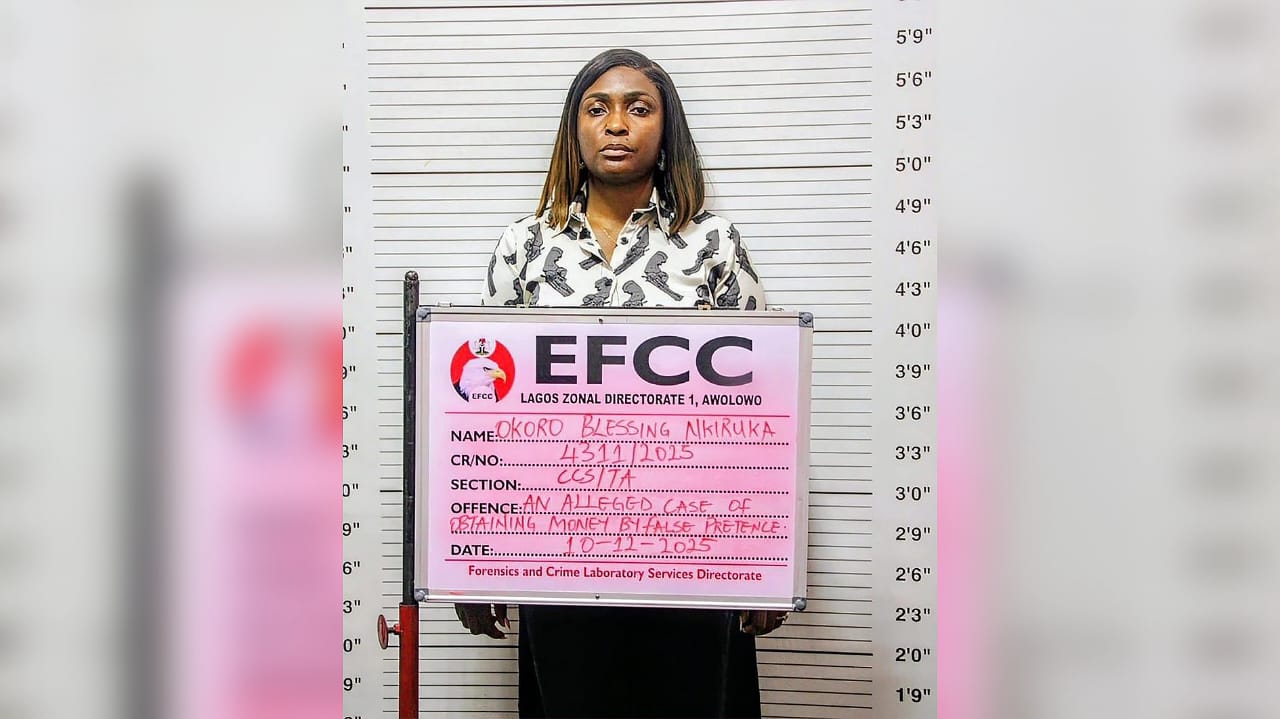
The legal battle involving controversial relationship coach and social media personality, Blessing Okoro, popularly known as Blessing CEO, took a fresh turn on Friday as the Federal High Court in Ikoyi, Lagos, reserved ruling on her bail application until June 9, 2026.
Blessing CEO is currently facing a two-count charge brought against her by the Lagos Zonal Directorate of the Economic and Financial Crimes Commission (EFCC) over allegations of obtaining money under false pretences and stealing N36 million in a disputed property transaction.
At Friday’s proceedings, defence counsel, P.I. Nwafuru, appealed to the court to admit the defendant to bail on liberal terms, arguing that she would make herself available throughout the trial. However, the request was strongly opposed by the EFCC, which insisted that the circumstances surrounding the case warranted caution.
Prosecution counsel, S.I. Suleiman, informed the court that the anti-graft agency had already filed a comprehensive counter-affidavit challenging the bail application.
According to him, investigators encountered difficulties during the course of their probe, alleging that the defendant at some point stopped responding to invitations issued by the Commission.
The prosecution urged the court to reject the bail request and instead focus on ensuring a speedy trial, arguing that the allegations before the court involve serious financial misconduct that deserves urgent judicial attention.

Beyond the bail arguments, the court also heard testimony from the prosecution’s first witness, EFCC investigator Bufa Regina Okangbe, who gave a detailed account of the investigation that led to the charges against the social media influencer.
Okangbe told the court that the Commission launched an investigation after receiving a petition alleging that Blessing CEO collected N36 million from a complainant in connection with a property transaction.
According to her, investigators conducted extensive checks, including a Bank Verification Number (BVN) search, which allegedly revealed multiple bank accounts linked to the defendant.
She disclosed that the EFCC subsequently contacted several financial institutions, the Lagos State Land Bureau, and the Corporate Affairs Commission (CAC) as part of efforts to verify ownership claims relating to the disputed property and establish the flow of funds connected to the transaction.
The witness further testified that during questioning, the defendant made statements in the presence of her husband and legal representative, allegedly acknowledging receipt of N30 million from the complainant.
A key aspect of the prosecution’s case emerged from findings obtained from the Lagos State Land Bureau. According to the witness, records showed that the property at the centre of the dispute was not owned by Blessing CEO but by one Tunbosun Osobu.
The court heard that Osobu later appeared before investigators alongside his lawyer and son, where he reportedly confirmed that he had leased the property to the defendant for a period of three years. The lease, according to investigators, expired in 2023 before being renewed in 2025.
Okangbe also revealed that the complainant submitted several documents to investigators, including a tenancy acquisition form and a lease agreement allegedly executed between the complainant and the defendant.
As part of its efforts to strengthen the case, the EFCC tendered several documents before the court through the witness, including the original petition, statements made by the defendant during the investigation, tenancy records, and bank statements linked to both the complainant and the defendant.
With arguments on the bail application concluded and evidence already beginning to unfold, attention now shifts to June 9 when Justice D.I. Dipeolu is expected to decide whether Blessing CEO will be granted bail pending the determination of the alleged N36 million fraud case.

