 Follow Us on Google News
 Follow Us on Google Discover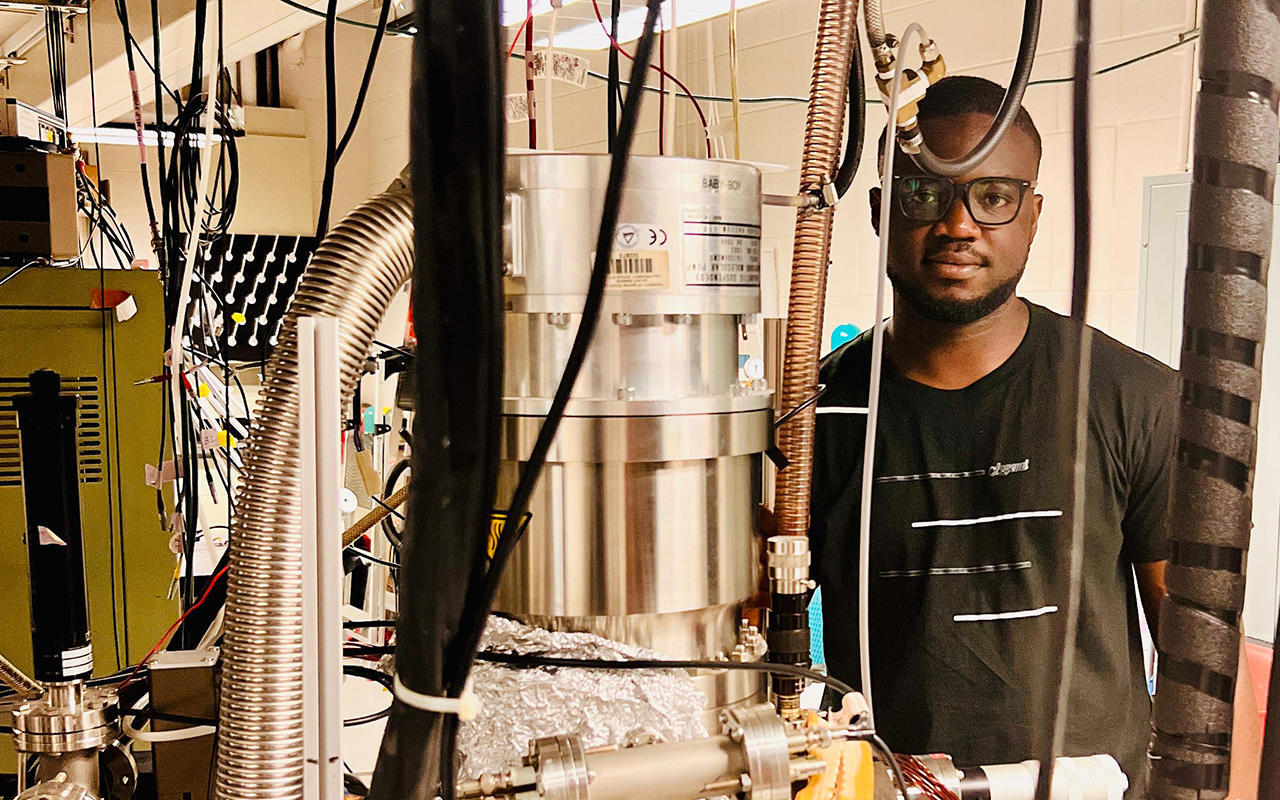
Blessed Oguh, a Ph.D. candidate at Wayne State University’s Department of Chemistry, is helping reshape how scientists explore the ultrafast world of atomic and molecular dynamics. This area of chemical physics uses incredibly short bursts of light to study fundamental processes that happen in attoseconds, which is a billionth of a billionth of a second. Originally from Imo State, Nigeria, Blessed earned his Bachelor of Science degree in Industrial Chemistry from the University of Jos, Plateau State, graduating with first-class honors. He went on to pursue doctoral studies at Wayne State, where he joined the Li Lab, a research group that is at the forefront of ultrafast laser spectroscopy. The group uses powerful laser pulses to examine how atoms and molecules behave at the very instant the instant of light-matter interraction.
At the heart of Blessed’s research is one of the most challenging questions in modern physics and chemistry: What happens in the moment when an electron escapes from an atom or molecule under intense laser light? Understanding this almost instantaneous event, when electrons break free and bonds begin to rearrange, holds the key to unlocking the mysteries of chemical reactions, energy transfer, and material properties at the quantum level.
Blessed has developed new experimental techniques that allow researchers to map both the timing and direction of these ionization events with impressive precision. One of his major contributions is the creation of a two-camera time-of-flight measurement system based on the Time-to-Brightness Converter (TBC) technique. This system uses regular Complementary Metal-Oxide Semiconductor (CMOS) sensors, the same kind found in everyday digital cameras, to achieve nanosecond timing resolution and three-dimensional momentum mapping of ions and electrons. By translating pixel brightness into a time marker, his method removes the need for expensive high-speed electronics and makes advanced measurements more affordable and scalable.
Beyond this, Blessed Oguh has helped address one of the most debated questions in ultrafast physics: How long does an electron spend tunneling through the energy barrier during ionization? Through his work on the phase-resolved attoclock technique, he developed a way to measure electron deflection angles with high accuracy as a function of ionization potential. This provides clearer insights into the timing of tunneling, a problem that has challenged researchers for more than three decades.
What makes Blessed’s work especially impactful is how it combines scientific discovery with practical value. His techniques lower the cost of advanced molecular imaging while maintaining high precision. From fundamental science to applied fields like LiDAR technology, his innovations could shape the future of autonomous vehicles, environmental sensing, and other technologies.
As Blessed Oguh continues his doctoral research at Wayne State, he is dedicated to developing the next generation of momentum imaging tools for chemists, physicists, and engineers. His work offers both new answers to long-standing scientific questions and practical solutions for the next generation of ultrafast measurements.

