 Follow Us on Google News
 Follow Us on Google Discover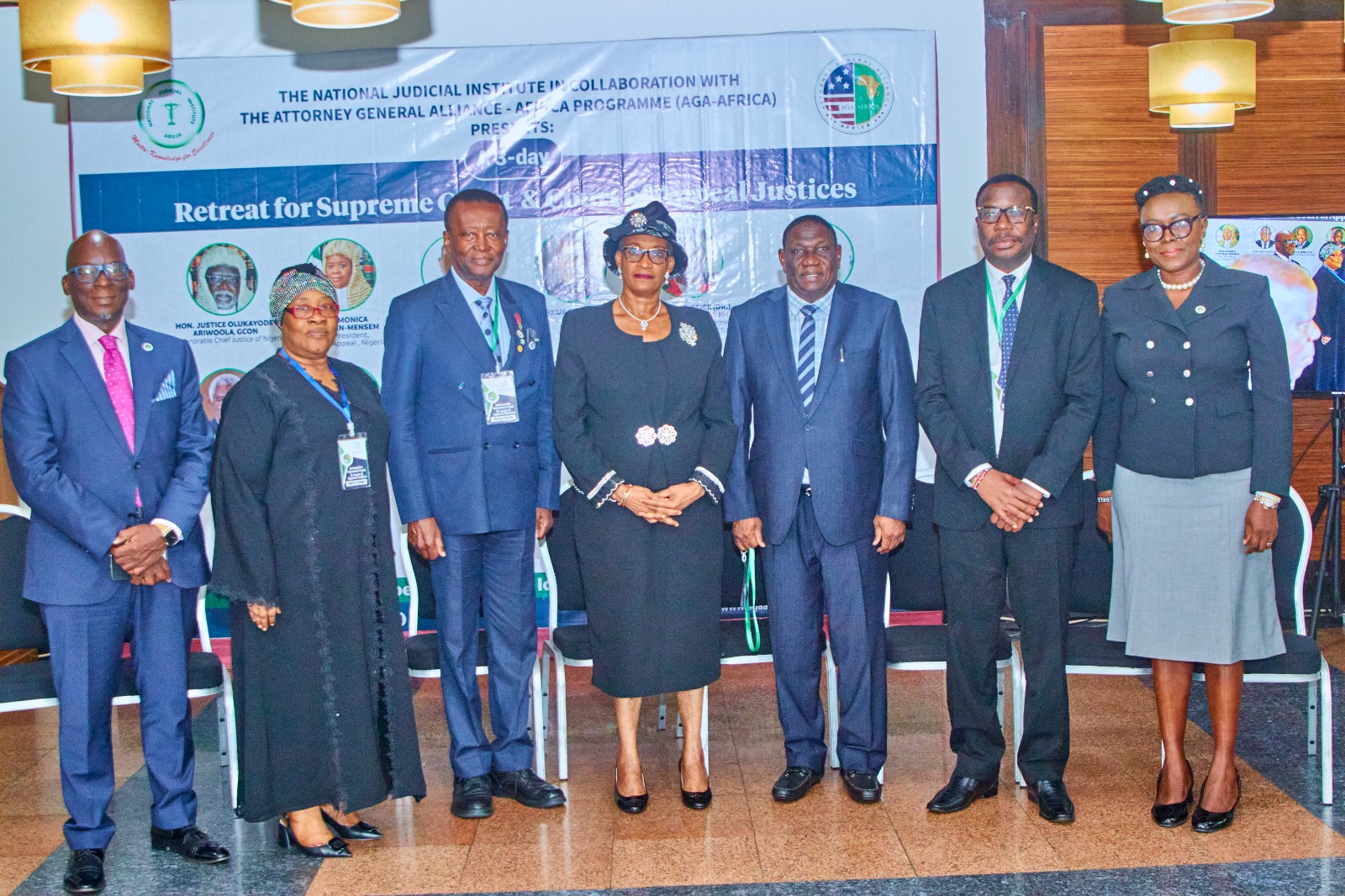

The Chief Justice of Nigeria (CJN), Justice Olukayode Ariwoola, has charged the judiciary to be neutral arbiters and sustain the ethos of democracy to gain public confidence.
[ad]
Ariwoola gave the charge at a 3-day retreat for Justices of the Supreme Court and Court of Appeal, organised by the Attorney General Alliance-Africa (AGA-AFRICA) in collaboration with the National Judicial Institute (NJI) in Uyo, Akwa Ibom State capital.
The CJN, represented by Justice Helen Ogunwumiju said the theme of the retreat, which is “achieving efficiency and effectiveness in a judicial system in Nigeria” was apt, adding that such retreats would serve as constant reminder to judicial officers of the crucial role they play in the society towards the attainment of a stable polity.
“In the light of the above, you will agree with me that democracy can only thrive on the respect for the rule of law and its principles also advocate the independence of the Judiciary, the doctrine of separation of powers, guarantee of fundamental rights, freedom of expression epitomised by free press as well as free and fair elections, all of which can only be guaranteed by an efficient and effective judiciary.
“Therefore, efficiency and effectiveness are not mere aspirations but essential foundations upon which our justice system rests. They are also the cornerstone of a judiciary that earns the trust and confidence of its people.
[ad]
“To achieve this, it is imperative to explore innovative case management techniques, embrace modern technologies to streamline court processes, and generally dispense justice in a manner that restores faith in the rule of law.
“I must reiterate that as we move forward into this digital age, we must embrace the potential of technology which would significantly enhance efficiency by streamlining administrative tasks, aid legal research, reduce backlog of cases, and generally improve transparency and efficiency in the administration of justice,” the CJN said.
He charged them to utilise the opportunity to engage in meaningful discussions, share best practices, and generally learn from one another.

In a welcome address, NJI Administrator, Justice Salisu Garba Abdullahi stated that a vibrant and independent Judiciary manned by upright judicial officers remained indispensable to the sustenance of public confidence in the administration of Justice.
He added that the theme of the retreat could not have come at a better time as it would afford the justices the opportunity to appraise the judicial system with a view to proffering interventions for improvements.
“The pursuit of Justice is the cornerstone of any thriving democracy and it is essential that our judicial system operate with utmost efficiency and effectiveness to uphold the principle upon which our nation was founded. In this light, concerted efforts must be made towards the timely resolution of cases, the streamlining of legal procedures and the elimination of unnecessary delays.
“Therefore, it is incumbent upon us to invest in several key areas such as ICT and also leverage on case management among many others.
According to Justice Abdullahi, it is imperative for judges to ensure that Justice is not only done but should be seen to be done in a manner that represents the rights and needs of all parties involved as speedy justice delivery instills confidence in the legal system.
[ad]
The NJI, he said, will not relent in fulfilling its mandate of delivering quality judicial education to judicial officers by organising workshops, seminars, conferences and by collaborative efforts to hold retreats to improve the quality of judicial decisions and enhance the overall effectiveness and efficiency of the judicial system.
In a remark, Chukukere Unamba-Opara, AGA-Africa Programme Director and Country Coordinator for Kenya said the AGA-Africa Programme has been consistently dedicated to strengthening the legal landscape, adding that their commitment to enhancing the capabilities of judiciary remains unwavering.
“Our collaboration has seen us engage in various meaningful initiatives, including but not limited to retreats for esteemed Supreme Court and Court of Appeal Justices.
“We have also conducted workshops on Asset Forfeiture Regime Under Nigerian Law and the Bench’s Perspective of the Capital Market; Effective Administration of Criminal Justice; and Oral Advocacy and Electronic Evidence.
“This history of collaboration seamlessly paves the way for our continued support of these events. These workshops are reflective of the work that we do across our partner countries – Ghana, Kenya, Lesotho, Malawi, Rwanda, Sierra Leone, South Africa, Uganda, Zambia, and Nigeria in the areas of transnational organised crime, including Trafficking, Money Laundering, and Wildlife Crime,” Unamba-Opara explained.
[ad]

