 Follow Us on Google News
 Follow Us on Google Discover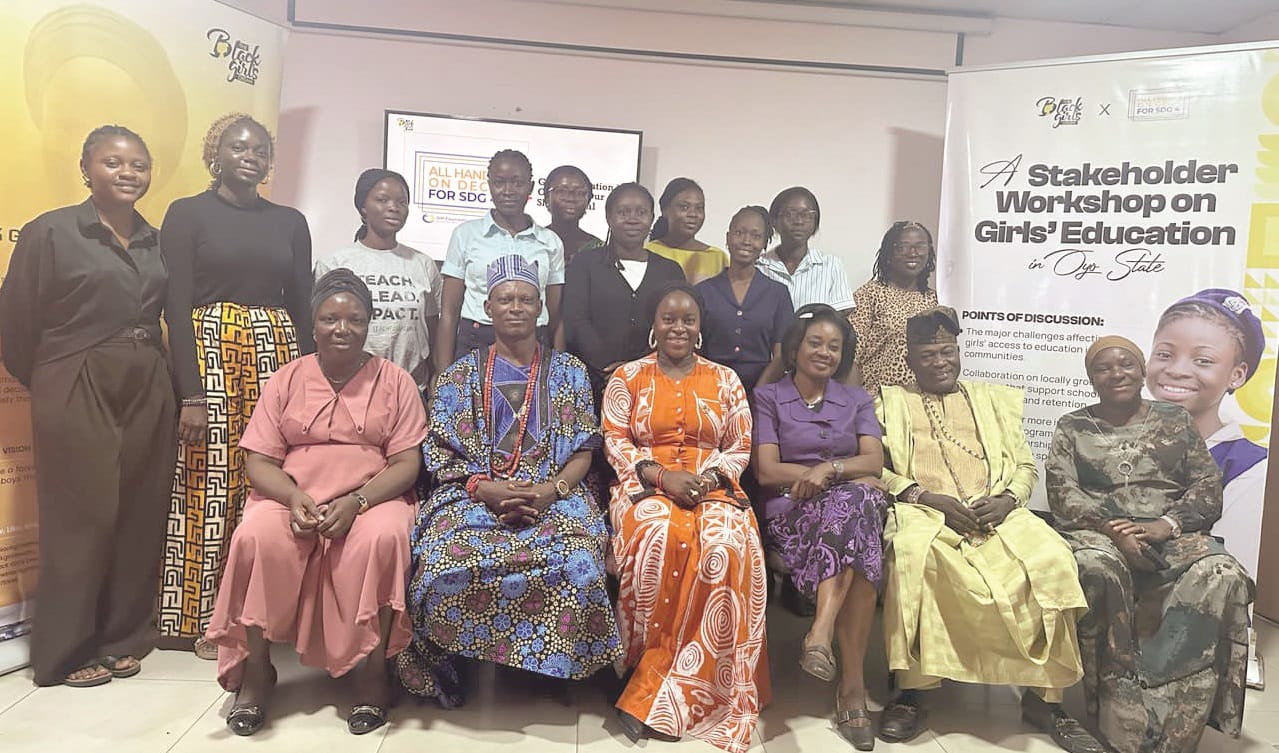
A non-governmental organisation (NGO), the Black Girls’ Dream Initiative (BGDI), in collaboration with some education stakeholders, has urged the Oyo State government, schools, and parents to prioritise the education of the girl-child in the state.
The stakeholders made this charge in Ibadan on Wednesday during a sensitisation workshop convened by BGDI in partnership with Global Schools Forum and the IDF Foundation. The workshop was tagged ‘All hands must be on deck’ and themed ‘Girls’ education in Oyo State: Our shared goal’.
The stakeholders comprised teachers, civil servants, parents, traditional rulers, and civil society organisations (CSOs).
The founder of BGDI, Karimot Odebode, revealed that about 20.1 per cent of out-of-school children live in Oyo State, making the state the highest in south-western Nigeria, and that 20 million children are out of school in Nigeria, making it the second leading country with the highest number of out-of-school children in the world.
Odebode stated that the essence of the workshop is to reverse the indiscriminate and unserious ways in which female students and the girl-child are treated in their education, and to spotlight the problem of out-of-school children in Oyo State.
She added that they are doing this by engaging decision-makers and opening doors for re-entry into the classroom, stressing that, “Every girl deserves a second chance at learning — whether through formal school or alternative pathways.”

Odebode emphasised that to solve the out-of-school problems facing the state and to curb the discrimination and abuse of the girl-child, some innovative measures and policies must be initiated and implemented by all the relevant education stakeholders in the state.
According to her, some of the measures included community-led solutions, collaborative support ecosystems, active participation of parents and guardians in their wards’ education and upbringing, and active teachers and school leaders’ participation in students’ welfare.
Others included regular stakeholder workshops, school-based advocacy projects, community mobilisation and town hall meetings, storytelling and public enlightenment programmes, and contributing actively to SDG4 – quality education.
In light of this, Odebode stated that the girl-child is important to the home and society; hence, her education and future must be the business of everyone in the state, school, and home.
“We are the enablers of change. We need to move from conversation to action. Change happens when stakeholders act together. What we do today shapes the data tomorrow,” she said.
The stakeholders, in their contributions and intentions, identified the major challenges facing the girl-child’s education and the reasons behind the proliferation of out-of-school children in Oyo State.
The Baale Sinko of Ido Local Government Area of Oyo State, Adeleke Waheed Mobolaji, and the Mogaji of Ogundele Compound, Labiran, Ibadan, Chief Ogunsina Oluseyi Oladebo, stressed that the home, especially the mother, has a vital role to play in training girls and keeping them in schools.
The two traditional rulers, Mobolaji and Oladebo, advised that special attention should be given to the girl-child in terms of education and other opportunities because of her natural and biological makeup. They added that collaborations among society, schools and parents are needed to motivate students and build a better future for them.
Some of the teachers and parents at the event M. C. Ebike, Janet Adio, Fausat Boladale, Rejoice Adegoke, O. O. Ogundare, Peace Akinola, Dorcas Oyinloye, emphasised the need to encourage parents to motivate their children to go to school and instil in them the value of education to the individual and society.
They urged schools and teachers to provide a conducive learning environment that would entice girls to learn, and that they should not stigmatise girls based on their family, health, or social conditions. Furthermore, they enjoined the government to provide an innovative curriculum that would impact the students and their lives.
Opeyemi Lawal of Project Wabi Sabi, Adetokunbo Ikumoluyi of Hosec Foundation, and Opeyemi Adebisi of Teach for Nigeria spoke from the civil society perceptive on how the girl-child can be better trained in school.
The convener of the event, Karimot Odebode, stated that the feedback and recommendations from the stakeholders regarding the theme and outcome of the sensitisation workshop will be submitted to the appropriate government authorities for policy formulation and implementation.

