 Follow Us on Google News


 Follow Us on Google Discover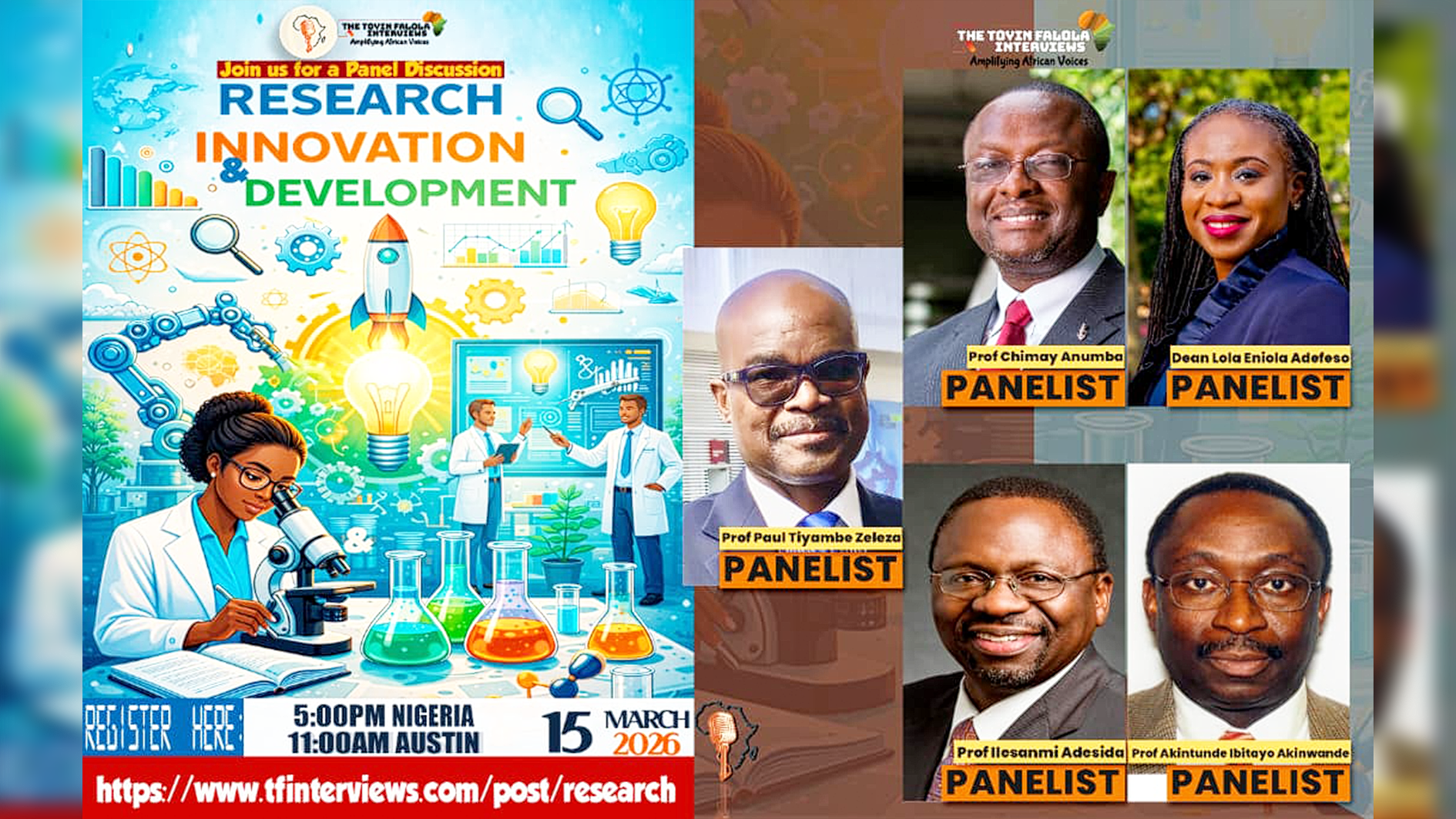
Prominent scholars and academic leaders have urged African governments to adopt deliberate national policies aimed at strengthening research ecosystems across the continent, emphasizing that sustainable development will remain difficult without coordinated investment in research, innovation, and development.
This appeal was made on Sunday night during the Toyin Falola Interviews. The event brought together leading scholars to discuss the theme “Research, Innovation and Development,” focusing on how Africa can build stronger knowledge systems capable of driving economic growth and technological advancement.
The panel discussion was chaired by renowned historian and Africanist Toyin Falola and moderated by distinguished scientist and academic administrator Ilesanmi Adesida. Other speakers included Akintunde Ibitayo Akinwande of the Massachusetts Institute of Technology, Chimay Anumba of the University of Florida, Lola Eniola-Adefeso of the University of Illinois Chicago, and the President of the Academic Staff Union of Universities (ASUU), Chris Piwuna.
Opening the conversation, Falola stressed that research and innovation remain indispensable tools for Africa’s progress, noting that no society can address its challenges without producing knowledge and technological solutions.
“As Africans we cannot transform our continent without what we call RI&D (research, innovation and development)… We cannot create economic growth without it. We cannot improve our systems of governance without technologies. We cannot improve our health, education and culture without research, innovation and development,” he said.
Falola also pointed out that the debate around research must extend beyond funding to deeper structural questions, including how Africa can reclaim indigenous knowledge systems and integrate them into contemporary academic frameworks.

“How do we decolonise knowledge? How do we avoid exploitation and domination as Africans within the corridors of research, innovation and development?” he asked.
Adesida highlighted the central role research plays in national development, explaining that innovation emerges when countries deliberately connect knowledge production to economic and technological growth.
“Research has connection to technological development, economic development and social development. Nations that are able to do this move very fast,” he said.
He cited examples of countries such as South Korea, Singapore, Taiwan, and China, where sustained investment in research has helped drive rapid national development.
Adesida also expressed concern that many African countries are failing to invest adequately in research, despite international recommendations.
“UNESCO recommends about one to two percent of annual GDP to be spent on research but many African countries spend about 0.2 percent or even lower,” he noted.
Professor Chimay Anumba of the University of Florida stressed that research systems require strong institutional and national infrastructure to function effectively.
According to him, scientific research plays a critical role in solving many of the pressing problems facing society.
“Research in science, technology and engineering is critical for the advancement of humanity… it helps improve the quality of life and addresses major challenges such as poverty, climate change and healthcare,” he said.
Anumba emphasised that governments must demonstrate commitment by establishing agencies that coordinate research funding and programmes.
“At the national level, you need strong governmental commitment… there must be the provision of considerable amount of funding and programmes that support diverse research partnerships,” he added.
Professor Lola Eniola-Adefeso, a chemical and biomedical engineer and dean at the University of Illinois Chicago College of Engineering, underscored the long-term economic value of investing in research.
She noted that although basic research often carries uncertainty, it remains the foundation for technological breakthroughs.
“Basic research is risky because you never know what you would get out of it… but many nations invest heavily in it because it generates the technology and medicine of tomorrow,” she said.
Eniola-Adefeso explained that research funding can produce significant economic returns.
“In biomedical research in the United States, every single dollar that the NIH invests in basic research generates about 2.5 dollars in outcome,” she said.
She added that Africa’s rapidly growing youth population makes investment in research even more urgent.
“African countries need to think about how they will create employment and economic opportunities for those young people. One of the best ways to do that is investing in research,” she said.
Professor Akintunde Ibitayo Akinwande of MIT highlighted the growing role of interdisciplinary collaboration in modern research.
“There is a lot of multidisciplinarity in research… those in biomedical engineering are collaborating with those in the social sciences,” he said.
He also noted that research outcomes are often unpredictable, making institutional support essential.
“If you are doing basic research and you don’t have tolerance for failure, you will not continue your work,” he said.

