 Follow Us on Google News
 Follow Us on Google Discover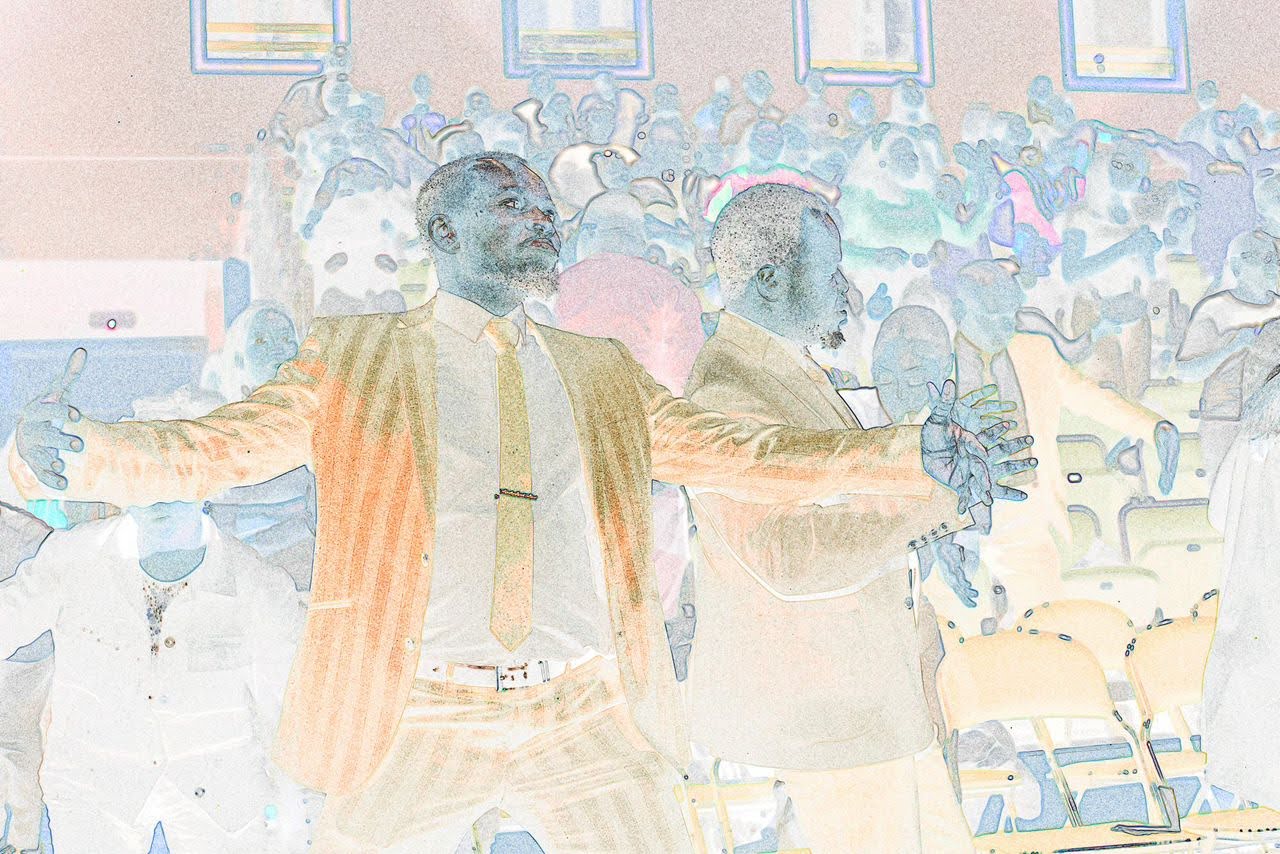
Mercy Oduz is a photographer with a keen eye for capturing the sacred, transforming fleeting moments in worship into haunting, almost liturgical visions.
Her work, particularly in pieces like ‘Big God’ and ‘Before the Lord’, occupies a space between documentary and reverie, where the boundaries of reality blur, and the spiritual bleeds into frames. Her technique, which often employs solarisation and inversion filters, lends her images an otherworldly texture, as if the subjects are not merely captured but revealed, their inner radiance made visible.
In ‘Big God,’ two men in suits stand with arms outstretched, their gestures suspended between exaltation and surrender. The inverted tones, ghostly blues, muted pinks, and searing whites flatten the scene into something resembling an X-ray or a medieval fresco. The graininess of the image acts as a kind of visual static, a disruption that heightens the emotional resonance. There is a kinship here with the work of South African photographer Roger Ballen, whose stark, high-contrast portraits of marginalised communities also blur the line between the real and the surreal. But where Ballen’s subjects often seem trapped in their environments, Oduz’s figures appear to transcend theirs, bathed in an almost celestial glow.
The crowd behind them dissolves into abstraction, a sea of hands and shadows, evoking the ecstatic unity of a revival tent or a Pentecostal service. This communal energy calls to mind the work of Brazilian photographer Sebastião Salgado, whose monochrome epics, Workers and Genesis, similarly emphasise the collective over the individual. Oduz’s images feel less like records of an event than like fragments of a vision, half-remembered upon waking.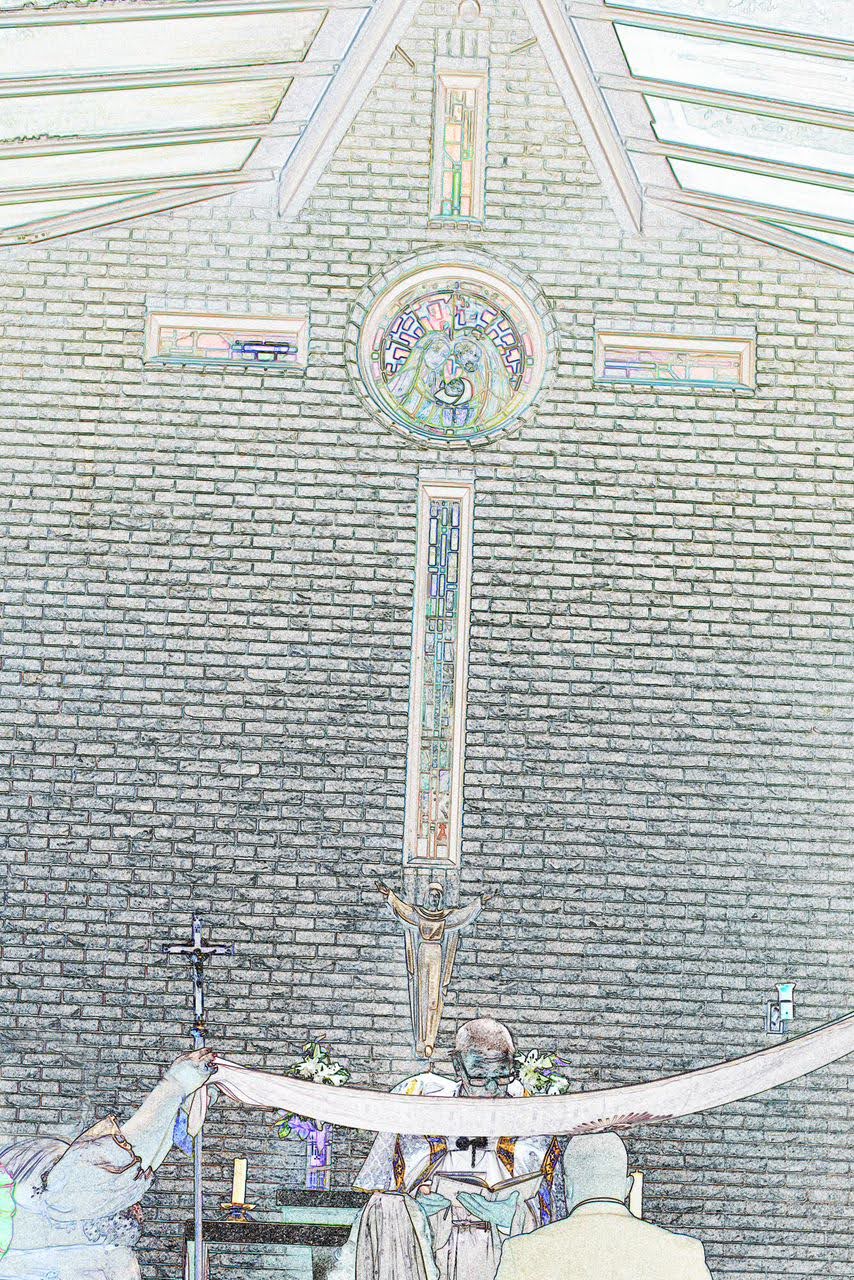
Before the Lord, the companion piece to Big God, shifts from motion to stillness. Here, a priest kneels before an altar, his bowed head haloed by the geometry of the church, brick walls, stained glass, the stark lines of a crucifix. The solarised effect renders the scene in delicate pastels, as if the very air has been sanctified. The white cloth draped in the foreground acts as a visual threshold, separating the sacred from the profane. There is something of the Dutch Masters in this composition. The way light carves out space, the quiet drama of humility before the divine. But Oduz’s distortion pushes the image beyond realism into something closer to a medieval icon, where the material world is merely a vessel for the unseen.
In this, she shares an affinity with the Japanese photographer Hiroshi Sugimoto, whose long exposure seascapes and eerily empty theatres evoke a similar sense of timelessness. Both artists are less concerned with capturing a moment than with distilling its essence, stripping away the extraneous until only the sublime remains.
Together, Big God and Before the Lord form a diptych of devotion, one ecstatic, the other contemplative. They are less about religion per se than about the human impulse toward transcendence, the way a gesture, a space, a shaft of light can become a portal to something beyond the visible. Oduz’s genius lies in her ability to make that threshold tangible, to render the ineffable in grain and gradient. In a world oversaturated with images, her photographs feel like relics of a deeper, more luminous reality.
lhekire is an arts critic covering the music, fashion, arts, and film industry across Africa.

