 Follow Us on Google News
 Follow Us on Google Discover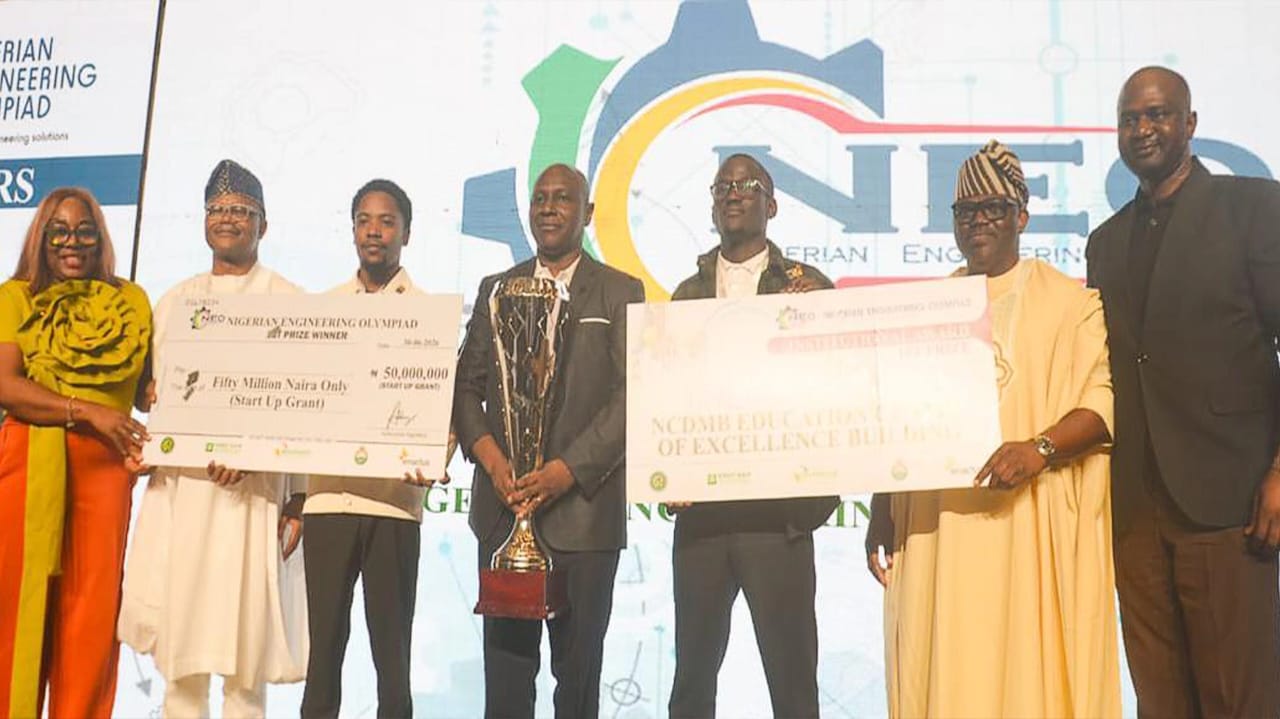
Four student-led engineering innovations from the Modibbo Adama University of Technology (MAUT), Yola; the University of Ibadan (UI); the University of Jos (UniJos); and the University of Nigeria, Nsukka (UNN), have emerged winners of the maiden Nigerian Engineering Olympiad, sharing N110 million in seed funding to accelerate the commercialisation of their innovations, alongside grants totalling N125 million for their engineering faculties, bringing the total value of prizes and grants to N235 million.
At the competition’s Grand Finale held in Lagos, Team Mavericks of the MAUT emerged the overall winner and was awarded a N50 million cash prize and a Centre of Excellence building for a community security innovation named “Ubuntu Sapphire”, a community-powered rapid alert system that links households through low-cost devices to instantly notify neighbours and emergency responders during security incidents.
UI placed second, receiving N30 million for “Aurora Birth,” a health-technology device designed to cut neonatal deaths from birth asphyxia in low-resource settings. UniJos came third with N20 million for “Sentra,” a solar-powered device that uses artificial intelligence to detect crop pests, diseases and soil deficiencies before symptoms appear. UNN finished fourth with N10 million for “Flameless,” a modular power system that converts associated gas into electricity for households and businesses.
The competition, which had Enactus Nigeria as technical partner, was sponsored by NCDMB, with Renaissance Africa Energy Company and First Exploration and Petroleum Development Company (First E&P) serving as funding partners.
Speaking on behalf of NCDMB’s Executive Secretary, Felix Ogbe, the Board’s Director of Planning, Research and Statistics, Silas Ajimijaye, said the Board remained committed to initiatives that develop human capital, promote entrepreneurship and create opportunities for young Nigerians. He described the event as “a celebration of talent, innovation and the immense potential of Nigerian youths to solve real-world challenges through science and engineering.”
Ajimijaye said the Board’s mandate was to build human and institutional capacity that enables Nigerians to compete within the oil and gas industry and the wider economy, describing youth development as “a strategic investment in Nigeria’s future.”

He disclosed that another panel of judges were currently evaluating entries for the NCDMB Technology Innovation Challenge at the Board’s headquarters in Yenagoa, Bayelsa State, and that the Board had launched a Young Researchers Programme with no fewer than 500 undergraduate students already enrolled.
The Country Director of Enactus Nigeria, Michael Ajayi, said the journey to the maiden Olympiad began over two years ago, noting that the competition attracted 375 applications from 984 students across 80 tertiary institutions spanning the six geopolitical zones.
He said entries went through a multi-stage assessment involving 202 judges and evaluators, 177 professionals, over 852 man-hours of evaluation and six regional competitions. The top 30 innovations, five from each geopolitical zone, each received N3 million development grants, totalling N90 million, to build prototypes over eight weeks, before the field was narrowed to 12 finalists who underwent a two-week business development boot camp.
Also speaking, the Nigerian Society of Engineers (NSE) President, Engr Ali Rabiu, represented by the former NSE president, Engr. Margaret Oguntola, urged industry leaders and corporate organisations to back young innovators with funding, incubation and patent support. She described the competition as a national innovation movement that had grown out of a conversation at the Nigeria oil and gas conference in Abuja in July 2024, where discussions with NCDMB’s executive secretary, Dr Felix Ogbe, led to the Olympiad’s creation.
“It is okay to have an idea, but what matters is developing those ideas into solutions,” Oguntola said, adding that the future belonged to those who dared to create it.
The Director-General of the National Agency for Science and Engineering Infrastructure (NASENI), Mr Khalil Halilu, represented by the Deputy Director, Engineering Infrastructure Department, Engr Emmanuel Ajani, said the top three winners would be admitted into the agency’s Innovation Hub, where they will get business development support, mentorship and access to manufacturing partners to help move their prototypes toward the market.
Halilu said Nigeria’s biggest challenge was not a shortage of innovation but the failure to convert research into commercially viable products.
“The distance between a prototype and mass production is a huge leap, and that is where many innovations die in our environment,” he said, noting that many university innovations remained confined to laboratories and journal papers instead of reaching the market.
Renaissance Africa’s vice-president for relations and sustainable development, Igo Weli, said prototype development funding for participating teams would rise from N3 million to N5 million in the next edition. First E&P’s general manager for engineering and capital projects, John Alamu, said the Olympiad was a platform for strengthening STEM education and curbing brain drain among young engineers.
Organisers said the Nigerian Engineering Olympiad is designed to bridge Nigeria’s engineering skills gap through seed funding, mentorship, technical guidance and industry partnerships. Over the next three years, the initiative is expected to produce more than 150 engineering prototypes and numerous technology start-ups capable of advancing Nigeria’s industrial transformation.

