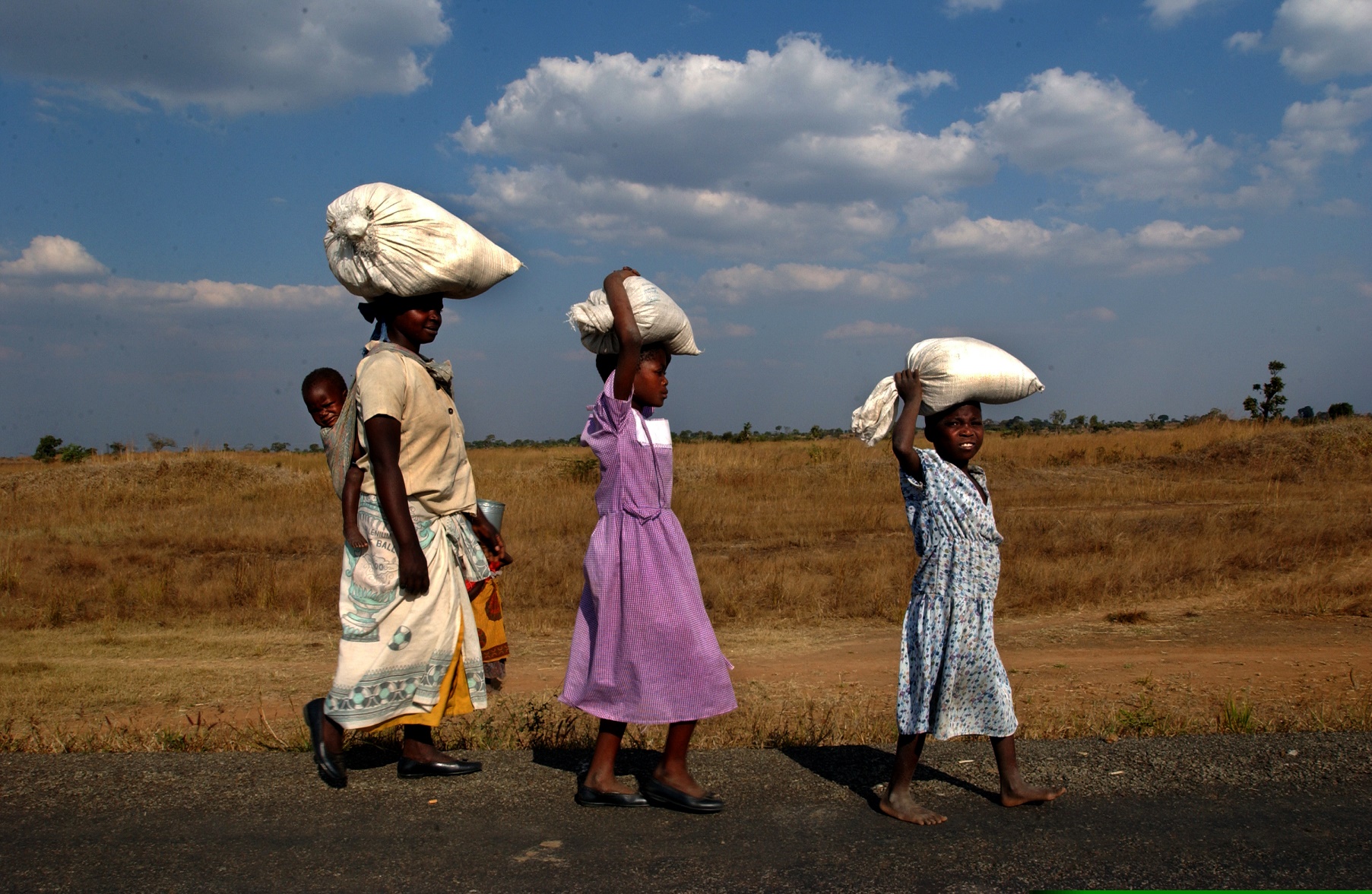
On 29 June, a woman, carrying a baby on her back and holding the hand of a small child, and two older girls carry sacks of maize home from a small farm where they work in exchange for food, in the village of Chipumi. Because of droughts and flooding during the past year, many Malawians were unable to buy seeds to grow their own food crops.
In June 2002, deepening malnutrition caused by a growing food shortage threatens 3.2 million people in Malawi -- 500,000 of which are already affected by the crisis. Almost half of the country's 10.6 million inhabitants are children under 15. The food crisis is part of a region-wide shortage affecting several countries in southern Africa, the result of a combination of harsh climatic conditions (droughts and flooding), poor management of food reserves and political and economic instability. An estimated 12.8 million people in the region, including 2.3 million children under five, will need food assistance through March 2003. In Malawi, as in several other affected countries, widespread poverty and the increasing economic and social disruption caused by a devastating HIV/AIDS crisis are additional factors disrupting agriculture and the ability of social services to respond. UNICEF is joining the soon-to-be-released United Nations Inter-Agency Appeal for southern Africa, of which an estimated US $3.5 million is for UNICEF nutrition, health, water and sanitation and education/protection interventions in Malawi. Support already initiated includes supplementary and therapeutic feeding assistance for pregnant or lactating women and malnourished children under five -- including 8,000 chronically or severely malnourished children to be reached through 20 centres located country-wide.
Global Alliance for Improved Nutrition (GAIN) and Institute of Public Analysts of Nigeria (IPAN) have created the GAIN-IPAN Certificate Course in Laboratory Analysis of Food Micronutrients (LAoFM) with support from the Bill and Melinda Gates Foundation (BMGF).
The course is aimed at tackling malnutrition and the associated stunted growth.
GAIN is a Swiss-based foundation launched at the United Nations in 2002 to tackle human suffering caused by malnutrition. Working with governments, businesses, and civil society, it aims to transform food systems to deliver more nutritious food for all people, especially the most vulnerable.
[ad]
The course will equip candidates with comprehensive understanding of the theory, principles, and applications of physicochemical and instrumental techniques applicable to the analysis of micronutrients in food.
According to the United Nations Children’s Fund, “Nigeria has the second highest burden of stunted children in the world, with a national prevalence rate of 32 per cent of children under five. An estimated two million children in Nigeria suffer from Severe Acute Malnutrition (SAM).”
Highlighting the strategic context of the programme, Country Director of GAIN in Nigeria, Dr. Michael Ojo, said: “The availability of analytical capacity development programmes is a required component for improving Nigeria’s nutrition profile.
“Therefore, GAIN has partnered with IPAN, to ensure food laboratory analysts can improve their skills and competence to guarantee the quality of their food testing and achieve better results.”
[ad]
 Follow Us on Google News
 Follow Us on Google Discover