 Follow Us on Google News


 Follow Us on Google Discover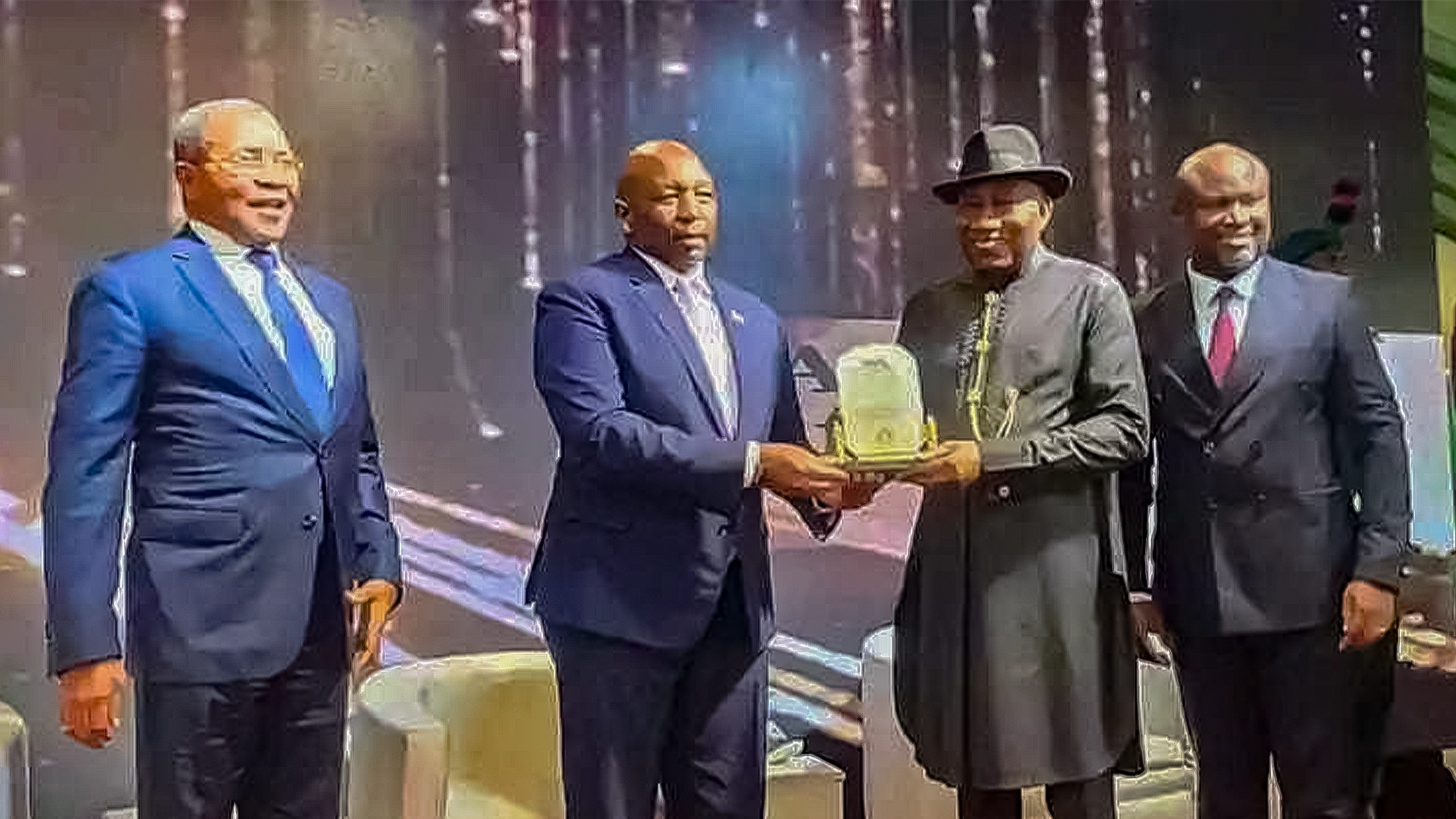
Former President Goodluck Jonathan and the Minister of Finance and Coordinating Minister of the Economy, Dr. Taiwo Oyedele, have called for the removal of institutional and regulatory barriers hindering trade across Africa.
They insisted that stronger institutions, policy reforms and deeper regional integration are critical to unlocking the continent’s economic potential.
They made the call in Abuja at the Breaking Barriers to Trade and Leadership Summit, organised by the Africa Leadership Organization (ALO).
Jonathan, who joined the Prime Minister of Lesotho, Samuel Matekane, former Tanzanian President Jakaya Kikwete, former Liberian Vice President Jewel Howard-Taylor and other African leaders at the summit, said the continent’s long-term prosperity depends on building strong democratic institutions and promoting closer economic integration among African countries.
According to him, discussions at the high-level gathering focused on the vast opportunities for sustainable economic growth and the urgent need to secure Africa’s economic future through stronger institutions, expanded regional trade and purposeful leadership.
He stressed that effective institutions remain the foundation for economic development, investor confidence and sustainable governance across the continent.

Jonathan was also honoured with the Award for Democratic Leadership and Institutional Integrity by the Africa Leadership Organization in recognition of his contributions to democratic governance and institution building.
Receiving the award, the former President described the recognition as a tribute to the collective efforts of individuals and institutions committed to strengthening democracy and advancing sustainable development in Africa.
“I accept this honour with humility and regard it as recognition of the collective efforts of all those committed to advancing democratic governance, strengthening institutions, and promoting Africa’s growth and development,” he said.
Speaking on the theme of the summit, Oyedele said Africa’s greatest barriers to trade and leadership are no longer primarily physical but institutional, regulatory and policy-induced.
He noted that businesses across the continent continue to face unnecessary bottlenecks arising from multiple taxation, border delays, weak logistics, cumbersome regulations and inefficient approval processes.
According to him, these barriers increase the cost of doing business, discourage investment and reduce Africa’s global competitiveness.
“The greatest barriers to trade and leadership are really not physical. They are mostly institutional. They are policy-induced. They are regulatory, and sometimes they are psychological,” Oyedele said.
He observed that trucks transporting goods between African countries often spend more time at border checkpoints than on the road, while investors frequently spend more time obtaining regulatory approvals than establishing factories.
The minister also lamented that many young entrepreneurs with innovative business ideas remain unable to access finance because existing systems were designed for yesterday’s economy rather than tomorrow’s opportunities.
Describing intra-African trade as one of the continent’s greatest untapped opportunities, Oyedele said Africa’s population of more than 1.4 billion people provides a huge market whose potential can only be realised by dismantling barriers to commerce.
“The problem has never been a lack of markets. The problem is too many barriers—tariffs, non-tariff barriers, border delays, regulatory inconsistencies, weak logistics and multiple duplicative taxation,” he stated.
He maintained that removing such barriers is no longer aspirational but an economic imperative requiring urgent action from governments across the continent.
Oyedele said while governments have an important role to play, sustainable economic growth would largely be driven by the private sector.
According to him, governments should concentrate on creating the right policy environment through stable macroeconomic policies, efficient infrastructure, simple regulations, fair taxation, strong institutions and predictable rules.
“When we get these right, the private sector responds, investment increases, productivity rises, employment expands and everyone benefits,” he said.
He further stressed that breaking barriers should be seen as a continuous reform process rather than a one-off event.
“Every unnecessary regulation removed, every institution strengthened, every entrepreneur empowered and every investment facilitated is a building block towards a more prosperous Africa,” he added.
Earlier, Nigeria’s Minister of State for Foreign Affairs, Ambassador Sola Enikanolaiye, who represented the ministry at the event, said Africa must move beyond reacting to global developments and begin shaping them through stronger trade, greater continental influence and resilient institutions.
He described the African Continental Free Trade Area (AfCFTA) as the continent’s biggest economic opportunity but warned that poor infrastructure, multiple checkpoints, cumbersome border procedures and lack of trust among businesses continue to undermine regional trade.
He reaffirmed Nigeria’s commitment to industrialisation, trade facilitation and support for micro, small and medium enterprises, particularly women-owned businesses, to maximise opportunities under the AfCFTA.
Speaking, Lesotho Prime Minister Samuel Matekane urged African leaders to prioritise building enduring institutions over personality-driven leadership.
He argued that weak institutions remain one of the biggest obstacles to investment and economic development because investors place greater confidence in predictable systems than individual leaders.

