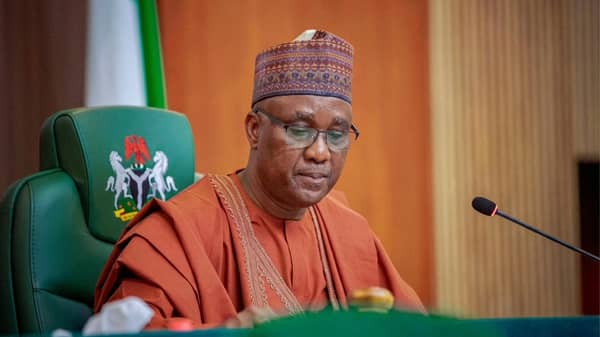
Reps pass N43.56tr, N48.31tr revised budget for 2024, 2025
Barely five days after President Bola Tinubu presented a N58.18 trillion proposal for the 2026 fiscal year, the Senate yesterday raised the size of the budget to N58.47 trillion, adding about N292 billion to the executive estimate, and passed the Appropriation Bill for second reading.
This was as the House of Representatives passed the Repeal and Re-Enactment Appropriation Bill, approving a revised N43.56 trillion budget framework for the 2024 fiscal year.
It also passed the revised N48.31 trillion 2025 budget.
This follows the consideration and adoption of the report of its Committee on Appropriations during plenary presided over by Speaker Tajudeen Abbas.
With the approval, it means the House okayed Tinubu’s request for the extension of the implementation of the capital component of the 2025 budget to March 31, 2026.
Last week, the President transmitted the Appropriation (Repeal and Re-Enactment) Bills for 2024 and 2025. The bills propose repealing the existing Appropriation Acts and re-enacting revised expenditure plans that reflect fiscal realities and execution capacity.
Under the revised figures, the President said the 2024 budget of N35.06 trillion would be replaced with N43.56 trillion, while the 2025 budget of N54.99 trillion would be re-enacted at N48.32 trillion to cover statutory transfers, debt service, recurrent expenditures and capital development contributions.
For 2025, of the N48.32 trillion, N3.64 trillion is set aside for statutory transfers, N14.31 trillion for debt service, N13.58 trillion for recurrent (non-debt) expenditure, and N16.76 trillion for capital expenditure through development fund contributions.
The President described the move as part of broader fiscal reforms aimed at eliminating overlaps from multiple concurrently running budgets, strengthening planning, execution, and accountability across government expenditure cycles.
The passage of the bill repeals the 2024 and 2025 Appropriation Act and authorises fresh withdrawals from the Consolidated Revenue Fund of the Federation for the year ending December 31, 2025, in line with prevailing fiscal realities and government spending priorities.
The bill, which was considered at the Committee of Supply, was presented by the Chairman of the House Committee on Appropriations, Abubakar Kabir Abubakar, and subsequently adopted by the House after lawmakers approved its provisions clause by clause.
Bichi told the lawmakers that the committee met with the economic team of the President, comprising the Minister of Finance, Wale Edun; Minister of Budget and Economic Planning, Abubakar Bagudu; and Director-General of the Budget Office, Tanimu Yakubu, to obtain insight into the justification for the repeal and enactment of the 2024 and 2025 Appropriations Act.
Bichi said the repeal and re-enactment of the 2025 budget would balance responsiveness with fiscal responsibility, ensuring that urgent expenditures do not weaken legislative oversight or undermine fiscal freedoms.
He explained that N16.76 trillion was reduced from the capital allocation and rolled over to the 2026 fiscal year due to funding constraints.
The Senate’s upward review aligns the 2026 budget with the figure earlier approved by the Federal Executive Council (FEC) during the preparatory stage of the 2026 estimates.
While presenting the draft budget to a joint session of the National Assembly on Friday, President Tinubu had proposed a slightly lower sum of N58.18 trillion.
Explaining the discrepancy, Chairman of the Senate Committee on Appropriations, Adeola Olamilekan, said the difference arose from minor miscalculations in the President’s presentation speech and supporting documents, stressing that the appropriation bill itself remains the authoritative document for legislative consideration.
“The official budget figure for deliberation is the one contained in the appropriation bill,” Adeola said. “While minor miscalculations may have occurred in the President’s speech or supporting documents, the National Assembly will consider the bill itself as the authoritative figure. Therefore, the official size of the 2026 federal budget stands at N58.472 trillion.”
He added that the variation should not distract lawmakers or the public from the substance of the spending plan, noting that once deliberations commence, the National Assembly would verify and finalise the true size of the budget.
The Senate, which gave the budget accelerated consideration, described the proposal as one of the best fiscal frameworks the country has produced in recent years, citing its strong capital component and focus on security and economic consolidation.
Leading the debate, Senate Leader, Opeyemi Bamidele (Ekiti Central), said the proposed Appropriation Act seeks to authorise withdrawals from the Consolidated Revenue Fund of the Federation to fund government activities for the year ending December 31, 2026.
He recalled that the bill had already passed first reading, having been laid before a joint session of the National Assembly on December 19, 2025.
Bamidele described the 2026 budget as a “budget of consolidation,” designed to stabilise the economy and deepen ongoing reforms.