 Follow Us on Google News
 Follow Us on Google Discover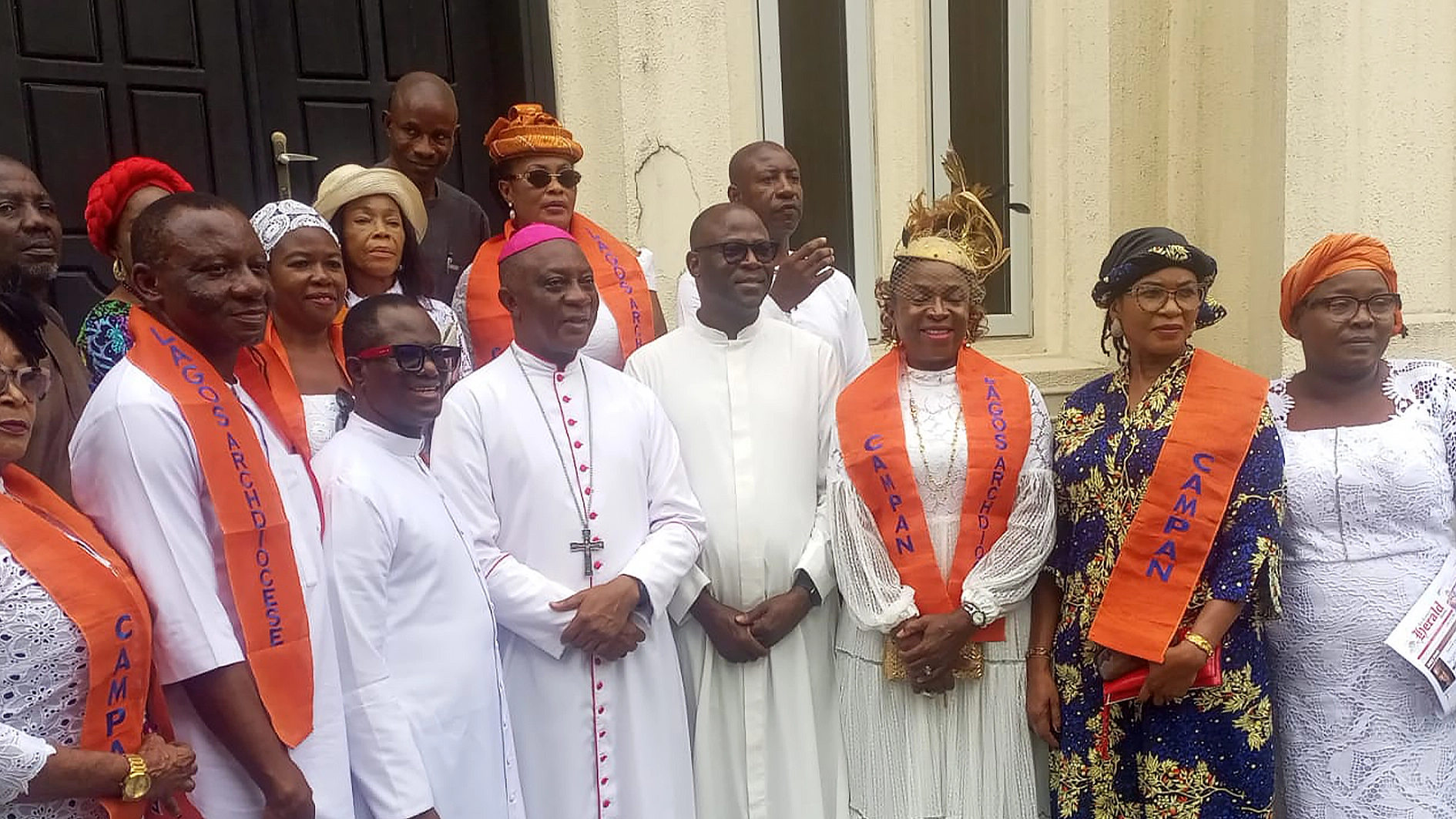
The Catholic Archbishop of Lagos Metropolitan See, Most Rev. Alfred Adewale Martins, has called on the Federal Government to demonstrate a genuine commitment to accountability by creating accessible avenues for citizens to verify the infrastructural projects funded by foreign loans.
The cleric made the call yesterday, during the 60th World Communications Day, organized by the Directorate of Social Communications, Catholic Archdiocese of Lagos, in collaboration with the Order of Knights of Saint Mulumba at the Holy Cross Cathedral, Lagos.
The Archbishop’s remarks come amid growing public criticism over Nigeria’s escalating national debt. Under President Bola Tinubu’s administration, the federal government has relied heavily on global lenders, securing over $8 billion from the World Bank and the African Development Bank (AfDB). Nigeria’s total public debt has surged past ₦159 trillion and is projected to reach ₦170 trillion.
Speaking during an interactive session with journalists, Archbishop Martins noted that while borrowing can serve as a legitimate tool for development, it must be tied to identifiable and verifiable infrastructure.
“The problem generally arises when borrowing is done and the funds never meet the purpose for which they were collected,” Martins said, lamenting the government’s historic failure to maintain transparency. “If citizens are cynical about borrowing, it is the duty of the government to reassure everyone by ensuring that the monies are put to measurable, visible use.”
The Archbishop blamed systemic corruption for the country’s piling debt, arguing that removing corrupt tendencies from the procurement process would allow loans to effectively drive development. He also charged the media to rigorously investigate government loans, track disbursements, and hold officials accountable for project execution.

Speaking on this year’s World Communications Day theme, “Preserving Human Voices and Faces,” Archbishop Martins cautioned against allowing rapid technological advancements to erode human relationships. Despite the rise of Artificial Intelligence (AI), the cleric emphasised the need to preserve authentic human interaction and emotional depth.
Martins said: “Very often, it is easier to send text messages than to make calls. But the human voice carries emotions and psychological soothing that text messages simply cannot replicate. We must not allow technology to become a barrier to genuine human relationships.” He added that education and media literacy are vital tools to safeguarding human values in a digital age.
Echoing the Archbishop’s sentiments, the Director of Social Communications, Very Rev. Fr. Anthony Godonu, stated that the theme highlights an urgent need to safeguard humanity against the over-automation of communication by algorithms and virtual simulations.
Godonu warned against letting technology diminish the sacredness of human dignity, pointing out that Nigeria has already suffered the consequences of digital misinformation.
“In recent years, misinformation, fake news, manipulated digital content, and divisive propaganda have contributed to social tensions, religious misunderstandings, political polarization, and deep distrust within society,” Godonu said.
He noted that during critical national moments, such as elections, social media platforms are frequently flooded with doctored content designed to provoke raw emotion rather than promote truth.
Godonu concluded by challenging all media professionals, content creators, and digital citizens to communicate responsibly, ethically, and with a human soul.

