 Governments in the Niger Delta have been urged to join hands in the fight against human-induced methane emission to save lives and the environments of the oil-rich region.
It was gathered that one of the major ways to stop the dangerous emisions was funding of biogas digesters to convert waste to power and create huge wealth in the region.
According to experts from various research centres under the auspices of the African Initiative for Transparency, Accountability, and Responsible Leadership (AfriTAL) and partners during a meeting in Port Harcourt at the weekend, humans cause almost 50% of methane emissions that add to the 50% from fossil fuel to threaten the region.
The researchers explained that with biogas digestors, families and estates could generate power from wastes generated in the area for homes.
Presenting samples of the digesters, the experts said N2m can produce one set but under mass production schemes, the unit costs will drastically reduce.
Speaking, Executive Director of AfriTAL,Brown Louis Ogbeifun, said the research is for the possibility of communities redesigning their septic tanks and soak-away systems in such a way that they become a veritable source if electricity and cooking gas so that waste turns to wealth and reduce the raging environmental threat.
He said , of all the significant sources of emissions into the atmosphere, agriculture and improper waste management relate to human daily activities and wastes.
“These activities and wastes contribute immensely to the anthropogenic sources of methane, which has been labeled a potent greenhouse gas (GHG) contributing to global warming. Methane emissions degrade the environment and contribute to human health hazards if not contained.” He stated
He said uncontained methane in the atmosphere accelerates global warming and worsens air quality by forming ground-level ozone (O3).
“The formation of ground-level ozone could occur through complex chemical and photochemical reactions involving other pollutants, such as nitrogen oxides (NOx) and volatile organic compounds (VOCs). These chemical reactions are accelerated by high-intensity sunlight penetration downward. As NOx descends and disperses through the lower atmosphere, it can meet and react with methane and other hydrocarbons at ground level, contributing to the formation of ground-level ozone. Although atmospheric methane has a shorter lifespan than carbon dioxide (CO2), it has an intense warming effect on the climate, making it critical for climate change actors to advocate and implement mitigation strategies to reduce methane emissions to the atmosphere.”
Continuing, he said: “To bring the impact of climate change and what we can relate to closer to us, many people are complaining that as the rainy season with flash floods recedes, extreme heat with nocturnal beads of sweat is now occurring, which makes it difficult for them to have a refreshing night’s rest when sleeping in a room without air conditioning or a fan. Yet, those affected would still need to wake up and go to work daily. No doubt, not having recurring, adequate, and relaxing night sleep can gradually lead to sleeplessness, raised blood pressure, low productivity at work, and frequent visits to healthcare facilities.”
He said methane has been identified as a potent greenhouse gas contributing significantly to global warming. “It has been stated that over 100 years, its effects are almost 30 times greater than those of carbon dioxide (Copilot), which makes it an urgent call to action by everybody. Although methane is very useful and naturally occurring in the atmosphere, it becomes hazardous in high concentrations.”
Summarising the workshop, Ogbeifun said: “We have no control over what government will throw at us, but we do, on what we can do”.
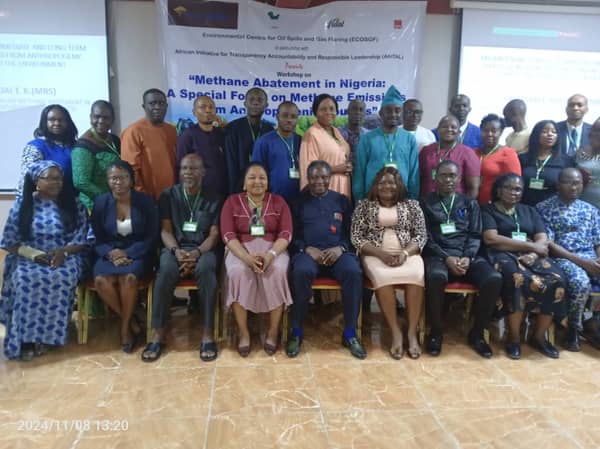
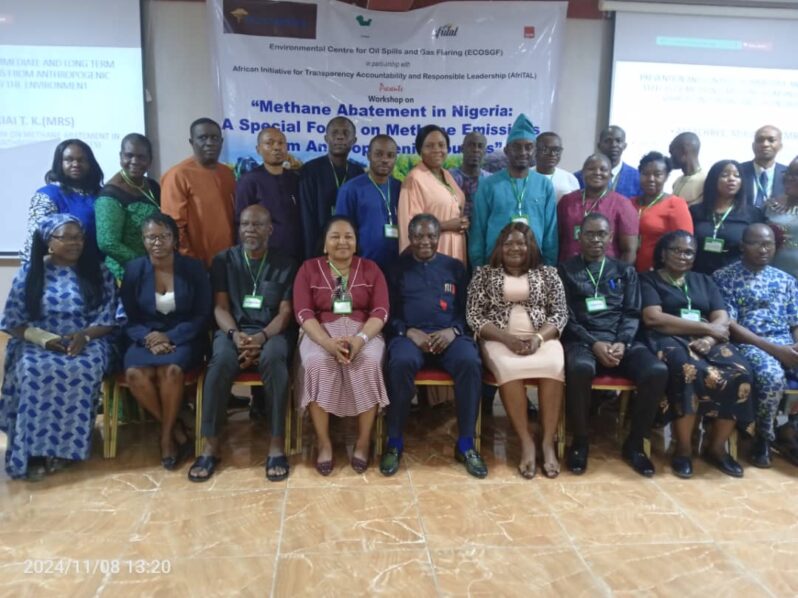
The workshop themed ‘Methane Abatement in Nigeria: Special Focus on Anthropogenic Sources’, was funded by Trust-Africa.
Contributing, a researcher who fabricated biogas digesters, Peter Chukwudi (PhD), showed how families, estates or communities can use their refuse dumps to generate power and gas cookers.
To abate methane emissions, Soberekon Afiesimama, , during his presentation on ‘Methane Abatement in Nigeria: A Call to Action’, said financial support for methane reduction projects, environmental education, research, regulatory measures, technological innovations, among others, are some of the collective actions that can be taken to abate methane emissions in Nigeria.
Speaking, Nimi Elele from the Department of Climate Change, Ministry of Environment, stated that going by the Sustainable Development Goal 17, partnership is very key in abating methane emissions in Nigeria.
According to her, “There has to be mind-reengineering”, which is the process of redesigning and reevaluating one’s interpretations of the world and their place in it.
“If we do not do anything, the effects of Methane gas emissions that we feel today will worsen”, she said, while urging participants at the workshop to make serious efforts to act differently in their various spaces. “Educate at least one person, plant economic trees”, she added
In a goodwill message,Christopher Nku, the Project Officer, Environment Desk, Stakeholder Democracy Network (SDN), worried that, while the sources from fossil fuels can be detected and quantified, the anthropogenic sources are yet to be quantified.
“As a result, the solution to this, is to create awareness on the release and management of this greenhouse gas to the environment; and to consciously be responsible for our actions.”
Furthermore, Godswill Ukoikpoko (PhD), Director of Veterinary Services, Rivers State Ministry of Agriculture, stressed that efforts should be made to reach out to the new Ministry of Livestock development created by the Federal government.
“There are many things we can do to abate Methane emissions in Nigeria. Let us reach out to the new Ministry so that we can incorporate some of the Methane abatement activities in what the new Ministry will do”, he said.
On her part, the Headmistress of the Rivers State University Staff School, Charles Ibifuro , assured to educate her students on Methane emissions to enable them become conscious of how they interact with the environment.