 Follow Us on Google News
 Follow Us on Google Discover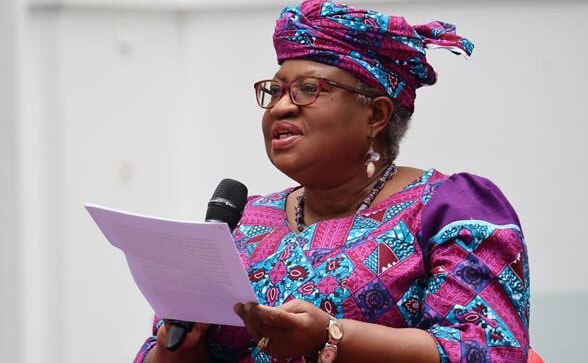

Nation’s online population showing enthusiasm, says survey
Director General of the World Trade Organisation, Dr Ngozi Okonjo-Iweala, has said Nigeria and three other African countries will reap significant economic benefits from Artificial Intelligence (AI), with potential gains exceeding $136 billion.
[ad]
She also stated that AI has the potential to boost global economic activity by up to $15.7 trillion by 2030, with the global south, including Nigeria, standing to gain substantially.
The WTO DG spoke in Abuja, yesterday while delivering a keynote address at the 10th convocation ceremony of African University of Science and Technology (AUST).
While listing the three other countries including Kenya, Ghana and South Africa, she called on African countries to harness the benefits of AI by investing in basic infrastructure, regulatory frameworks, digital literacy, and upskilling young people.
“These are four countries making strides in technology, and I’m glad Nigeria is fully one of them,” she said.
She continued: “If Nigeria could get it right, her economy could reap major rewards. A recent report by Access Partnership, a public policy consultancy focused on technology, estimates that AI could generate $136 billion in productivity gains, cost savings, time savings and increased revenues for four countries.
“But the gains and the savings amount to 13 per cent of the 2022 GDP of these four countries, with Nigeria in line to receive 43 per cent of the estimated gains”.

The former finance minister referenced a PricewaterhouseCoopers (PwC) report, which predicted that Artificial Intelligence (AI) would boost the global economy by 14 per cent by 2030, adding a staggering $15.7 trillion to global GDP.
The keynote speaker said: “The global south, including Nigeria, has much to gain, but countries across the developing world will need to be proactive to seize this potential, and we cannot afford to be left behind. Universities, like AUST, have a big role to play in thinking about what AI means for the development of Nigeria and the continent as a whole, and how we can capitalize on the opportunities whilst managing the risks.”
She said AI could address long-standing development challenges in Nigeria, such as education, healthcare, agriculture, finance, energy, and infrastructure, among others.
[ad]
MEANWHILE, a new global survey from Ipsos and Google has revealed that attitudes towards artificial intelligence (AI) are trending positively as its use becomes more widespread.
The study, “Our Life with AI: From Innovation to Application,” surveyed 21,000 people across 21 countries, finding that global AI usage had jumped to 48 per cent and excitement about its potential now exceeds concerns (57 per cent vs 43 per cent, up from 50 per cent / 50 per cent last year).
In Nigeria, AI adoption and enthusiasm are even higher. 70 per cent of the online population have used generative AI, surpassing the 48 per cent global average. Moreover, 87 per cent are excited about AI’s potential and see its benefits outweighing the risks.
President of Global Affairs, Google & Alphabet, Kent Walker, said AI is starting to deliver magic at scale, making people’s lives easier and better.
[ad]

