 Follow Us on Google News
 Follow Us on Google Discover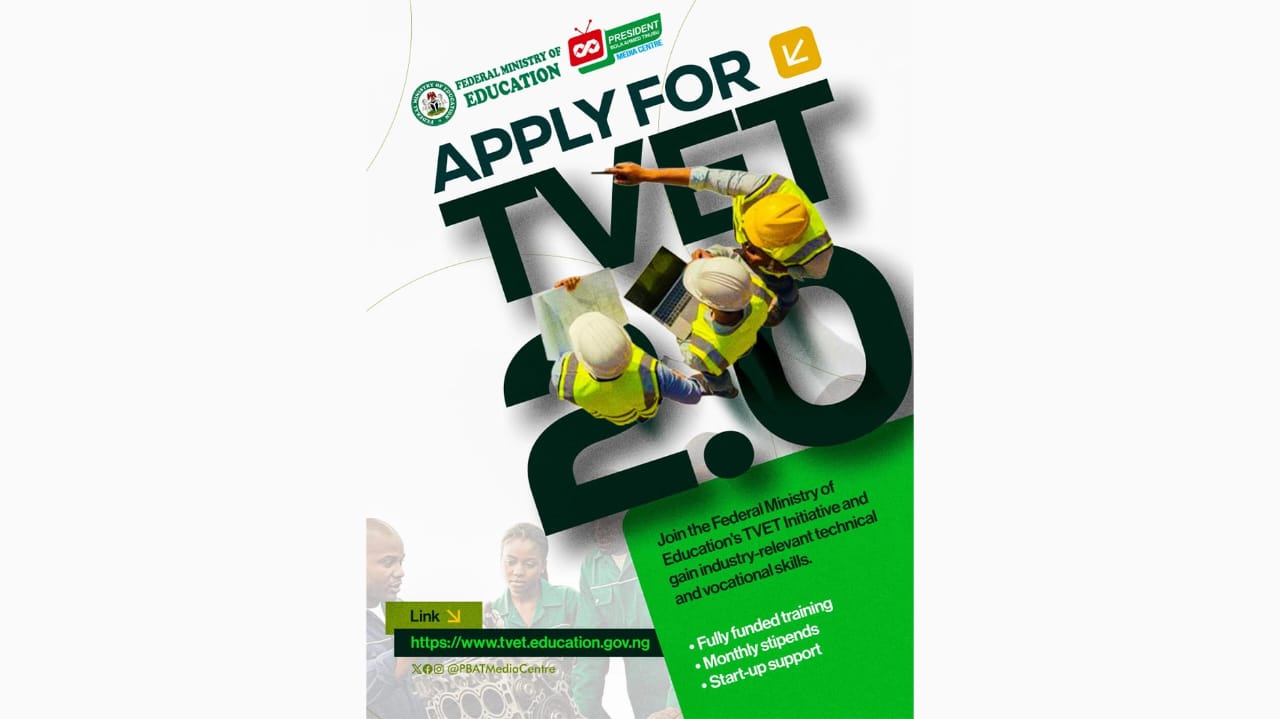
The Federal Government of Nigeria, in collaboration with the Institute of Education, Singapore, has commenced a capacity-building programme aimed at strengthening the delivery of Technical and Vocational Education and Training (TVET) across the country through the training of instructors and educators.
The initiative, tagged the “Train the Trainers (Pedagogy & Assessment) Programme,” is a 10-day intensive training jointly organised by the Federal Ministry of Education, the National Board for Technical Education (NBTE), and the Institute of Education, Singapore.
The programme is implemented in two cohorts, with the first cohort of 60 TVET teachers at the federal and state levels, currently undergoing training in Abuja, while a second cohort of another 60 teachers is scheduled to participate in Lagos.
Speaking with reporters at the training, Adebayo Onigbanjo, National Coordinator, Special Programmes, Office of the Minister of Education, explained that the programme is designed to equip Nigerian educators with modern pedagogical and assessment skills.
He noted that participants are expected to transfer the knowledge gained to their colleagues through a cascading training model, enabling the enhanced teaching methods to ultimately benefit students across the country.
Onigbanjo explained that the programme aims to train additional members of Federal Technical Colleges to meet the growing demand for skilled professionals.

The ultimate goal, he said, is to increase capacity in technical education by producing more competent instructors who can deliver quality vocational education and prepare students with industry-relevant skills.
He added that the initiative forms part of the Federal Government’s broader efforts to reposition the TVET sector as a key driver of economic growth, job creation and industrial development.
According to him, improving the quality of teaching in technical institutions will ensure that graduates are better equipped to meet the demands of the labour market and contribute meaningfully to national development.
According to him, the programme forms part of a broader partnership between Nigeria and Singapore aimed at developing a new generation of highly skilled technical instructors capable of training thousands of students across the country.
“We are working with the Institute of Technical Education Services in Singapore to develop capacity for TVET in Nigeria. This training focuses on pedagogy and assessment, equipping teachers with the best methods for technical instruction,” Onigbanjo said.
He expressed confidence that the knowledge and expertise gained during the programme would strengthen the capacity of instructors across Federal Technical Colleges, create a multiplier effect through continuous peer-to-peer training, and ultimately enhance learning outcomes for thousands of students nationwide.
He revealed that over 1.3 million Nigerians registered for technical skills training when the initiative was launched last year, making it imperative to build sufficient teaching capacity.
“We need more trainers. Those being trained today will return to their schools and train their colleagues, allowing us to scale up capacity across the country,” he said.
Also speaking, Technical Assistant to the Minister of Education on TVET, Dr Nabila Mohamed, said the programme seeks to reposition technical education by shifting classroom instruction from theory-based teaching to competency-based practical learning.
She noted that the training would expose participants to modern instructional techniques that would enable them to better engage students and prepare them for the workplace.
“The biggest takeaway is making training competency-based. Rather than focusing mainly on theory, teachers will integrate practical skills that prepare students for employment while learning effective methods of delivering those skills,” she said.
Manager of the Academic Pedagogy Programme at Singapore’s Institute of Technical Education Services, Choo Poh Lian, said the training was not intended to teach specific trades but to strengthen teachers’ pedagogical skills for practical instruction.
She explained that participants would learn demonstration techniques, student engagement strategies, effective feedback mechanisms and performance-based assessment methods aligned with industry standards.
“We are sharing how Singapore teaches practical skills so that graduates become workplace-ready. We are focusing on pedagogy, how teachers demonstrate, guide students through practical tasks, provide constructive feedback, and assess competencies based on industry performance criteria,” she said.
One of the participants, Odebode Adegoke, from the Federal Science and Technical College, Ijebu-Imushin, Ogun State, described the training as timely and impactful, saying it had exposed participants to modern teaching approaches that would significantly improve the quality of technical education in Nigeria.
Adegoke said the programme had broadened his understanding of competency-based instruction and assessment, noting that the practical methods being introduced would make learning more engaging and relevant to industry needs.
According to him, the exposure to Singapore’s globally recognised TVET model would enable teachers to move beyond traditional classroom teaching by placing greater emphasis on practical demonstrations, hands-on learning and continuous assessment of students’ competencies.
The programme, which runs from June 29 to July 10, marks another milestone in the Federal Government’s drive to reposition technical and vocational education as a key pillar for job creation, industrial development and economic growth.

